

 January casino revenues from Indiana present a conundrum. Although the state is still the most lucrative casino jurisdiction in the Midwest ($192 million last month), it’s hard to tell whether the half-full glass is filling or emptying. Foot traffic was down 12% but players’ spending rose 7.5%. The two didn’t quite cancel each other out, as Indiana finished the month down 6% from last year. So we’ve gone from more players spending less — the longtime quandary in Illinois — to fewer players spending more. I’m not sure which is preferable although I think new tax rates mean last month’s Indiana results are a harbinger of things to come. Which is one of the key reasons that I believe prophecies of recovery in the gaming sector are more akin to wishful thinking. As Richard H. Thaler, an economics boffin at the University of Chicago says, “I wouldn’t expect [tax increases] to have much of an effect on BMW consumption.”
“It’s almost a zero-sum game whenever a new casino opens,” adds Fitch Ratings analyst Alex Bumazhny, which  means Indiana’s three-year streak of declining tax revenues from casinos is unlikely to be broken in 2013. So there’s not only little relief in sight for the Hoosier State, its southern riverboats have to brace for the impact of oncoming Horseshoe Cincinnati (right). The latter is expected to hit Penn National Gaming‘s Hollywood Lawrenceburg (-15% last month) hard, but the worst casualty is the Grand Victoria riverboat, a few miles downriver. At $6.3 million last month (-1%), it was one of the state’s two lowest-grossing casinos (Majestic Star II, -9%, was the other). Loss of traffic from Ohio could easily prove fatal. But if Grand Victoria is in critical condition, one needn’t worry about Horseshoe Southern Indiana*, up 11% as it feasts upon Continue reading
 “IGT’s valuation is near its all-time low on the basis of net income and cash flow. We believe this reflects the investment community’s lack of faith in the operating strategy and capital allocation decisions of IGT management and the board.” — Orange Capital Managing Director Daniel Lewis, in an open letter to International Gaming Technology Chairman Phil Satre,
 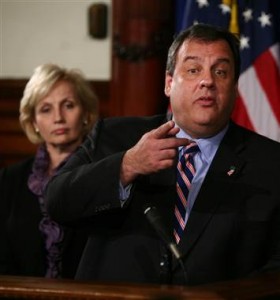 New Jersey Gov. Chris Christie (R) loves to veto Internet gambling bills so much that
  A preview of Ameristar Casinos‘ 4Q12 report draws an about-what-we-expected reaction from Joseph Greff of J.P. Morgan. Ameristar narrowly missed most of Wall Street‘s expectations, a result Greff partially attributes to “sluggish … regional gaming spend.” Hardest-hit by the competition was Ameristar’s Kansas City casino (left, -8%), which has been losing business to Penn National Gaming‘s racino at Kansas Speedway. Bright spots on the map were Black Hawk, Colorado, and Vicksburg, while dominant performer Ameristar St. Charles held steady — news that will be welcomed over at Pinnacle Entertainment, owner-to-be of it and all other Ameristar properties. That transaction is said to be speeding along and could close sometime this spring. Pinnacle’s concentration of ownership in the St. Louis area is expected to be problematic but it gives CEO Anthony Sanfilippo a perfect excuse to cut loose Lumiere Place, whose luster is now a distant memory.
 federal standing of the Mashpee Wampanoags (
 Our question for the day is, “Who benefits?” Taking the long view of Caesars Entertainment to bundle a mixed bag of Planet Hollywood, its-casino-to-be in Baltimore and Caesars Interactive, in whose interest is it to purchase minority stakes, since CEO Gary Loveman intends to maintain majority control. Or, in the case of his Maryland casino, a majority of a minority stake. It’s like being offered a lift by an inebriated motorist. You’re along for the ride but you’re at the mercy of the drunkard behind the wheel. And, as Caesars “strategy” swerves from pillar to to post, your trip would be … interesting, to say the least
 William Clifford and intending to start shopping for casinos to own on a lease-back basis once my REIT goes through, my first call would be to Loveman. I’d have money and he’d have property that he’s desperate to unload, so it’s a perfect fit … especially with so much real estate on the Las Vegas Strip and major metropolitan areas. (If Caesars were to go belly up, Penn could abrogate the leases, and confiscate the licenses and slot machines … and it would already own the bricks and mortar.)
 Scientific Games has lost the faith of Deutsche Bank‘s Carlo Santarelli. The analyst put out a “sell” recommendation this morning on SGMS stock, issuing a new target price of $6/share, down from $7. (Scientific was trading at $9.49 at the time.) Is this a big deal? Yes, because you see gaming stocks pegged as a “sell” slightly less frequently than as you see Halley’s Comet. Most Wall Street analysts take refuge in “neutral” ratings on iffy stocks but Santarelli went way out on a limb. Reasons for his decision include the contention that Scientific’s “business model remains stagnant and will continue to be reliant on tough-to-handicap
  and somewhat binary legislative events [read: politics],” whose benefit to Scientific is difficult to quantify. “[The] rich premium and difficult to identify synergies make the pro forma outlook … daunting,” not least because Scientific is no longer as dominant a candidate for privatized state lotteries and the online-lottery sector has been slow to develop. Or so the argument. Bottom line: Scientific is overpaying for an asset — WMS Industries — with a “difficult fundamental outlook” during a slow business cycle.
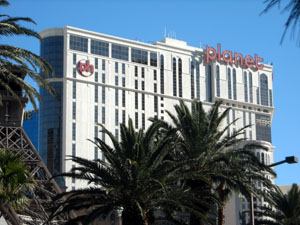 It may have taken time for Gary Loveman‘s chickens to come home to roost but they’re doing it by the flockful. To raise cash, pronto, Caesars Entertainment — which hasn’t turned a profit in over three years — has piled several random assets into wishfully named entity Caesars Growth Venture Partners, in which it would continue to maintain “a significant portion,”
 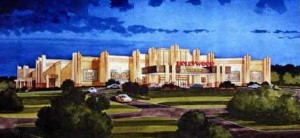 Penn National Gaming trimmed its 2013 revenue projections today by 3% — not surprising, given the “headwinds” represented by recent tax changes that will eat into Americans’ discretionary income. Sluggish early slot performance in the Columbus and Toledo markets was blamed on a lack of marketing and comping “into underpenetrated submarkets,” as Joseph Greff of J.P. Morgan put it (sounding just a wee bit pornographic). Table games, investors were assured, were doing “just fine.” Revenue generally met expectations but cash flow and profitability were disappointing, with Ohio taking some of the blame, as did Penn’s expensive electoral bust in Maryland, which cut into the bottom line.
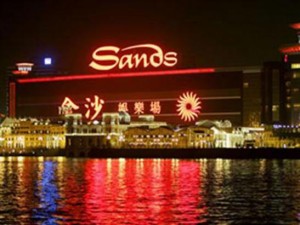 numbers at Marina Bay Sands — a cause of “significant investor consternation in recent months,” as Santarelli put it. Greff described the numbers as “better than expected mass [market] revenues … and meaningfully stronger than expected VIP volumes.” He projects over $2.6 billion in cash flow from Sands’ Macao casinos and $1.6 billion from Marina Bay Sands this year (a 21% return on investment). Sands Cotai Central is underperforming its neighbors, casualty of another Sheldon Adelson “soft opening,” but is expected to improve as another 1,800 hotel rooms hit the market in “Phase 2B.” (Adelson’s opening are so soft that
  year ago, when it hit $13/share. As International Game Technology shares fell toward $15 today, the WMS takeover was a dispatch that
 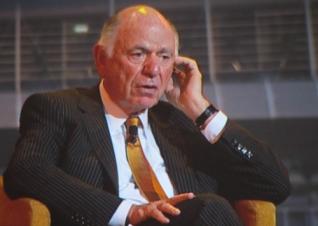 Sheldon Adelson being too busy trying to dictate American foreign policy, it was left to his Number Two Man, COO Michael Leven (left) to go to Toronto and make the case for a Las Vegas Sands megaresort.
  As the clock ticks toward a shareholder fight over International Game Technology, CEO Patti Hart tried to rally her troops with a bit of good news. IGT has inked a pact to sell 1,375 VLTs to Saskatchewan, representing one-third of the VLT market in that province. Since Wall Street analysts had already incorporated this into their 2013 revenue model, it didn’t set off a big “Wow!” However, Manitoba is coming up on a 6,000-VLT replacement cycle. If IGT can capture at least 35% of that business, it would be worth another four cents of per-share earnings, according to one analyst. But if Hart is banking her presidency on the most recent earnings report, she can expect only mild enthusiasm from the Street. Carlo Santarelli of Deutsche Bank summarized the numbers as mostly “good” — as in the interactive segment — leavened by a couple of dashes of “not good.”
 Some of you — and you know who you are — get to Las Vegas several times a year but rarely have the chance to foray far past either the Las Vegas Strip or Downtown. (It’s the same with me and the greatest place on Earth, Manhattan: There’s a well-worn groove through the middle of the island that marks my usual axis.) Huffington Post
 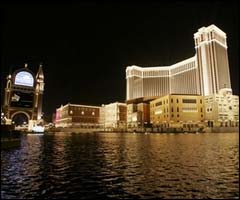 Ever since the government of Macao put a hard cap on the number of table games in the enclave, casino operators have been forced to do a certain amount of cap-and-trade. In order to stock up Sands Cotai, 200 tables had to be removed from Venetian Macao. According to J.P. Morgan analyst Joseph Greff, these were supplanted by “slots, electronic tables, double-dealer games or semi-mechanical tables which have a relatively lower yield.” (I guess this settles the question of whether the Macanese government regards an electronic table as a slot or not.) “Venetian Macao’s mass market volume was negatively impacted (somewhat)” … a situation potentially alleviated by today’s announcement that city hall was granting Sands China
 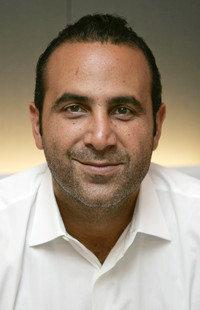 That’s how much time Sam Nazarian has to scare up $115 million from overseas sources. If the deal isn’t done by Feb. 28,
  That’s essentially the ‘what if’ scenario taken on by Las Vegas Sun columnist J. Patrick Coolican (virtually the only person left at the Sun who’s worth reading). He’s weighed the pros and cons of the Loveman Gang, er, Business Roundtable agenda for Medicare and Social Security. He finds a fair amount of merit in its nostrums, mostly with regard to tweaks in Social Security. “