 “Prior to the official opening, a 60-minute opening ceremony was held outside of the main entrance to the casino, where local and state politicians patted each other on the back for finally getting the casino opened, a mere 10 years – exactly 3,650 days – after legislation was signed by then-Gov. George Pataki to allow casinos at racetracks.” That’s David Grening‘s acidic take on the glacial pace of racino development in New York State, prompted by the opening of Resorts World New York. To no one’s surprise, customers turned out in abundance — which means that November’s revenue report from Atlantic City will now be awaited with bated breath.
 Coincidentally or not, Caesars Entertainment and Unite-Here reached a four-casino/three-year pact in A.C., which will be put to a vote tomorrow. It seems to be a given that the union made concessions, but exactly what it rendered unto Caesars won’t be known until after the balloting. If the Caesars workforce is amenable to the new deal, those Boardwalk properties whose employees are in a far weaker bargaining position (like those at Colony Capital‘s penniless, ludicrously re-named ACH), will be the next ones polled. Once the Caesars-workforce domino topples, everyone else will capitulate right quick. Interestingly, this is the opposite of the approach taken in Detroit, where employees at the lower-echelon casinos were polled first, setting up union bosses to be humiliated by their MGM Grand Detroit rank and file, who said the new arrangement was spinach and to hell with it.
 Gambling expansion in Florida is running into a predictable but formidable opponent: Mickey Mouse. The mighty rodent and his puppet ally, the Florida Chamber of Commerce, are getting to rumble with the Lege. Ignore the mouthwash about protecting the kiddies. What’s at stake are convention revenues the Orlando area (aka Mouse Central) could lose to Dade and Broward counties. Miami Beach, whose convention facilities are antiquated, is going into a defensive crouch, opposing casino expansion instead of courting it. The Seminole Tribe seems to be playing a cagey game, simultaneously threatening to take its $200 million annual tax contribution off the table but signaling that it would be tractable to inclusion in the three-casino Miami-area expansion that’s under debate. Massachusetts has handed the Seminoles a useful precedent. Like their Bay State counterparts, Florida lawmakers could set aside Continue reading →


 Barring a huge reversal from the Pennsylvania Supreme Court, the long and mostly inept saga of Foxwoods Philadelphia has finally come to a conclusion. The politically juiced-in trio of Ron Rubin, Lewis Katz and Comcast Chairman Ed Snider (collectively known on S&G as Sniderkatz) got a 6-1 thumbs-down from the Commonwealth Court. Sniderkatz was one of several parties whose suitability for a casino license in Pennsylvania appeared to owe far more to Democratic Party fealty than to actual competence. Choosing soon-to-be-insolvent Foxwoods Resort Casino as a partner would effectively doom the project — subsequent flirtations with Steve Wynn and Gary Loveman notwithstanding. Four years and three designs later, all Sniderkatz has to show for itself is a vacant lot.
 No surprise that Borgata remains in a class by itself among Atlantic City resorts. It finished October at 0.0% deviance from last year, as flat as “flat” can be. The lone gainer in the market was Resorts Atlantic City, up 9% and showing positive results for the sixth time in 10 months, an achievement unmatched on the Boardwalk this year. Dennis Gomes‘ fiscal shock therapy and radical image makeover of the dowager have gotten Resorts’ numbers out of the doghouse. It’s a multi-year project to undo the financial damage inflicted by Colony Capital but Gomes should be making believers of everyone by now.
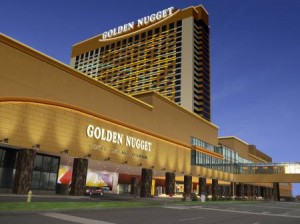 For those who might say that Resorts had nowhere to go but up, look at the Golden Nugget (formerly Trump Marina) where Tilman Fertitta is getting a bruising introduction to A.C. Revenues bottomed out at $9 million (-28%), marking a steady decline in revenue from month to month and three straight months of double-digit negativity, putting the Pépite d’Or on pace to be the city’s lowest-grossing casino for two years straight. Trump Entertainment Resorts can and can’t gloat. Trump Taj Mahal ($30 million, -3%) remains firmly ensconced within the second tier of performers, right up there with the bigger and better
  … or maybe not. Dealers at Wynn Las Vegas
 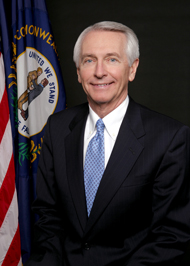 Let’s start on the sunny side of the street. Voters in Kentucky, as expected, returned Gov. Steve Beshear (D, right) to office,
  Ready to rumble. In a more long-term play, New Jersey voters said “yes” to sports betting at racetracks — helping wean them off the teat of the casino industry — and casinos, throwing a potential lifeline to both. There are still several legislative, electoral, judicial and possibly even Congressional hurdles to be vaulted. However, state Sen. Raymond Lesniak (D, right) and Gov. Chris Christie (R) are finally on the same page, and
 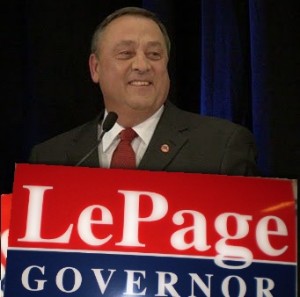 We don’t second-guess the electorate here at S&G (or try not to) but it’s a kind of a bummer to report that Maine voters
  “The era of government-granted casino monopolies is over. Many of our markets are now oversaturated with commercial and tribal casinos. In some states, licenses are even being left untaken. The era of limitless capital is over. Between huge commercial casino bankruptcies, tribal defaults and challenging returns, spending billions on ever-fancier amenities is no longer possible.” — Fine Point Group founder Randall Fine, throwing a bucket of cold water on attendees at the 2011 Global Gaming Expo. Fine’s proposition couldn’t have been more different from the
 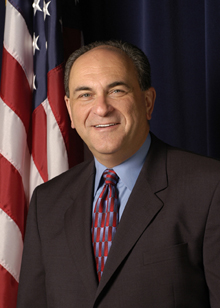 State Rep. Lou “Death Wish” Lang (D, right) continues to dare, then double-dare Gov. Pat Quinn (D) to veto what’s now a 2.6X expansion of the number of gambling positions in the state of Illinois. Lang has offered a few relatively meaningless concessions (such as: no slot routes at airports) but his demands still far exceed his compromises: five racinos and four outstate casinos, plus one in downtown Chicago. In keeping with his “screw you” attitude toward existing operators, Lang would curb the number of slots they are allowed to add by 20%. Somebody needs to smack Lang upside the head with the latest set of monthly revenue reports from the Land of Lincoln’s already embattled casino industry. First the good news: Gross receipts have risen for five months straight, with only a hint of imminent decline.
 In one of the most Pyrrhic victories in casino-industry history, Colony Capital
  One of the conditions of the swap is that Colony and its underwriters recapitalize ACH(ooo!) to the tune of $24 million and change. Aside from paying the electric bill, Colony might do well to retire the unpaid bills and pension obligations that have stymied its attempts to sell the place for 10 months. The former Golden Nugget Atlantic City is on pace to lose $22 million this year alone, so investing $24 million (
 “Goldman Sachs Mortgage Co. is willing to dump funds into the property.” — attorney Bud Hicks, using a most inadvisable phrase with regard to the struggling Las Vegas Hilton. Goldman is trying to oust majority owner Colony Capital and place former Riviera exec Ronald P. Johnson at the soon-to-be-ex-Hilton’s helm.
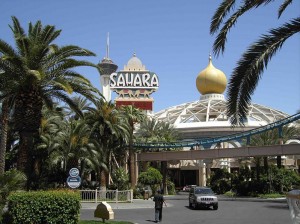 Chuck Monster had this right on the money: He called Sahara owner Sam Nazarian‘s bluff over and over and over again on the latter’s luxury-megaresort predictions for the aging, shuttered property. Today, the Clark County Commission took the wraps off Nazarian’s not-so-big remake of the Sahara.
 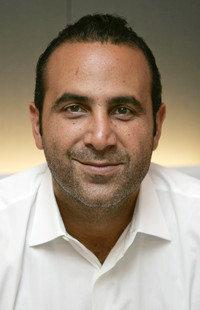 Today’s revelation begs more questions than it answers. Why did it take Sahara Sam so long to figure out that neither the Strip economy nor the banking community had the appetite for additional megaresort development — particularly at a spot that is closer to the Stratosphere than to either Circus Circus or the Riviera? How will the hotel be repositioned now that The Naz has stripped it of furnishings, cleaning the property out in the biggest-ass rummage sale known to mankind? How does he intend to recapture his customer base now that he’s offloaded his database to MGM Resorts International and hard-wired M Life into his SBE Entertainment loyalty program? Why was it necessary to close the entire Sahara and pink-slip 1,050 employees if a low-cost makeover was Nazarian’s endgame? And will Smilin’ Sammy Naz apply for a gaming license this time around? If he doesn’t, any serious discussion of Sahara 2.0 is moot.
 “And here I thought newspapers only printed bad news.” — Las Vegas Sun reader Jerry Fink, on
  While Massachusetts lawmakers sharpen their scissors in order to cut and paste two versions of the Lege’s casino-enabling bill, the city of Holyoke is happy to find itself between Hard Rock International and Paper City Development. The partnership
  Here’s a casino-development story with several personal angles. When I lived in Minneapolis and wrote from the since-defunct Twin Cities Reader, my publisher was R.T. Rybak. Now he’s mayor of the city and is trying to hold onto the perennially underachieving Minnesota Vikings. He’s floated several formulas, one of which entails licensing a casino on Block E for $20 million. Block E sits right smack downtown, across from a shopping mall called — yes — City Center. Back in the 1980s, Block E was home to a couple of newsstands that specialized in porn and provided me with some of my first post-collegiate employment.
 But times change and one type of pleasure gives way to another. At the risk of engaging in sophistry, what Rybak is proposing is a circuitous tax levy to raise stadium money for the feckless Vikes. You and I gamble on Hennepin Ave., and a cut of those gross revenues is dedicated to paying for the Cargill Dome or whatever the new gridiron will be dubbed. So far, Rybak’s going it alone. But if he wants to make converts,
  “The north will let the heathens in the south have the casinos, and they’ll take the benefits.” — former casino opponent (and Florida governor) Jeb Bush, during a recent visit to Las Vegas, putting his money