

It’s here and it’s a sensory overload. If the severe CityCenter six-pack is a convent of Carmelite nuns, The Cosmopolitan of Las Vegas is a drag queen. It’s unstintingly flamboyant, often fabulous, unremittingly outrageous and campy as all get-out. On the inside, anyway. The exterior remains one of the great architectural underachievements of post-Mirage Vegas. Barring a convex wall hither and a modest diagonal slope thither, it’s a design that looks as though nerve ran out well before the money did …
 The Cosmopolitan you’ll never see.
Inside, Cosmo’s a far different story and nobody will look at it and ask, “Where did the $3.9 billion go?” In sensibility, it’s the gayest thing to hit the Strip since Liberace. Few styles — and nary a decorative material — have been spared in this blitzkrieg upon your eyeballs. It’s aesthetic Babel: a deafening proliferation of visual languages yelling at one another simultaneously, with no single dialect achieving dominance.
More for that reason than despite it, patrons will warm to the Cosmo as they never did to its austere rival, Aria. The former proclaims “Fun!” where the latter means to Improve You. Cosmo meets you at the street, whereas Aria demands that customers alter their grazing pattern to make the long climb up to the casino, a block away.
The flamboyance begins once inside the porte-cochere, an unobtrusive tunnel off Harmon Avenue. Giant silver letters proclaim THE COSMOPOLITAN, and the driveway is lined with chandeliers and pillars that are bedizened with hundreds of tiny bulbs. Entrances are guarded by statues of Chinese dragons, in a random gesture toward the Asian market. (Aria retrofitted its entrances with some of these gremlins, too, as an incongruous afterthought.)
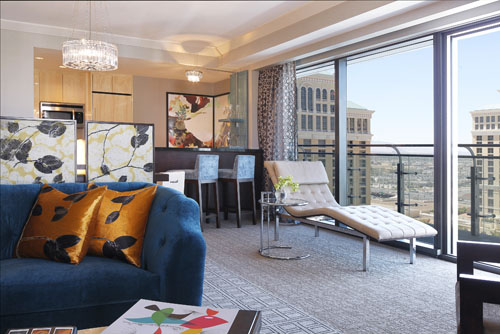
Even the kitchen sink. Inside, Cosmo fairly shouts “GAUDY!” and “GLITZY!” People don’t come to Las Vegas for tasteful restraint and Cosmo makes Encore look self-effacing. If it or Bellagio evoke a relaxed feeling, the barrage of visual cues at Cosmo will give you the heebie-jeebies — and one suspects that was the idea. It’s as though an army of rival decorators (14 discrete firms are credited) was set loose with no directive other than to outdo each other and let money be no object. The kind of selective lavishness practiced by Steve Wynn and Roger Thomas is here thrown completely to the winds, from the onyx flooring to the mirrored ceilings. However, for its proliferation of materials and surfaces, Cosmo rarely has the tactile appeal of Encore. You won’t cop as many feels of the decor.
Speaking in tongues. The “West” (actually north) check-in lobby alone is visually trilingual. To the right is a wide, utilitarian corridor, its walls covered in stamped leather. (Even the most functional public areas of Wynncore and Venelazzo are plusher.) In the middle stand two rows of columns. Eight of them display wraparound CGI artwork by Digital Kitchen. By day, butterflies cavort over silhouetted flowers or virtual library shelves surround one. “More sexy” imagery is promised for after dark.
To the left is a row of red, studded-felt check-in desks, designed in Louis XIV style and intended to facilitate more personal guest/clerk interaction. Elevators to the West Tower open immediately onto the lobby but woe betide the guest booked into the East Tower. You either have to take an elevator to the second floor and traverse it or lug your luggage across the casino floor … which promises to be awkward with a capital “A.”
 Upskirt. Subtly linking the casino floor and lobby is the Vesper Bar (yes, a Casino Royale reference), its furniture a weird mix of styles from Modernist egg-cup barstools to elaborately embroidered settees. Overhead, the ceiling alternates endless pleats — inspired by the petticoats in Alice in Wonderland, we were told — with raindrop-like glass globes. An ornate, Old World bar cabinet is incongruously shoehorned into the space, so tall it intrudes into the ceiling decor. With its $5-$6 beers and $10-$14 cocktails, the Vesper Bar almost qualifies as a Strip bargain and offers a limited breakfast menu, too. Victorian couches nearby are accessorized with old-style white telephones of the type synonymous with the cinema of Mussolini-era Italy.
The Big C. The casino floor, designed by Friedmutter Group, is as much a success as Aria’s was a colossal dud. (By the numbers: 1,478 slots, 41 bar-top machines and 83 tables.) A few “gaming cabañas” — beaded curtains and bottle service for high rollers — are a nod to the semi-private salons of Encore but that’s as close to a chambered look as Cosmo gets, although bejeweled soffits effectively diminish the ceiling’s height. The long curve of the casino floor looks considerably cozier than its 100,000 square feet would suggest, as Friedmutter has cunningly wrapped it around the central tower of bars — known as “The Chandelier” — in an elongated “C.” Light fixtures resemble clouds of feathers or garlands of red leaves. The Book & Stage lounge protrudes into the gaming floor in a bright, lucite “V.” We’re worlds away from the dank vibe of Aria. Even though the latter’s casino lighting quotient has been upped, the prevalence of very dark colors in its design negates the added wattage.
Playpen. Cosmo’s slot floor is considerably more conducive to a feeling of play. Although as server-based as Aria’s, deploying International Game Technology‘s platform, the slot cabinetry is higher-profile and more attention-getting, replete with brilliant LCD screens. No rows of dumb terminals here. Participation games — including a Continue reading
 It’s back to business as usual for Ameristar Casinos, whose board decided “a sale is not in the best interests of the Company and its stockholders at this time.” Which is a nice way of saying there’s no bidding war to be had for Ameristar, the lucrativity of its assets notwithstanding. J.P. Morgan analyst Joseph Greff opined “there was little interest from third parties in buying the entire company by either casino operators or private equity at prices much higher than the $18+/- share price range.”
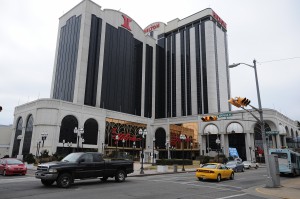 Such is the prognosis from J.P. Morgan analyst Joseph Greff after the November revenues rolled in from the Boardwalk. Basically, the double-edged sword that was table games in Pennsylvania and a casino in Philadelphia has swung, and lopped 12.5% off Atlantic City‘s already anemic performance (down 27 months in a row). November marks four months of double-digit declines for the seaside gambling destination and the worst so far. Of the last 23 months, only February 2010 was worse and that by the thinnest of margins ($100,000 to be precise).
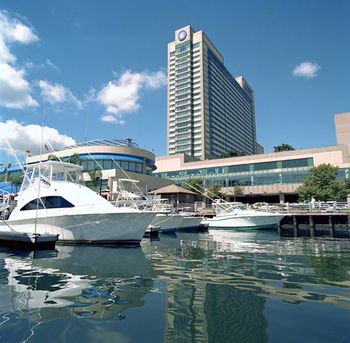 Bright spots. Yes, there were a couple. Trump Marina (left) has evidently fallen so far it now has no place to go but up. Its $12 million take, while hardly a barn-burner, represented a 2% increase. Hey, you’ve gotta start somewhere. Even more impressive was the 11% increase notched by Tropicana Atlantic City, where the combination of old management and new ownership (Carl Icahn) is bringing gamblers back. The Trop’s $26 million haul was actually bigger than that of two of the Caesars-owned properties.
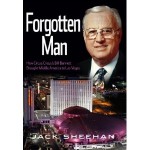 Bennett bio botched. There’s a good biography to be extracted from the troubled life and eventful times of Excalibur and Luxor creator Bill Bennett. Unfortunately, Forgotten Man is not that book. Author Jack Sheehan really phoned this one in, so much so that it’s like reading through piles of semi-organized interview transcripts. The physical presentation by Stephens Press is beautiful but its editorial input seems to have MIA. Still, Bennett emerges as an eminently fair employer, one who didn’t just believe in trickle-down economics but actually practiced them. If Circus Circus had a good year, he reasoned, the employees should get a piece of it. I wonder what he’d think of the fiscal pickle into which the casino industry got and the ways — like suspension of 401(k) plans — it’s used to extricate itself.
 Levity aside, the fact of the raid itself is less significant than its timing, which just happened to coincide with a visit by the man Jon Ralston calls Gondolier Numero Uno. A Sands China spokeswoman of admirable composure
 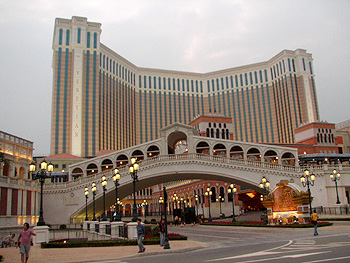 While this is clearly a case of selective prosecution, designed to let Adelson know who’s boss in China, that may not be enough to get him off the hook back home. S&G called the Nevada Gaming Control Board but all its members were en route to an undisclosed destination, so one doesn’t know if l’affaire Macau will be sufficient to put Sands in their cross-hairs. However, casino operators can be sanctioned for bringing disrepute on the industry, so Adelson should set some money aside for paying near-inevitable fines. Harsh allegations made by fired Sands CEO Steven Jacobs might get a second look, too. It will be interesting to see what, if any, reaction this gets in Singapore and Pennsylvania (where Adelson operates) or in states like Massachusetts or Texas (where he’d like to). Serious PR damage control is in order, to say the least. Oh, and forget about Sites 7 & 8 while you’re at it. You have been punk’d.
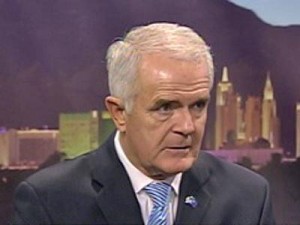 Speaking of cleaning house, incoming Nevada governor Brian Sandoval is making it clear that appointees of Gov. Jim Gibbons (left) won’t be welcome in his administration. A quartet of high-ranking officials who have either been terminated or have fallen on their swords includes Nevada Gaming Control Board Chairman Dennis Neilander (who falls into the second category) and NGCB member Randall Sayre, who finds himself among the sacked. Sayre was, through no fault of his own, the focus of the scandal that gave Midnight Jim Gibbons his nickname. Gentleman Jim had himself sworn into office mere seconds into New Year’s Day 2007 in a midnight ceremony that played more like a satanic ritual. Gibbons’ purpose—about which he initially dissembled—was to void two Kenny Guinn appointments to the NGCB. Neilander was quickly reprieved but a Guinn crony was replaced with Sayre in a petty feud from which nobody emerged with a shiny escutcheon.
 “The Eighties called. They want their graphics back.” — comment overheard during the archaic video montage that precedes
 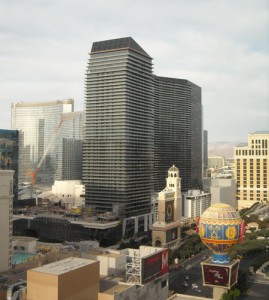 It seems like David G. Schwartz is everywhere today. Las Vegas’ resident casino expert has not one but two stories out on The Cosmopolitan. From what he writes, Cosmo execs have convinced themselves they’ve reinvented the casino. It hinges upon something known as “the curious class,” a demographically indefinable mass of people who don’t come to Vegas. (If they don’t, how curious can they be?) The Curious Class member “defines herself in terms of wanting something new and different, but it has to be meaningful and relevant,” quoth Cosmo Chief Strategy Officer Sherry Harris. “The new luxury is less about status and more about purpose. It’s defined as seeking experience over services, and it requires emotional connection that is worth returning to.”
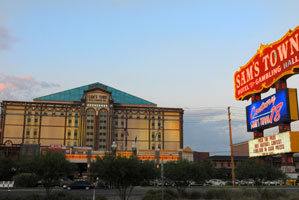 That’s how UNLV‘s gaming guru, Prof. David G. Schwartz, describes his reaction to the October revenue numbers, released today. The
  In a lengthy Asia Times dispatch, the reliable Muhammad Cohen runs through various scenarios about why the government of Macao would pull back two Cotai Strip™ sites from a ‘george’ investor like Las Vegas Sands. Since the acreage will probably be reallocated to tacky local favorite Stanley Ho, city hall’s preferred “economic diversification” argument doesn’t quite wash. The bottom line, per Cohen, is that the Chinese did this to Sheldon Adelson because A) they could and B) they don’t like him anymore. An Asia Times source says that the mogul has morphed into the Ugly American, crass and pushy. Sensational allegations of Adelsonian misconduct level by recently sacked Sands China CEO Steven Jacobs, may have also put Mr. Sands in bad odor with officialdom. Adelson’s recurring urge to publicly humiliate his former underlings has come back to bite him in the tuchus and it could very well cost him the completion of “Asia’s Las Vegas™.”
 There’s also a lot of money left on the table in the aftermath of Sixty Votes’ latest capitulation. J.P. Morgan has crunched the numbers and reports that what was a $1.5 billion industry two years ago will swell to between $3.5 billion and $5 billion by 2015 (which would have meant no more than $1 billion “rake” for the states and Uncle Sam). Given their existing player databases and online infrastructure, JPM liked Caesars Entertainment, MGM Resorts International and Station Casinos‘ chances to capitalize on this potential new market. In five years, that could mean as much as $875 million to $1.25 billion in additional cash flow. Not coincidentally, those companies are the three largest industry donors — not counting Mike Ensign‘s defunct Mandalay Gaming Group — to Old Sixty Votes’ war chest.
 “Even though Democrats still have the majority, the perception is that Republicans are in charge. And being the party of ‘no’ has worked in Republicans’ favor.” — gaming-law expert I. Nelson Rose,
 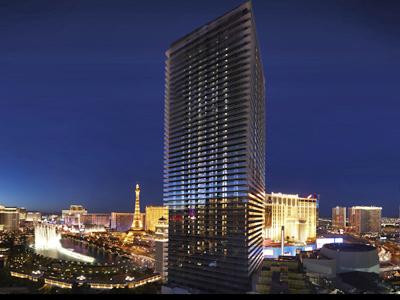 It may be $1.9 billion over budget and 2.5 years behind schedule but The Cosmopolitan appears to be hitting the market with perfect timing. That’s
  It will take Las Vegas seven years to return to its former prosperity. Or so concludes a new report from consulting firm PricewaterhouseCoopers, which sees casino revenue improving in late 2011 (in line with a Moody’s Investor Service report that placed recovery at least a year away) and regaining 2007 levels by 2014. That’s
 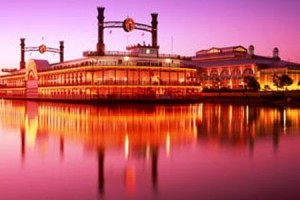 Bright spots were the land-based Jumer’s Casino Rock Island (+10%) and Boyd Gaming‘s Par-A-Dice riverboat (+1%). Hardest-hit was Penn National Gaming‘s Empress Joliet, posting a far-worse-than-expected 16% decline. Penn was down 10% statewide — not good news for a company with a lot of buns in the oven. As usual, the revenue leader ($22 million, -3%) was MGM Resorts International‘s Grand Victoria (left), which continues to widen its lead on runner-up Harrah’s Joliet.