

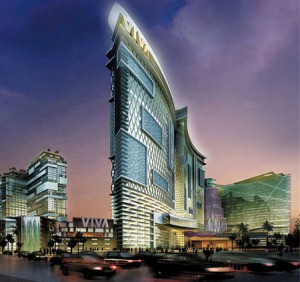
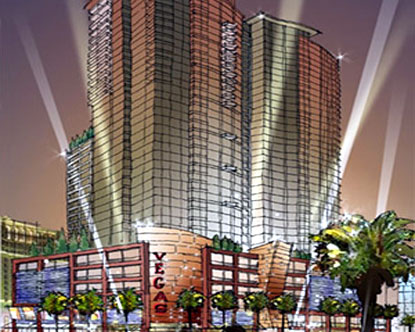
 “[T]he confidence that property prices and stock markets would permanently defy gravity” is a phrase that perfectly encapsulates how the casino industry got itself into its present pickle. In what other mindset could an industry convince itself that it could dump CityCenter, Cosmopolitan, a grotesquely enlarged (and now deficit-ridden) Hard Rock Hotel and failsinos like Fontainebleau, Echelon, the Plaza, the short-lived Maxim project, Viva (above) and sundry other crack-pipe dreams into the Strip market more or less one atop the other? Executives at Harrah’s Entertainment and Station Casinos would have you believe that the Great Recession was the only thing that put them in the ditch.
That’s a load of bull manure. Those LBOs were predicated on expectations and projections of continued revenue growth … in short, upon a gravity-defying economy. Had things merely continued at 2006-07 those companies would still be strangulating on their debt-to-cash-flow ratios.
“Just around the corner/There’s a rainbow in the sky./So let’s have another cup of coffee/And let’s have another piece of pie.”
Those are the lyrics from a rather annoying and smug Depression-era song and there’s some of that self-deluding talk going through the casino industry these days. While the fallacies that gambling is “recession-proof” or even merely “recession-resistant” have been slain, one still hears happy talk of “pent-up demand.” Sterne Agee analyst David Hargreaves describes this as “an overused buzz phrase that only applies when people feel comfortably well off” or the “We’re expecting sunshine today because it rained yesterday” mentality.
Perhaps it can be best demonstrated as follows:
It’s a good thing for the industry that high-end play never went away en masse and that most of the major operators were sufficiently diverse, geographically, to capture the “convenience” gambler … especially when going to Vegas became Continue reading
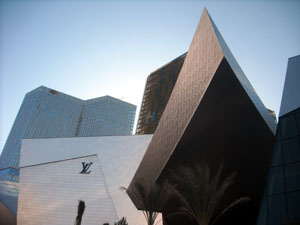 “It’s a risky story. We weren’t overly impressed with the results.” — Stern, Agee & Leach‘s David Bain on MGM Resorts International‘s
 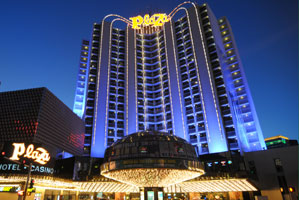 Musical chairs continue at Tamares Group‘s downtown Las Vegas collection of crumbling casinos. Bobby Ray Harris is out as casino manager and Anthony F. Santo is in. Otherwise,
  I’ve become well and truly tired of writing about Massachusetts and its political establishment’s inability to get its act together on casino legalization. Suffice it to say that with Gov. Deval Patrick and House Speaker Robert DeLeo (left)
 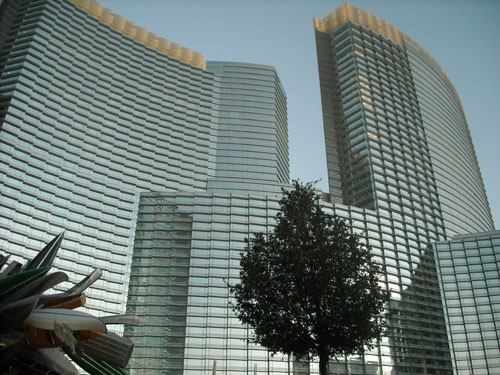 Undershooting Wall Street‘s expectations for 2Q10, MGM Resorts International missed analyst projections and also took a big-ass writedown on CityCenter (above) consigning $1.2 billion to the dustbin.
 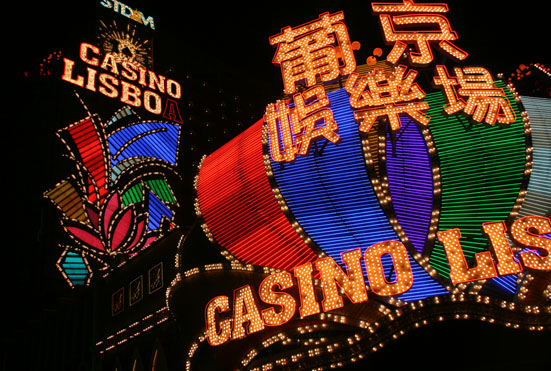 At some point, Peking may decide that Macao is overheated but for the moment it’s simply red-hot. Revenues vaulted 70% last month, to the tune of $2 billion U.S. dollars (or $25,435,856,924 Zimbabwean), the second-best number in Macanese history. Wynn Resorts continues to outperform the competition with its 15% market share. Stanley Ho‘s archipelago of aging casinos still holds fully a third of the market, with Sands China a distant second at 18.5%. Melco Crown International (15%) and Galaxy Entertainment (13%) nip at Wynn’s heels, while MGM Grand Paradise brings up the rear with 7% of market share. (Goldman Sachs puts Sheldon Adelson‘s market share at 20%, shaving a point off both Sociedade de Jogos de Macau and Galaxy.)
 “Living in Nevada is like sitting at a restaurant table where everyone’s kind of a cheapskate. Nobody here wants to pay taxes but you need that to have a competent government.” — Green Party
  “• Slot machines are disappearing from casinos. I don’t know whether they are trying to ‘uncluter’ the layout or whether the slot companies have pulled them back from lack of use, but the [Las Vegas] Hilton has, in my guess, about 1/3 fewer machines—or more. A large part of the ‘Space Quest’ casino is now a sitting area for the coffee bar, a dice pit has replaced a big slot area on the main floor, and about 1/3 of the machines have been pulled from the sports book. Same thing on a smaller scale at Planet Hollywood—there used to be a slot area beside the
  “The gaming industry in particular viewed itself as nearly invulnerable, and Las Vegas … viewed itself as a place that could continually transform and develop a new destination that would be successful. This time around, it just didn’t work.” — William Eadington, director of the Institute for the Study of Gambling & Professional Gaming, at UNR, on the “
 Nice try but … there’s little wrong with Gov. Chris Christie‘s rescue plan for Atlantic City — other than its timing, for which one can’t blame Christie. He’s been in office fewer than seven months, after all.