

A reader writes …
“I have noticed a definite reduction of postings to this blog. Is there just nothing to write about or is everything going to Twitter? I don’t twitter and really miss the information from this blog.”
Where to start? First, my apologies for any falloff in output. We did lose roughly a couple of weeks recently when some serious glitches rendered our S&G blogging software FUBAR, which put S&G behind the curve on the Station Casinos bankruptcy and the unraveling of some major stories on the East Coast. We’re (mostly) back to normal, although inexplicable deviations still occur — like last Friday’s essay on “Who killed Atlantic City?” showing up in the right-hand column.
When stories don’t merit more than a sentence or two of mention, they’ve been consigned to the S&G Twitter feed (@stiffsgeorges). However, Continue reading
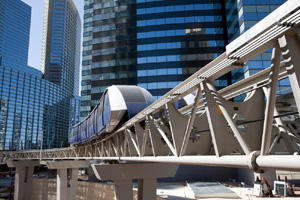 “It could never have worked if we had done it in phases. We could never have created what I wanted, which is this urbanization that is going to be so vitally important and makes it so different from another resort. If we’d just built, say, the [Aria] casino-hotel and had raw land around it, it would be a beautiful resort. But that’s what it would be. It would not be a building block in a modern city, and that’s what it is now because when you stand at the foot of Aria and look up, yes, you see the beautiful Cesar Pelli building but as you rotate from left to right, you then see the KPF-designed Mandarin Oriental, the Murphy Jahn[-designed] Veer Towers, Daniel Liebeskind’s crazy roof design on Crystals, you see Harmon [Hotel] peeking through the Veer Towers and you see Rafael Viñoly’s stunningly elegant Vdara.” — MGM Mirage CEO James Murren on why it was imperative to build CityCenter all at once (and arguably bit off considerably more than MGM or its lead contractor could chew in the process) and not in a phased-in manner.
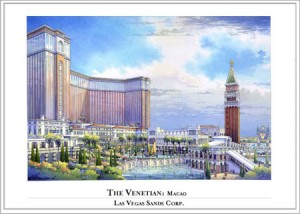 Cap-and-trade at Sands. Combing through Las Vegas Sands‘ 1Q10 report and the first week of business at Marina Bay Sands, analysts at J.P. Morgan are generally bullish on the company. They’re not expecting Sands to move many of its Macao condo units this year but speedily growing VIP play at Venetian Macao (left) generated that megaresort’s highest
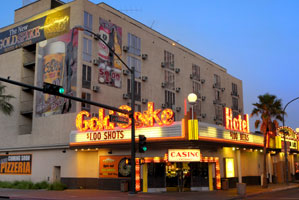 “There was a time where I wouldn’t walk in there for fear of getting a secondary lung disease. Now, it’s as cool and neat as a place as there is in the entire downtown.” — Las Vegas Mayor Oscar Goodman,
 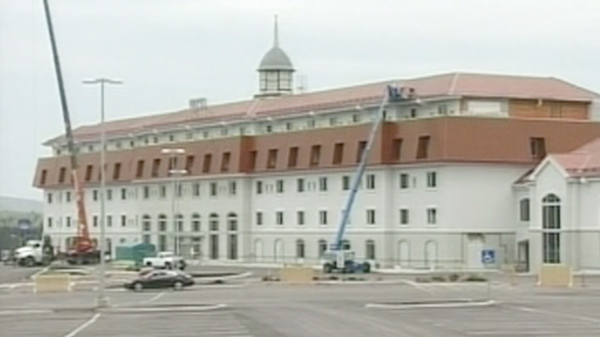 Move over, Atlantic City, here come “the Maritimes.” (Quoth the Mackenzie Brothers, “Zoom in on the Maritimes, eh?”) Not to be outdone by Nova Scotia‘s casinos or Prince Edward Island‘s racino, New Brunswick has struck back with a 22-table, 500-slot casino in Moncton. Already,
  “[Steve] Wynn does business in Las Vegas, where Gaming Inc. pays a 6.75 percent tax rate and casino bosses bray like thunderstruck donkeys when someone reminds them Mississippi casinos pay 8 percent, Atlantic City casinos contribute 9[%], and Louisiana riverboats pay 21.5[%]. Wynn claims he is sincerely considering moving his headquarters to Macau, an Asian mob-infested smuggler’s paradise ruled by a communist government where casinos pay an aggregate 40 percent tax rate. This is the atmosphere he says is less oppressive than the United States?” — Las Vegas Review-Journal columnist John L. Smith on
 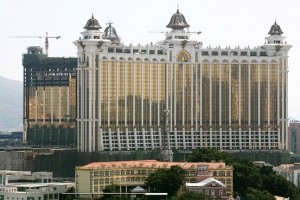 Pace T.S. Eliot, April was not the cruelest month for Macao. Quite the contrary: The protectorate posted gambling revenues of $1.72 billion, a single-month record. Galaxy Entertainment (whose new Cotai Strip™ pleasure palace is pictured, above) brought up the rear, along with MGM Grand Macau. Even if Stanley Ho is really on his deathbed, his Sociedade de Jogos de Macau continues to pull market share away from Las Vegas Sands in tiny increments. For April, SJM’s market share was 33% to Sands’ 21%. Wynn Resorts continues to get the most bang per gaming position, its 14% of market share good for third place, edging Melco Crown Entertainment‘s 13%.
 If any other gaming CEO than Sheldon Adelson opened the most expensive casino ever ($5.5 billion) and projected it would recoup its tab in five years — requiring a return on investment well above 20% when you take operating costs into account — Wall Street analysts would be rushing the phones to put “sell” orders on the stock.
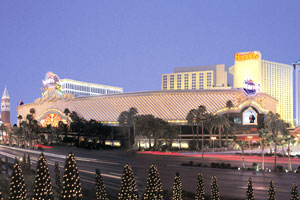 Let it be said at the outset that $39.99 for X number of meals at (most of) Harrah’s Entertainment‘s Strip buffets — up from $29.99 — is still one heckuva deal. If you can manage, say, breakfast, lunch and two dinners in a 24-hour period, that’s $10 per buffet. Try getting that price anywhere else in town and a meal you can stomach.