

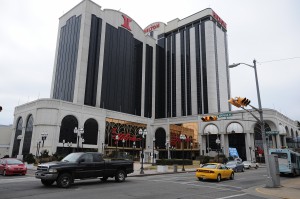
 In the shrinking Atlantic City market, where most of the casinos are operating in the red, it was inevitable that one or two of the so-called “parasitic” ones would bite the dust. While the ex-Atlantic City Hilton (preposterously rebranded as “ACH“) hasn’t had the Last Rites read yet, industry analysts are already penning its obituary. Even if it were given away, it’d be an expensive proposition: It’s on pace to lose $28 million this year and rebranding the property will cost millions more. That’s just the beginning of the hidden costs involved.
The downfall of Atlantic City’s gaming-centric economy may be the prime suspect in “Who shot ACH?” But a lengthening trail of bloodstains leads eventually to the executive offices of owner Colony Capital and its imbecilic CEO, Tom Barrack. This Stephenie Meyer-fixated boob paid a cool half-billion-plus for the property in a 2005 spending spree. Considering that Harrah’s Entertainment was being forced to divest itself of the property in order to engorge Caesars Atlantic City and Bally’s Wild Wild West, one questions Barrack paying a top-tier price in a buyer’s market. He had Gary Loveman right where he wanted him — and wrote Loveman a big-ass check.
 Revenues spiked the following year, then fell 50% over the next four. As they slipped, casino CEO Nicholas Ribis scapegoated property president Anthony Rodio (left, who made a comeback at Penn National Gaming). The much-despised Ribis replaced Rodio with an executive schlepped in from Tunica — and the revenue decline accelerated. Unfortunately, no one at Colony thought to fire Ribis. Whatever good he may have done — including a recent $20 million reinvestment in the facility — he did not improve the Hilton’s fortunes.
 Nor was that all. Barrack (right) further ran up the tab on his acquisition by foolishly pledging it as collateral against still more debt. Unpaid bills mounted and then, finally, when rescue was in sight in the person of Tilman Fertitta, Colony got greedy. While Resorts Atlantic City and Trump Marina were on the market in the $30 million-$4o million range, the A.C. Hilton’s asking price shot up to between $50 million and $75 million. (This was amid the brief euphoria about potential Internet gambling in New Jersey.) Fertitta eventually walked away and struck a deal with Trump Entertainment Resorts, relieving it of the Marina for $38 million.
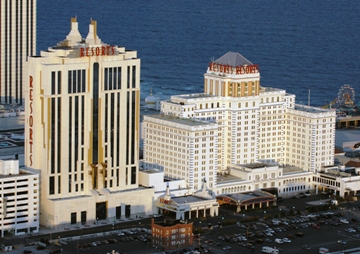 As ever, Dr. David G. Schwartz has made a persuasive case for why the money spent on something like the Seminole Tribe‘s Hard Rock project (just to the south of “ACH”) would be better invested in a distressed but extant property. Trouble is, Barrack has booby-trapped the A.C. Hilton with so many costs above and beyond its face price that it’s a far riskier investment than was Dennis Gomes‘ purchase of Resorts (left). The Seminoles might not necessarily be fools to buy it at a fire-sale price, but pre-existing liabilities would eat through a lot of the $250 million the tribe has otherwise earmarked for Hard Rock construction — and you’d still have an old casino with a dowdy image at the wrong end of the Boardwalk. At least a Hard Rock would have a reputable brand and novelty … and fewer hotel rooms to amortize.
Colony took a $514 million investment and has run its value down to almost nothing. It’s unfortunate that the practice of tarring and feathering has gone out of fashion. The Hilton would have been sent to ICU eventually, perhaps very eventually, but Colony has done almost everything possible to hasten its demise. It didn’t have to be this way.

David,
As a regular visitor to Atlantic City, I can give you a few reasons why Hard Rock is better off building new rather than buy a distressed property like the AC Hilton. Hard Rocks plan allows them to design and build the rooms with newer products, amenities, and configuration. They won’t have to deal with 1970’s building designs and try to retrofit the room to their design. Places like the Claridge Tower at Bally’s, the original Temple Tower at Caesars, or the Ocean Tower at Resorts have tiny bathrooms which are big turnoffs to a lot of visitors. I haven’t stayed at the ACH, so I can’t say for sure what their bathrooms sizes are. But bathroom sizes is just an example of an issues that an older property would have. They can wire the property with 21st technology without having to figure out wiring etc.
Opening with only 200 rooms, rather than try to fill up 500+ rooms (or in the ACH’s case 800 rooms) will give them more flexibility on room rates. The location that Hard Rock is proposing allows them to take advantage of the ocean better than an existing building.
Building new, rather than buying an existing property, will allow a company to completely hire their own staff and will not be saddled with the possibility of a disgruntled staff. The unions have been picketing Resorts due to the wage cuts that the staff took when Gomes took over.
The problem with so many of the casino properties in AC is that they never added many non-gaming amenities or revenue streams and the buildings aren’t really set up to be able to add much to them. Atlantic City needs something new to draw new crowds. Putting lipstick on the AC Hilton or Trump Plaza doesn’t alter the Boardwalk Skyline or make it seem like something new.
Not everybody likes to stay at big megaresorts. The smaller properties and/or the boutique casinos need to find the right niche and cater to them.
Flip
Great article. Ribis actually had a stellar management team in place for the “Resorts International” portfolio (LV Hilton, Resorts and Hilton AC, Resorts and Bally’s Tunica and Resorts Chicago properties) but they all fled after management figured out that Colony was just putting it on “autopilot” as one of your other blogger’s so correctly put it. Rodio was hired by “Resorts” original management team and the Hilton was; albeit briefly, on the up and up. They were playing big, courting big-time players and it seemed to be working. Not sure what happened, but firing Rodio was a terrible move. Anyway, as I have said before, Colony made some handsome profits off the sale of the former Harrah’s/Resorts Riverboat in Chicago and the Atlantic City land now being targeted by the Seminoles for the Hard Rock. They should have paid down the debt on the entire portfolio instead of putting the chips in their own pocket! You summed it all up ” It didn’t have to be this way”
As a former employee of the Atlantic City Hilton, I can give a little insight into arrogant management team that took over the Hilton. After the merger they cut all departments operating budgets down to nothing. Colony Capital had this grand vision that they were going to keep the property for a couple of years put as little money as they could into it and sell it for a big profit. They turned around a property in Reno and make a big profit they claimed a few year before they purchased us. There was downright hostile environment for employees and long time employees start leaving in droves and this was in 2006 when they were making great profits. The economy downturn didn’t help matter much, but there’s only so long you can suck profits out of a business and put very little back into it before it suffers. You could have the best management team in the world, but if you don’t have good experienced employees working for them, all the management tricks in the world isn’t going to save you. As a longtime employee (15 years) I left at the end of 2006 cause I saw the writing on the wall.