
Steve Wynn‘s executive chair isn’t even cold yet and already Wynn Resorts is shifting its priorities, evidently. Yesterday Deutsche Bank analyst Carlo Santarelli wrote that he believes the company “is likely to complete its convention space at Paradise Park and move to Wynn West, leaving the Paradise Park hotel and lagoon project for further 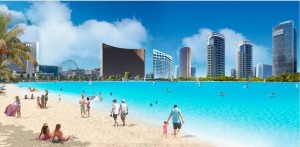 consideration.” So say goodbye to nightly fireworks, free ice cream and giant apes, animatronic or otherwise. And take a good look at that rendering of Wynn Paradise Park because you’re probably never going to see it again. Wynn Resorts, if Santarelli is right, is moving away from the experimental, sometimes daffy things that Steve Wynn would initiate and towards what it understands: another hotel-casino on the Strip. Here’s hoping they try some new ideas in architecture and that Wynn West won’t look like the afterbirth of the amours of Wynn Las Vegas and Encore. It’s a good thing the company didn’t completely rip up the golf course, lest that acreage remain fallow. In an unrelated (?) development, Dr. Ray Irani abruptly resigned from the board of directors, while Alvin Shoemaker will step down at the end of his term.
In a piece of good news for WYNN shareholders, the company settled its lawsuit with Universal Entertainment, removing what Santarelli called “the single biggest financial overhang … The settlement marks the end of the 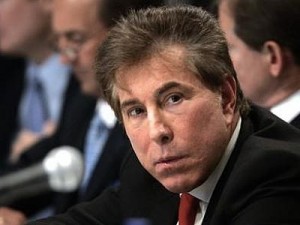 6 year legal battle over the redemption of Mr. [Kazuo] Okada’s stake and ends all litigation between the parties.” With both Okada and Steve Wynn out of the picture, it doubtless made peace terms easier to reach between Universal and Wynn Resorts. Pacification isn’t coming cheap: Wynn Resorts must pay Universal $2.4 billion — a $1.9 billion promissory note with a $464 million cherry on top, to settle interest payments. Still, we have to go with Santarelli’s description of this as a “big positive.”
While the ink was drying on the settlement Wynn CEO Matt Maddox and CFO Craig Billings gave a song and dance at a JP Morgan investor forum. Not surprisingly, they outlined their priority as “to change the narrative by reducing the noise from regulators, reducing the noise from  litigation, and getting back to highlighting the company’s attractive fundamentals in Macau and Las Vegas.” They described themselves as “excited” by the Okada accord, even though it’s going to cost them plenty. After all, it’s tax deductible. Based on early polling, they’re going to stick with the Wynn brand and hope to charm regulators into realizing that Wynn Resorts “is a well-run company, leaving the main issue Steve’s ~12% shareholding (worst case regulators call for a liquidation, which management notes would be orderly).” In a cryptic remark that must surely be an allusion to Wynn Boston Harbor, the execs said management “would not let the fate of a single property jeopardize the rest of its business.”
The Wynn brand certainly isn’t toxic in Macao, where Wynn Macau is up 19% in the first quarter so far and Wynn Palace is 37% higher. Giving credit where it’s due, Maddox and Billings noted that premium-mass-market play was up since MGM Cotai opened across the street. While not specifically downsizing Paradise Park, the execs said they were “reviewing” it and “the lagoon concept may be more exclusive (possibly only open to resort guests).” They added that their Macao properties were a higher priority, ditto Japan.
Speaking of MGM Resorts International, it also made its obeisances to Wall Street, with CEO Jim Murren and CFO Dan D’Arrigo in attendance. They said MGM was “using sports as a strategy, as it drives volumes during slower periods and helps the company transition (along 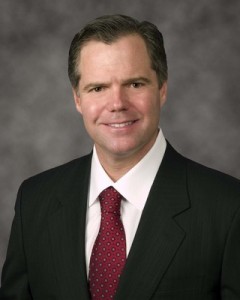 with Las Vegas) from traditional gaming to a broader sports and entertainment focus,” and are now talking about Major League Soccer to complement the NHL, NFL and WNBA (two of which are hosted at MGM megaresorts). With room construction going for almost a million clams apiece, Murren and D’Arrigo said they saw no reason to build new capacity. Nodding to the 50/50 ownership of CityCenter with Dubai World, Murren & Co. made some vague noises about wanting to own the whole enchilada, hopefully within five years. They also said they’d trade off higher occupancy overall in favor of more-profitable customers (read: conventioneers). Softness persists along the Mandalay Mile following the events of Oct. 1 and Murren doesn’t expect recovery this year. As for Park MGM, management anticipates “high teens” ROI, with room rates 50 bucks higher than the Monte Carlo norm ($126/night).
Over in China, MGM Cotai was admittedly lagging the market, but Murren expects it to catch up once junkets and high-roller villas are 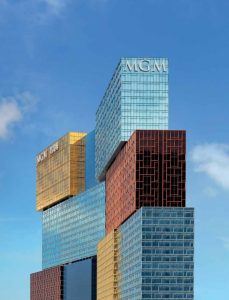 complete. He is also “generally sanguine about concession renewals and expects the process to be well defined by both the Macanese government and Beijing long before actually enacted.” He also anticipates turning on a big spigot of cash flow — which would certainly fund a CityCenter buyout — in the near future, with MGM Springfield, MGM Cotai and Park MGM all substantially finished, and no projects in the pipeline. No mention was made of Japan, which comes as a bit of a surprise.
* Churchill Downs was also in the building and said it bought Presque Isle Downs for its high cash flow “as well as providing a foothold into the attractive/high-population Pennsylvania market, where real money online gaming legislation has already been passed.” As far as expansion in Illinois and Florida, Churchill Downs couldn’t handicap the former and said chances in the Sunshine State change by the day. Instead, its priority is the acquisition of ‘instant racing’ VLT venues, which occupy a gray area of gambling but where CHDN sees green fields.

[…] Stiffs & Georges blog has more on this from a casino stock analyst. We should know more in a month or […]