

Despite having one less weekend day this year, April was a good month for Louisiana, as gambling revenue rose 5%. The growth was especially  dramatic in the Pelican State market, up 19%. By contrast, Shreveport/Bossier City was down 3%. The increase was especially dramatic at Harrah’s New Orleans, up 42.5% (no, that’s not a typo). So much for the allegedly pernicious effects of the smoking ban. Smoke-free Fair Grounds racino was up 7%, as the two casinos grossed $35 million and $3 million respectively. Elsewhere in the Crescent City, Boyd Gaming‘s Treasure Chest was down 4%, to $9.5 million, and Pinnacle Entertainment‘s Boomtown riverboat notched a 1% gain to $10 million.
It was an adverse month for Boyd properties pretty much everywhere. Amelia Belle was off 11%, to $4 million, Delta Downs slipped 8% to $14.5 million, Evangeline Downs dipped 4%, to $7 million, and Sam’s Town in Shreveport was 4% off its feed, grossing $6.4 million. Caesars 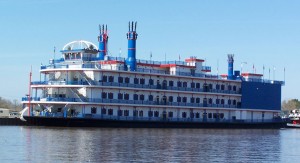 Entertainment had an unusually good month at Harrah’s Louisiana Downs, up 6% to $4 million, but not at Horseshoe Bossier City, down 7% to $14 million. The area’s star performer was Margaritaville, up 10% to $13.5 million. By contrast, normally reliable Eldorado Shreveport was off 9%, to $11 million, and Diamond Jack’s suffered a calamitous 26.5% plunge in revenue, never very big to begin with.
Except for L’Auberge Baton Rouge (of course), the market in “Red Stick” was pretty ‘meh.’ L’Auberge grossed $15 million, good for a 6% increase. GLPI‘s Casino Rouge was flat at $6 million, the same amount as grossed by Tropicana Entertainment‘s Belle of Baton Rouge, down 4.5%. And last, but far from least, the juicy Lake Charles market was dominated by L’Auberge du Lac, up 16% to $29 million. Golden Nugget eked out a 3% gain, for $23 million and Isle of Capri grossed $10 million, a 9% setback.
* If anything might cool Sheldon Adelson‘s ardor for a Japanese casino it’s a Morgan Stanley report that overseas casino operators can only hope for 40% shares in any gambling houses they build. The  prospect of Adelson being a back-seat driver on a $10 billion megaresort borders on the inconceivable and we know how poorly he plays with others. (Just ask Lui-Che Woo and Mark Davis.) By contrast, Hard Rock International has been broadcasting its willingness to be a minority partner in a Japanese casino on all frequencies.
“We suspect the most likely shareholding structure could be 40% (main local partner), 40% (foreign operator), and 20% (all other local partners),” wrote analysts Praveen Choudhary and Thomas Allen. They tipped Osaka and Yokohama as the likeliest locations, with Tokyo lurking in the wings. As for a smaller, regional casino, Choudhary and Allen picked Sasebo, “given existing infrastructure, support from the city/prefecture, and proximity to China.” If Osaka is chosen for a mega resort, its proximity to Wakayama would pretty much squelch Wakayama’s chances, observers say. Already, as we’ve reported, Mayor Masahiro Obana‘s preference for a gaijin-only casino makes for an unpromising business model, too.
“I personally think the Singaporean way would be sufficient as a restriction. But Japanese are perfectionist – even if there is a 1% of chance that a person can become addicted, then there would be opposition. And we would like to eliminate that opposition from the beginning,” said Wakayama Governor Yoshinobu Nisaka.
We know things are pretty crazy in the nation’s capital these days but that doesn’t quite excuse the Washington Post for taking so long to cop to the new regimen in Las Vegas: stiff video poker players who want free drinks. As Caesars’ Richard Broome, a good guy, put it: “We are making a concerted effort to reward our larger-spending customers. This discourages people who are just looking for a free drink.” The article, which reads like a puff for Ardent Complimentary Validation System, used by Caesars, goes on to say that MGM Resorts International is following in Caesars’ footsteps and even going further: New Jersey and Mississippi punters could get stiffed too.
As MGM’s Alan Feldman puts it, “In the 1950s, the industry was trying to incentivize. Now, it’s a reward.” In other words, they don’t just want your business, they want you to appreciate them. In defense of the new system, aside from quantifying the value of video poker players it no longer puts them at the mercy of a bartender’s caprice. So I guess there’s something to be said for it after all.
* City commissioners of Miami Beach are so dead-set against casinos that they voted through not one but two preliminary ordinances banning gambling from the city. Motivating factors were said to be “more crime, traffic and addiction to gambling.”
* It looked like Oklahoma tribal casinos were going to get dice and card games until the Sooner State Legislature dropped the idea like a hot brick. In doing so, it threw away a possible $20 million in annual tax revenue. Also included in the package was — if allowed federally — the prospect of sports betting. I don’t see the logic of the Lege in this matter, particularly when the state gets something in return for giving so little.
