
Lawmakers in Pennsylvania have passed an unbalanced budget but are still undecided on how (not “if”) to expand gambling to cover the  shortfall. One late-entrant idea that is gaining more traction than anything else is the proposal of mini-casinos, 10 of them. (The size of the casinos still appears to be undefined.) This would give the Keystone State three tiers of casinos: big, Vegas-style ones like Rivers Casino in Pittsburgh; smaller, restricted-admission resort casinos like Valley Forge (which sits immediately below the bluff upon George Washington encamped his army) and now “mini casinos.” Penn National Gaming is crying foul, since most of the prime locations happen to be around its eponymous racino near Harrisburg.
Complained Penn spokesman Eric Schippers, “The vast majority of the potential sites for these new casinos fall within our market area in Central Pennsylvania, representing a severe threat to our property and the more than 1,050 jobs it represents.” That argument stirs little pity with lawmakers, since Penn stood to be the greatest beneficiary of slot routes — an early favorite in the debate that has faded to the rear of the pack. Existing casinos would each enjoy an exclusivity zone, 25 miles in radius. Given the number of casinos in the Philadelphia area (four, going on five), they would have little to fear, unlike lone wolves like Penn National. As one news report puts it, “Overlapping rings in the Philadelphia, the Lehigh Valley and into the Scranton Wilkes-Barre regions mean there literally could not be any of the new casinos built in a roughly 500-square-mile block in the eastern third of the state.”
An idea gaining traction is to auction the mini-casino licenses, starting at $10 million. (Nobody knows how to squeeze blood from a stone like a legislator facing a budget deficit.) Some, however, question whether more gambling positions is the answer to the problem. As Spectrum Gaming Group‘s Michael Pollock says, “The worst reason to expand gambling is to solve this year’s budget shortfall.” Just don’t say that around the state house.
* Shawn Scott‘s latest attempt to reinvent himself as a legitimate casino owner got a quiet pass from the Maine Legislature, which could have removed his York County racino quest from the November ballot but elected to stand pat. Scott’s not out of the woods yet. Three of the entities funding the petition drive failed to submit important  documentation with the Maine Ethics Commission. (If they had, it might have been the first time that Scott and ethics were in the same room simultaneously.) Given Scott’s problems to date, which include “questionable record keeping and unpaid bills,” it’s no surprise that his financial reports should be in disarray. The Ethics Commission is trying to get a clear picture of exactly who is behind the octopus-like funding of Scott’s racino scheme, their confidence not bolstered by a previous investigation that “revealed a long history of questionable and deceptive practices in other states, including Nevada, New York and Louisiana.” Scott will probably fare well at the ballot box but his chances of being licensed are quite another question indeed.
* The Massachusetts Gaming Commission decided against putting the state’s fourth and final casino license out for bidding but there may soon be a compelling reason to reverse that edict. Beset with litigation involving the Interior Department‘s land-into-trust transfer, the Mashpee Wampanoag may decide to recast Project First Light as a commercial casino and apply for state approval instead. While Taunton Mayor Tom Hoye, a casino supporter, characterized going the state route as a last-ditch option, he also made it clear that multiple plans of attack were on the table. “I think the state would be happy to take the $85 million fee,” Hoye added. (The tribe kept mum on the issue.)
For the Gaming Commission, giving the license to the Mashpee tribe would relieve it of its concern that a tribal casino *and* a commercial  one would saturate southeastern Massachusetts. Both the Legislature and the MGC have tried to get the Mashpee on board with the idea of going the commercial-casino route, possibly piggybacking with partner Genting Group, but the tribe has been resistant. Then, a year ago, the Obama administration’s land-into-trust granted was overturned by a federal court, “With respect, this is not a close call,” opined Judge William G. Young.
Meanwhile, Neil Bluhm‘s casino-development group has begun agitating for reconsideration of its Brockton proposal, rejected by the MGC some time ago. Casino opponent Michelle Littlefield taunted the tribe to open its books to regulators, saying, “I doubt they would be successful. But I don’t begrudge them the chance to try.” That’s mighty white of her.
* Even though the Bureau of Indian Affairs hasn’t approved an off-reservation East Windsor casino, both Mohegan Sun and 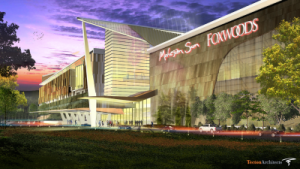 Foxwoods Resort Casino are going to proceed with its construction. MGM Resorts International, in the meantime, promises continued litigation. Said MGM veep Uri Clinton, “We continue to believe that the process put in place by the legislature and signed today by the governor violates both the Connecticut and U.S. constitutions. As such, we will continue to pursue all legal remedies.”
* S&G congratulates Paige Lion, new chief information at Affinity Gaming. Lion’s resumé includes 22 years at Caesars Entertainment, so her hiring constitutes a feather in Affinity’s cap.
