

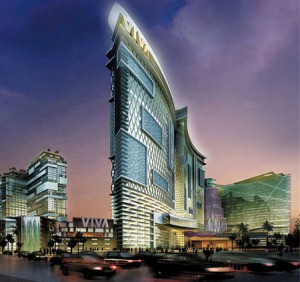
 “[T]he confidence that property prices and stock markets would permanently defy gravity” is a phrase that perfectly encapsulates how the casino industry got itself into its present pickle. In what other mindset could an industry convince itself that it could dump CityCenter, Cosmopolitan, a grotesquely enlarged (and now deficit-ridden) Hard Rock Hotel and failsinos like Fontainebleau, Echelon, the Plaza, the short-lived Maxim project, Viva (above) and sundry other crack-pipe dreams into the Strip market more or less one atop the other? Executives at Harrah’s Entertainment and Station Casinos would have you believe that the Great Recession was the only thing that put them in the ditch.
That’s a load of bull manure. Those LBOs were predicated on expectations and projections of continued revenue growth … in short, upon a gravity-defying economy. Had things merely continued at 2006-07 those companies would still be strangulating on their debt-to-cash-flow ratios.
“Just around the corner/There’s a rainbow in the sky./So let’s have another cup of coffee/And let’s have another piece of pie.”
Those are the lyrics from a rather annoying and smug Depression-era song and there’s some of that self-deluding talk going through the casino industry these days. While the fallacies that gambling is “recession-proof” or even merely “recession-resistant” have been slain, one still hears happy talk of “pent-up demand.” Sterne Agee analyst David Hargreaves describes this as “an overused buzz phrase that only applies when people feel comfortably well off” or the “We’re expecting sunshine today because it rained yesterday” mentality.
Perhaps it can be best demonstrated as follows:
It’s a good thing for the industry that high-end play never went away en masse and that most of the major operators were sufficiently diverse, geographically, to capture the “convenience” gambler … especially when going to Vegas became a serious inconvenience for John Q. Public. Nor can one blame Big Gaming for putting its chips on the luxury market. Whether there’s enough of it to go around as multi-billion-dollar megaresorts lumber into position is a proposition still in the testing stage. When MGM Resorts International‘s top performer, Bellagio, has to advertise its affordability, one suspects that — having pushed the envelope of high-end demand — the envelope is now pushing back.
To the extent that they keep playing, value-oriented gamblers are likelier to stay close to home, especially as economic hard times and public-service budgets conspire to create a self-propelled downward spiral, a phenomenon readily observable right here in Nevada, where homeless men sleep alongside the mega-McDonalds that is the one completed vestige of Echelon. In other states, that vicious circle is dead certain to generate political demand for more and more gambling venues, regardless of how diluted the marketplace has become. States like Massachusetts waited until the cash cow had been milked near to dry before they grabbed their buckets and queued up at the udders.
 But if executives believe that mid-market and bargain-niche play is coming back to the extent that room rates and restaurant prices can be ratcheted up again, they might want to think again. A growing disparity in wealth, wage stagnation and what the Financial Times calls “declining income mobility” are going to put a serious squeeze on the casino industry as Baby Boomers contemplate a bleak future. The clueless pronouncements of Archon Corp. CEO Sue Lowden during her recent, disastrous foray in electoral politics (recently dubbed “penicillin for poultry”) are indicative of the “reality gap” between CEOs and the man on the street. Ditto Steve Wynn‘s surprise to learn that being reduced to 32-hour weeks had inflicted serious financial hardship on his workers. To Wynn’s eternal credit, he moved swiftly to alleviate the situation. Many of his coevals seem locked into an ivory-tower mindset.
Somewhat in the same vein, MGM and Boyd Gaming retired a big note on Borgata, praise be — but also took a manufactured “dividend” by borrowing yet more moolah. (That “dividend” is going to have to be made up out of earnings per share somewhere down the road.) I have to agree with New Jersey Division of Gaming Enforcement attorney James C. Fogarty, who asked, “Isn’t there a better use of the money than that?”
Too much of a buzz-kill? Sorry. But too many people — especially on Wall Street and in the trade press — write what the industry wants to hear. The go-go days are gone and they ain’t comin’ back … at least not in the foreseeable future.
Speaking of which … judging by the prevailing fragrance (stale cigarette) of Eastside Cannery, owners William Paulos and William Wortman must have bottled up many cylinders’ worth of the old Nevada Palace air, which was roughly 50% tar, 45% nicotine and 5% oxygen. Y’know, just in case people feel nostalgic for the ashen old Palace. (The latter has the rare distinction of inspiring a play, Ernie Curcio‘s hilarious Rambis.)
That caveat aside, ECan — as Anthony Curtis calls it — is far cleaner than any Harrah’s property I’ve visited of late. It’s also well-staffed and the service ethic is great. Slot play was alarmingly thin at the time of our visit but The Dollar Bills provide a more hospitable experience than one can find in most Vegas casinos these days.

City Center ($8.5 billion dollars), Cosmopolitan ($4 billion dollars) and Fontainebleau ($4 billion dollars): $16.5 billion dollars spent on 3 massive hotel-casino projects. How can any company spend that much money to open a property and expect it to make money? Carl Icahn has a chance with the Fontainebleau because it looks like he will have to only ante up around another $1 billion dollars to get Fontainebleau finished but (as I have said previously) it just looks kind of bizarre down there at the north end of the Strip. Fontainebleau is a massive, bulky blue building that does not fit well at the north end of the Strip or really anywhere on the Strip for that matter. If anyone can make it work though Carl Icahn can.
As for the other two good luck. They are going to need it.
“Nor can one blame Big Gaming for putting its chips on the luxury market. Whether there’s enough of it to go around as multi-billion-dollar megaresorts lumber into position…”
– And I’m wondering if, given the well-publicized $millions lost due to unpaid markers & bad checks by high-roller welshers, the casinos are less likely to dole out credit to “luxury class” players.
“especially when going to Vegas became a serious inconvenience for John Q. Public”
– I just found a bus company that makes twice-a-week round trips to an Indian casino for free here in Southern California:
I drive ten minutes to a free municipal parking lot, board the bus at 8 AM, ride to the casino, get $15 free play as a “turnaround” patron, and board the bus at 3 PM for the return trip to my car.
I’m going to check it out.
I’m still going to go to Vegas later this year because I love it – and I have offers free stays + meals + gambling credits, and $75 round trip bus fare – but maybe less often than I have in the past.
so true, the Harrahs properties are a mess. I so wish they’d stop playing publicity games on the resort fee front and just figure out a way to hire some cleaners/painters.
Paul, Deutsche Bank may try to sort of manufacture a profit on Cosmo by writing off a billion here, a billion there and trying to bring the break-even number to somewhere around $1.5 billion-$2 billion. But DB has to take the rap for underwriting Ian Bruce Eichner with nothing but the underlying dirt as collateral.