

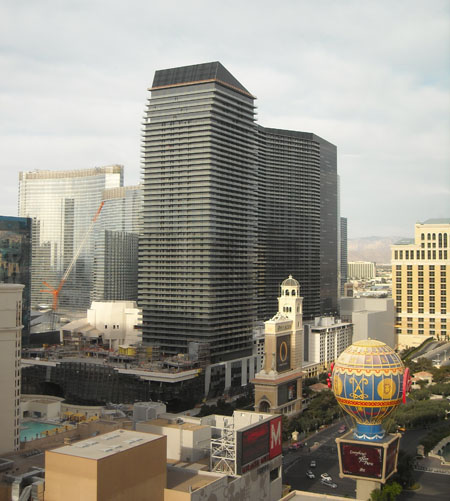
 Month after month of discouraging data from around the country makes it clear that any recovery in the casino industry is a long way off, perhaps years. Heck, just getting back to 2007 levels of prosperity doesn’t take into account the expansion that occurred in the intervening years. (And if you think Cosmopolitan is going to lift all boats, I’ll have whatever you’re drinking.)
Month after month, two disparate trends mark Las Vegas tourism and gambling data. More people are coming back but they’re spending quite a bit less. The CEOs of MGM Resorts International and Las Vegas Sands tell us that convention traffic on the way back up, with recovery projected for 2011. Since they’ve got access to data we don’t, let’s take them at their word. The bread-and-butter gambler, however, is turning into the nickel-and-dime gambler, reconfiguring Las Vegas into a market desperately dependent on high-end play.
Third-quarter trends in room revenue are flattening for MGM and Harrah’s Entertainment are flattening, after a protracted swoon. However, Wynn Resorts and Sands have been the only major Strip operators on the upswing. It cannot be mere coincidence that each has only two hotels to fill. The strategy of trying to monopolize as much of the Strip as possible has not served either MGM or Harrah’s well during the Great Recession. The “bundling” of the Strip was, and remains, a terrible idea, holding the market hostage to the vicissitudes of two companies.
In what would make a good Sharron Angle talking point (if she knew how to use it), the Las Vegas Sun points out the Aria has fiercely diluted the Strip gambling market, down 14% when Aria is subtracted from the mix. Also, that mainstay of the Strip, the fanny-packing Baby Boomer is tapped out. When your home value has shriveled and your 401(k) is in the crapper, gambling just isn’t the pleasant pastime it used to be. “During the boom years, many Americans used their homes like ATMs, withdrawing equity to spend on luxury goods and trips. Much of this ready cash has dried up in the recession, and declining home prices have made consumers feel less financially secure and more tight with their cash,” writes Liz Benston.
That’s bad news for companies like Harrah’s, which bank on packing in the retirees. Now that they’re sitting their few remaining nest eggs, the industry must put its hopes on the VIP market as well as all those mysteriously affluent twentysomethings who think naught of dropping several thou in an afternoon at Rehab. You’d expect that well would have dried up too, by now, but luckily for the casinos, those youngsters continue to party hearty.
 Cold feet in Massachusetts. Spooked by casino opponents and fears of dire social disintegration, the Boston Globe has gone into full retreat on the issue, uttering a craven call to legislators to kill the debate until next year. (At which point the Globe will probably say the same thing all over again.) The editorial’s generally squeamish tone indicates that the Globe was never down with this whole casino thing to begin with. (Smoking? Shocking! Free drinks? Horrors!)
True, the sausage-making on Beacon Hill has been particularly grisly and the Globe makes some good points about the juicing-in of certain favorite-son racinos. But vast amounts of revenue have already been lost by punting this debate from the ’09 Lege into this year. Casino licenses in Massachusetts will be even less valuable in 2011 — especially if Bay State tribes make a federal end-run and get a jump on the private sector. Gov. Deval Patrick and his unruly lawmakers literally can’t afford further delay.

One thing I’m always amused about in your economic reports is that you (or perhaps more accurately, the financial types you’re reporting and speculating on) always set the year 2007 as the gold standard for success.
Sometimes, what’s good for Vegas isn’t what’s good for America and vice versa. I’d think 2005 would be a reasonable target, the city was seeing reasonable gains and the country seemed stable.
2007 really should not be ballyhooed as an economically wonderful time since the writing was on the wall for the bursting bubble, in my opinion. By mid-2007, Canadian friends and relatives were dropping in just as part of a multi-city tour of the southwest, simply because our dollar had been destroyed to the point where American Fun Bucks weren’t much more expensive than their own coin-based currency. By fall, our dollar had fallen below for loonie the first time in 30-some years, and not for any happenings going on north of the border.
Vegas was simply one of the few recipients really milking it in as the US self-destructed in 2007-2008, because our economy is one of the few that is actually based entirely around outsiders and the country’s external debt couldn’t be loaded up fast enough to a country who has a national obsession with gambling, which is quite fortunate. It also helped that everyone at home who owned land felt financially invincible.
While all off this felt like money raining from the sky for Las Vegas, it was destructive to the rest of the countryside, and has put us in the situation we’re in now. The industry should lower it’s sights and look for a recovery not based on a Big Lie of getting rich quick spreading nationwide.
I’ve never seen a photo of Cosmopolitan from that perspective. Man, is it big, dark and foreboding….but I still can’t wait to see it.
Thanks, Detroit. I took the photo.
Mike, I agree with your analysis completely. You, me and a few other people maybe see 2006-07 as the apex of a bubble. For the casinos (as I’ve written on previous occasions, like “This Is Your Industry on Crack”), it was a baseline — a chimerical baseline, but one on which the Harrah’s and Station LBOs were predicated.
Whenever you see a casino executive crying into his or her beer about revenues being “only” at 2004 levels, it’s worth remembering that was the period in which the takeovers of Park Place Entertainment and Mandalay Resort Group were launched, and in which Tilman Fertitta arguably overpaid for the Golden Nugget. So the industry was feeling pretty flush. Then it caught a bad case of what the Japanese call “victory disease” (a false sense of invincibility) whose symptoms included Echelon, Cosmo, F-bleau, CityCenter, Red Rock Resort, Aliante Station, plus umpteen failsinos.
Another item to note about the reduced spending habits by increased number of tourist…could that not be attributed to the record low room rates? In other words these low room rates are making it much more affordable for the non-gambler and lower income travelers to visit Las Vegas. I have many friends that are considering a trip simply due to the Extreme low room rates, and they will not be dropping a load on the tables or in the slots. They want to “see” Vegas either for the first time or going back to check out all the changes. And many tourists are still under the impression that food/drinks are “cheap” in Vegas – and again the room rates lure them even more. But when they arrive – they realize “cheap” drinks are 8-10 bucks on the strip and “cheap” food is no longer the $3.99 buffett. For us Vegas Fans it is hard to believe people still have this fantasy…but so many do!
How are Tilman and the Golden Nugget doing? I know he put a lot of money into the expansion and refurbishment. It seems to be crowded every time I go there; is the money invested paying off?
Sorry for the confusion, Kurt. The reduced spending habits in question apply to gambling (although retail — meals, shopping, entertainment — has only recently started to nose out of a two-year-plus dive). People are visiting in slightly greater numbers but they’re wagering less. Judging by the amounts of water, soda and alcohol I see being toted into casino-hotels by guests, they’ve also had their fill of sky-high Strip prices, too.
Kerr, lemme get back to to ya after I’ve checked an SEC filing or two. A ways back, the Golden Nuggets were supplying a massive plurality (43% IIRC) of Landry’s revenue base. Given the size of Tilman’s restaurant portfolio, that’s not a great testament to the strength of his scores and scores of eateries.