
Glenn Straub wins our Liar Liar Pants on Fire Award hors concours for dissembling about any intentions to sell Revel while negotiating a deal to do precisely that. Give him credit, though, for raising the defunct megaresort’s value: The $200 million sale price 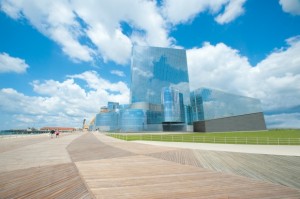 means he’ll pocket a tidy $118 million profit, minus the cost of capex improvements. Not only does Revel have a new owner, it also has a new name: Ocean Resort Casino. The buyer is Colorado mogul Bruce Deifik, who intends to have the property on line by summertime (might we suggest he accelerate the process by hiring a casino-management company?). According to Bloomberg, “Deifik said he planned to add an Asian noodle bar and a high-end players’ club.” (Has he been studying the downfall of Lucky Dragon Casino?)
In a parting shot at outgoing Gov. Chris Christie (R), Straub said, “I hope the newly elected governor, and Atlantic City officials, will reject the anti-business and anti-job creation attitude of the prior governor.” Straub also reiterated that he wasn’t going anywhere, renewing his expression of interest in Boardwalk Hall and Bader Field. Since the sale of Revel renders his lawsuit against the state moot — Straub didn’t want to have to apply for a gaming license — it would be interesting to see his creativity applied to a a non-gaming attraction, of which Atlantic City has too few.
Deifik has earmarked an additional $175 million for upgrades to Revel/Ocean, which will face some tough market challenges, including the lack of a player database or a brand 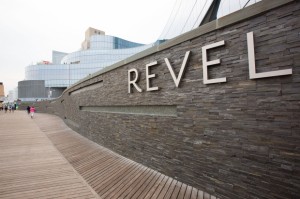 name, to say nothing of the fact it will be going up against Hard Rock Atlantic City, which has arguably — but not very — the best brand name in gaming. Still, “It’s like having Christmas in January. This is a sign to the market that Atlantic City is well on her way back the prominence that she once had,” said new Mayor Frank Gilliam (D). Rummy Pandit, executive director of the Lloyd D. Levenson Institute of Gaming, Hospitality & Tourism at Stockton University, added that Revel/Ocean brings two things of which Atlantic City is short: hotel rooms (1,399) and parking spaces (7,657).
Sounding a note of caution was Fitch Ratings Director Colin Mansfield, who told The Press of Atlantic City, “There is a healthy level of profitability when it comes to gross gaming revenues. The market is in a good spot. The introduction of two properties is not great for Atlantic City.” We’ll see where the chips fall next summer.
* Need proof Hard Rock’s brand-name value? Look to Iowa, where Hard Rock Casino gained 13.5%, for a $9 million gross. In good news for Boyd Gaming, its two Iowa properties, Diamond Jo Worth and Diamond Jo Dubuque, generated $12 million in gross gaming revenue, up 6.5% y/y. Penn National Gaming also had to be licking its chops as soon-to-be-owned Ameristar Council Bluffs grossed $15 million, a 2.5% gain.
* There was also good news for MGM Resorts International, which JP Morgan analyst Joseph Greff proclaimed “represents the gaming sector’s most attractive risk/reward for 2018, as it is now the best absolute value play in gaming after the sector’s sizable 2017 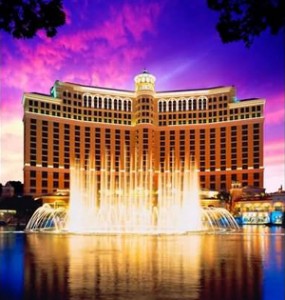 moves.” If you’re an MGM exec, what’s not to like about a corporate tax levy that’s expected to fall from $175 million last year to $30 million this year and the next? Still, Greff noted, “we believe investor expectations are reasonably low – we’d say almost negative, but probably more in the ‘I don’t give a hoot’ camp.” He argues that “what matters more is if MGM can meet or slightly exceed what we describe as pretty low bars. We think so.” He deemed Bellagio and MGM Grand the company’s “crown jewels” and its cash flow “cheap on an absolute basis.” Convention bookings, MGM’s bread and butter, “remain strong” while “we believe expectations are reasonable for the pace of the recovery post the tragic shooting, with Mandalay Bay/the south part of the strip recovering more slowly.”
* Effectively trying to bribe major-league sports into accepting betting on their events, Indiana state Rep. Alan Morrison has introduced a bill that would juice them into 20% of gross revenues. It’s a bizarre proposal and American Gaming Association President 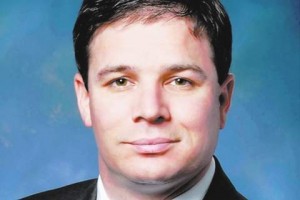 Geoff Freeman wasted no time in taking aim at it. “While we applaud Representative Morrison’s efforts to bring legal, transparent sports betting to Indiana, handing sports leagues 20 percent of what’s left over after winnings are paid out, undercuts its economic viability. Doing so will ensure the illegal market continues to thrive in the state, and gut the tax revenues available to fund essential public services. We believe Indiana taxpayers deserve better,” Freeman said. “We encourage Indiana to reject this short-sighted, misinformed idea, which simply replaces a failed federal prohibition with bad state policy.”

Hopefully finally something becomes of Revel, which beyond its many noted failures (database, marketing strategy, casino floor layout, lobby etc) it is a striking that has some of the nicest rooms and restaurants in AC. Can do a lot of tweeking with $175MM and make it work. Put a good casino manager in place who has a world of knowledge about AC (Mark Juliano has been rumored) and you might have a formula for success.
BTW, not much has been reported about Bruce Deifik; who unlike Straub, at least has some gaming experience having been a former President and COO of Greenspun and owns the Lucky Lucy Casino in NLV (never heard of it).
Anyway, there is a lot to be done there and a lot that can be accomplished. All the best to them. I am looking forward to visiting again.
Ps. they could have gotten a bit more original wit the name! Ocean Club is already taken, but it still beats TEN!
David, Isn’t Bruce Deifik part of Fifth Street Gaming? I am guessing that there will be some kind of cross-marketing between the Downtown Grand and the Ocean Resort.
Can they really open the former revel by summer? It’s been setting empty for over 3 years. By the way , where is de sanctis these days after that flop.