

Let’s start with the new kid on the block …
 Ohio: September saw Ohio‘s two casinos and one racino rake in an aggregate $50 million. The ‘novelty factor’ has waned, along with vacation time, since June’s $58 million haul, but that’s still an impressive number compared to the more-mature Maryland industry. Horseshoe Cleveland is, no surprise, the biggest contributor, grossing $21 million, followed by Hollywood Toledo ($16 million) and Scioto Downs ($13 million). J.P. Morgan analysts must not read the Columbus papers, as they put opening day attendance at Hollywood Casino Columbus at 25,000 souls — double what was reported on the scene. We won’t have a full month of Columbus revenues until November’s numbers come out but the ramp-up of Ohio’s fledgling casino industry — scarcely five months old — is impressive.
Maryland: Not having table games — pending the outcome of a November ballot — question and laboring under a take rate double Ohio’s 33%, Maryland casinos are  doubly handicapped. Table-game revenues might put Maryland on par with Ohio but we’re also seeing the relative ineffectiveness of trying to expand gambling on the doorstep of Pennsylvania, Delaware and West Virginia … long-established markets every one. Basically, there’s Cordish Gaming‘s Maryland Live (above, $32 million — or an impressive $248/slot/day) and then there’s everybody else. Penn National
  Gaming‘s bungled Hollywood Casino Perryville, red-headed stepchild of the Penn family, has fallen 35% from last year, eking out a miserable $6 million, for an incredibly subpar $133/slot/day. To loosely paraphrase Dr. David G. Schwartz, $200/slot/day is the Mendoza Line of slot revenue. For instance, Ocean Downs racino nudged 5% upward, posting a respectable $204/slot/day.
In a characteristically sleazy, shameless and thoroughly hypocritical move, Penn now reportedly wants to worm its way into a 49% stake in Maryland Live. This is the same Penn that spent $13 million to try and block the Arundel Mills development, and has tried to stymie and generally ratfuck Cordish at every turn.  Were I a Cordish exec, I’d tell Penn CEO Peter Carlino (left) to go to Hell, then laugh all the way to the bank. Having trounced Penn time and again, there’s no earthly reason David Cordish should suddenly be “george” and give away half his take to Carlino. The move appears to mostly an excuse for Penn to divest (read: dump ASAP) its Perryville dog. Penn has been a disgraceful corporate citizen in Maryland and richly deserves the comeuppance it is receiving. Meanwhile, the saga of Harrah’s Baltimore continues to be that of two steps forward and one step back.
Missouri: If any casino needs selling it’s Pinnacle Entertainment‘s high-end miscalculation in St. Louis. Revenues at Lumiere Place (left) continued their 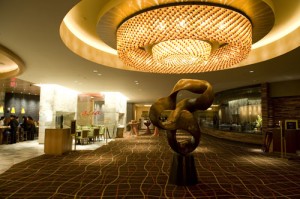 predominantly downward march last month (-9%), while the company’s mid-market River City both outgrossed Lumiere Place by $4 million and posted an 8% year/year gain to boot. Statewide, casino performance might be called listless, down 3%. Good outstate performance by Isle of Capri Casinos got negated by Kansas City results (for an aggregate 2% dip), of which more later. The only other bright spot was Ameristar St. Charles, up 2%. Despite a 3.5% slippage at orphaned Harrah’s Maryland Heights, it was still the state’s second-highest grosser. Owner-to-be Penn National should offer hosannas to Gary Loveman for abandoning such a valuable asset, a transaction that will transform Penn from the lowest-grossing publicly traded company in the state to the second-highest in one fell swoop.
 New casinos in Kansas really put a hurt on the K.C. market, which has suffered 3Q12 of across-the-board declivity. Penn’s Argosy Riverside got slammed with a 19% downturn, and both Ameristar Kansas City (left,-9.5%) and Harrah’s North Kansas City (-10%) absorbed swift kicks in the rear. Isle of Capri Kansas City‘s loose slots couldn’t stave off an 8% revenue slippage either. While the Missouri side of the St. Louis market has merely been flat last month, the Illinois-side properties were off 5% … but Kansas City casino were down 12%. Ouch!
Indiana: While still a revenue titan next to Illinois and Missouri (compare the Hoosier State’s $210 million gross to the Show-Me State’s $142 million), Indiana felt the effects of new Ohio competition, as well as an evident lack of consumer confidence, indicated by a 5% dip in admission and flat spending. (Hey, Wall Street, where’s all that “pent-up demand,” baby?) The northern half of the state was flat, year over year, but Ohio took an 8% bite out of southern Indiana’s butt.
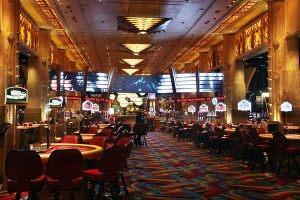 After a 17.5% revenue plunge at Hollywood Casino Lawrenceburg, Penn National sacked over 150 workers, even though — at $30 million — it’s far and away the highest grosser in the region. Slippage at Belterra (-2%), and aboard Casino Aztar (-2%) and Grand Victoria (-3%) was negligible, especially when you consider that H’wood Lawrenceburg outgrosses all three combined. The real story may be the resurgence of Horseshoe Southern Indiana, up 11% and defying the odds with two consecutive months of gains. Racinos got hit hard, with Hoosier Park off 11% and Indiana Live down 18%, although both won a respectable $16 million apiece.
Along the shores of Lake Michigan, despite tribal-casino proliferation across the border, Blue Chip continues to stave off competition handily, up 3%. The two  Majestic Star boats trod water and Ameristar East Chicago (+3%) made modest gains against titanic Horseshoe Hammond (-1%), although the latter still won exactly twice as much ($39 million) as Ameristar. Blue Chip owner Boyd Gaming outperformed J.P. Morgan’s projections, while stock analysts were divided on Ameristar.
Punk’d in Palmer. Desperate civic and business leaders in Palmer, Mass., have 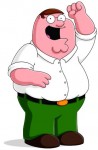 fallen hook, line and sinker for Mohegan Sun‘s con job. CEO Mitchell Etess came up and did a tap dance for the Quaboag Hills Chamber of Commerce (whose members do not include Peter Griffin), which proved even more of a pushover for bad footwork than the Dancing with the Stars judging panel. No, Etess hasn’t put up any earnest money and is evasive about when he’ll do so. Yes, his Connecticut casino is in dire straits at the moment and, yes, he still has to turn around Resorts Atlantic City. But he Etess can sneak this Trojan Horse past Massachusetts casino regulators, more power to him.

The St Louis casino market should be interesting in the next several months. I’m curious to see if Ameristar widens its advantage over the Penn National acquisition when the latter doesn’t have the Total Rewards nationwide pull behind it. The other thing to watch is how Isle of Capri’s new casino in Cape Girardeau affects River City in south St. Louis and their own casino in Caruthersville. The Cape Girardeau casino is closer to Caruthersville, which is just a blip on the revenue screen, but there’s a chance they could steal a few customers that have been making the drive up I-55 to River City.
As for Lumiere Place, it shouldn’t be a shock to anyone in St. Louis that River City is drinking their milkshake. Other than major league sporting events, there isn’t a lot pulling the suburbanites to downtown St Louis and there’s plenty of reasons keeping them away.
Love your work, David.
Thank YOU for the reference to my favorite movie line. Although, now that you mention it, I suppose we could say Pinnacle was drinking its own milkshake by building Lumiere Place AND River City (and then trying to build a *third* casino in the St. Louis area).