

 State Rep. Lou “Death Wish” Lang (D, right) continues to dare, then double-dare Gov. Pat Quinn (D) to veto what’s now a 2.6X expansion of the number of gambling positions in the state of Illinois. Lang has offered a few relatively meaningless concessions (such as: no slot routes at airports) but his demands still far exceed his compromises: five racinos and four outstate casinos, plus one in downtown Chicago. In keeping with his “screw you” attitude toward existing operators, Lang would curb the number of slots they are allowed to add by 20%. Somebody needs to smack Lang upside the head with the latest set of monthly revenue reports from the Land of Lincoln’s already embattled casino industry. First the good news: Gross receipts have risen for five months straight, with only a hint of imminent decline.
Now the bad news: Those gains have been driven almost entirely by Rivers Casino, which opened last July in Des Plaines. In October, the only other casino posting a gain was Jumer’s Casino Rock Island, while Casino Queen, moored in East St. Louis was flat.
 To put it bluntly, Neil Bluhm‘s Chicagoland casino ($31 million last month, right) is kicking the crap out of its immediate rivals. Harrah’s Joliet ($18 million) and MGM Resorts International‘s Grand Victoria Elgin (ditto) are feeling the worst of it but Penn National Gaming‘s Hollywood Aurora ($13 million) and Empress Joliet ($10 million) are hardly getting off unscathed. Penn can take consolation in the smaller percentage rate of its declines compared to the big boys. Over the past two months Empress Joliet is -1% and Hollywood Aurora is -10.5% (but still above Deutsche Bank analysts’ expectations). Rounding out a full year of declining revs, the worst such streak in the state, Harrah’s Joliet is -12.5% in September and October, while Grand Victoria is being decimated, -27% over the same 60-day period.
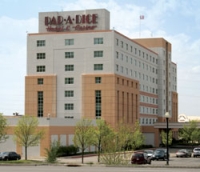 Take Rivers Casino out of last month’s picture and the Chicago market was down 17%, St. Louis was -5% and the statewide average was -13%. Compare that to a year ago, when Chicago revenues were flat — as were statewide ones overall. Only two casinos showed double-digit declines in October 2010, compared to five this year (Penn’s Alton Belle -12%, Harrah’s Metropolis -19%, Harrah’s Joliet -11%, Hollywood Aurora -11% and Grand Victoria -29%). That’s scarcely a propitious climate for casino expansion. Rivers Casino has already grossed far more than did either Alton Belle or Jumer’s Rock Island in all of 2010 and it’s within a couple of million of the entire 2010 grosses of Boyd Gaming‘s Par-A-Dice (above) and Harrah’s Metropolis.
Facts may be stubborn things, pace John Adams, but Lang is even stubborner. It’s an unfortunate reality that operators can’t hoist anchor and move their riverboats to Iowa, Missouri or Indiana. Instead they have to watch the sausage-making process in Springfield with what can only be great trepidation. If “Death Wish” Lou had set out to destroy Illinois’ casino industry on purpose, he could have hardly chosen a better time to administer the killing blow.
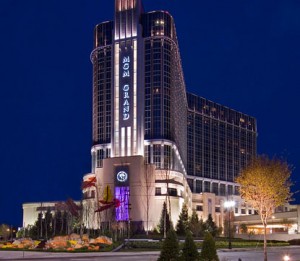 Workers win one. It was bad timing for MGM in Detroit. One can’t very well ask the workforce for major concessions when you’re reporting an improved third quarter plus continuing upward trends on the Las Vegas Strip. True, the company finished 3Q11 some $124 million in the red but two-thirds of that came from a writedown of Circus Circus Reno (highly symbolic, you might say). Without skyrocketing MGM Grand Paradise in Macao, gross revenues were up still 3% and even CityCenter is showing much improved numbers. In view of MGM’s $1.2 billion borrowing capacity, it got into the driver’s seat of Dan Lee‘s Mojito Pointe for pocket change: $30 million, or what could Louisiana‘s best bargain play since Thomas Jefferson bought the place.
 Down there amidst all the other good news was $139 million in net revenue and $38 million in cash flow at MGM Grand Detroit, better than the company’s two Mississippi properties combined and superior to most of its manifold Strip properties, too. MGM Motown also reported some of the highest cash-flow margins in the company. All of this conspired to undercut the poor-mouthing that both MGM itself and a coalition of labor unions had been laying on Detroit employees. MGM Detroit — knowing how good its performance was — smartly sweetened the pot just in the nick of time. The day after MGM reported its 3Q11 numbers, casino workers at MGM Grand Detroit voted three-to-one in favor of an improved contract offer. Signing bonuses were boosted to offset higher premiums and co-pays, and a proposed annual deductible was thrown out altogether.
Unlike their nominal representatives, MGM employees knew they were in a stronger bargaining position than their MotorCity and Greektown colleagues, and accordingly hung tough. Congratulations to all sides on reaching a speedy resolution which allows both sides to claim the PR victory of having the best-paid casino employees in Motown.

Gaming is in absolute shambles in Illinois. There is no one other to blame than the politicians. How are the existing operators expected to re-invest in their product with the absorbent and unstable tax rate and continuous political contentment for the industry? Leave it to Il to mess up a good thing. Well done.
On a separate note, good to hear that MGM seems to be making a comeback.
American Gaming Guru:
Very good response. I live in Chicago and pretty much agree with everything you have to say. Former Governors Ryan and Blagojevich are both where they belong: in jail.
Not caring either way, but it seems that the Indiana and Missouri casinos both allow smoking, which might to be a key attraction for those properties which are close to the borders of Illinois, but located without that State. Patrons are looking for a relaxing place to let loose, and in the mind of most smokers, I would imagine they are going to gravitate to those properties until there are no such outlets left.
Several properties in Indiana now have substantial non-smoking sections, but still accommodate all-comers in an attempt to maintain market share.
Looks like something that Illinois might want to look into.