
We never thought of Sheldon Adelson as a big online guy but the Las Vegas Sands CEO felt it imperative to let the Hong Kong Stock Exchange know that Parisian Macao had 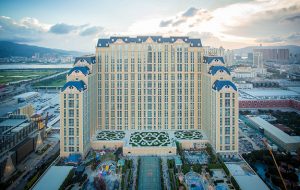 racked up over five billion social-media impressions to date. That’s not all. Some 92 million tourists and locals patronized Sands China properties in 2017 — a 25% increase. And, just in case the Macao government reads things like SEC filings, he made a point of saying, “Sands China has now invested approximately US$13 billion to deliver on our promise to help Macau in its economic diversification and its continued evolution into the world’s leading business and leisure tourism destination.” Aside from the anomaly of Adelson using ‘Macau’ instead of his preferred spelling (‘Macao’), the notable thing is that he’s singing a serenade to the government that’s bound to appeal.
This should just get better for Adelson, as aforesaid guvmint is projecting a 1%-3% increase in visitor traffic for Chinese New Year. “Our forecast is that it [the average hotel occupancy] will be above 85 percent and, in the busiest days … it can go above 90 percent,” said Macao Government Tourism Office director Maria Helena de Senna Fernandes, numbers that are music to ears of Adelson, deep in hotel rooms.
* With the hourglass running on provisionally legalized DFS in Massachusetts, Bay State lawmakers are debating what form permanent DFS should take. Casinos will be  envious of — if not irate at — the 15% tax rate proposed by state Sen. Eileen Donoghue (D), since they’ll be paying 25%. (Over at Plainridge Park, operator Penn National Gaming pays 49%.) There would also be a licensing fee, perhaps as high as $100,000, although that tilts the playing field in favor big boys like FanDuel and Boston‘s own DraftKings. The latter didn’t rush to endorse Donoghue’s bill, trotting out spokesman James Chisholm to say, “We continue to review the bill’s full implications, and look forward to discussions with her, the legislature and the governor as we adopt common sense legislation that protects consumers and allows us to continue to innovate and create jobs in Massachusetts.” Blah blah blah. Casinos and the lottery are likely to be less enthusiastic if this bill advances. Meanwhile, Attorney General Maura Healey continues to preach a “cautious approach” to Internet gambling in Massachusetts.
* Defying a federal court ruling, the Alabama-Coushatta Tribe of Texas is continuing to offer Class II gambling (electronic bingo) around the clock at its casino. While the issue hangs fire, Rep. Brian Babin and cosponsors from Alaska, Arizona and California are trying to rush a fix-it bill through Congress. His bill would declare the Alabama-Coushatta to be in compliance with the Indian Gaming Regulatory Act, which entitles Native American tribes to Class II gambling if the state in which they reside won’t compact with them for Class III. A federal court ruled that even Class II gambling contravened Lone Star State law. The case now goes to the Fifth Circuit Court of Appeals.
