

According to gaming-law expert I. Nelson Rose, the Supreme Court‘s ruling on sports betting goes far, far beyond gambling: “For the first time in American history, the U.S. Supreme Court expressly held that the  federal government cannot order states, or state officials, to do anything.” Yes, that means that Attorney General Jefferson Beauregard Sessions cannot make the states crack down on legal marijuana just because it happens to be outlawed at the federal level. As Justice Samuel Alito wrote, “conspicuously absent from the list of powers given to Congress is the power to issue direct orders to the governments of the States.” Adds Rose, “Attorney General Sessions cannot order state officials to do anything about marijuana, and Pres. Trump cannot order state law enforcement to help round up illegal aliens.”
Rose describes the case as the clash of two ridiculous laws, the Bradley Act and New Jersey‘s decriminalization of sports betting. “Accepting wagers on sports events is now legal and unregulated, even if the sports book was run by the Mob.” The Supremes KO’d the Bradley Act and opened the way for states to regulate sports wagering. Rose then enumerates various winners and losers, the latter including DFS, which “is already taking a big hit. In  Europe, it never really got off the ground, because there was real sports betting.” (Will be look back on the DFS era as a curious historic aberration?) As for ‘integrity fees,’ Rose says, “Teams have the rights to their games; but, they do not have any rights to the statistics generated by their games. You cannot copyright facts. So, the leagues have no real bargaining power, because they have nothing to sell.” He adds, “The NFL would love to see national regulations, and a big share of the wagers to go to the leagues. This is not going to happen, mainly because all but three states are already regulating legal gambling.”
Rose sees the ruling as the point of a spear to penetrate the wall of online gambling. As for legalization of sports wagering, he doesn’t think much will be accomplished before November’s elections but, after that, all bets are off, so to speak.
* MGM Growth Partners CEO James Stewart and CFO Andy Chien met with JP Morgan, and were a veritable pair of Chatty Cathies. For one thing, MGP as has been looking at Resorts World Las Vegas and 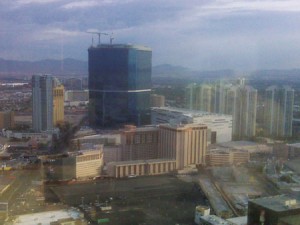 Fontainebleau/The Drew as potential acquisitions as “MGP believes that for a Strip property to be viable, it needs scale (4,000+ rooms), and while The Drew and Genting’s Resorts World would certainly be large enough, there has yet to be much progress on either project.” That’s a burn. Further CityCenter asset sales are possible but Dubai World has to be on board with the idea. As for Hard Rock Rocksino, MGP says it has fielded quite a number of offers but is waiting to get licensed in Ohio before it picks a new tenant.
When it comes to corporate image, Stewart and Chien accorded themselves a pardonable pat on the back: “MGP notes that the [merger-and-acquisition] environment remains rational, with MGP seen as the trophy/premier asset buyer, GLPI emerging as the more value-focused REIT willing to do deals of all sizes, and VICI [Properties], while still new on the block, being more focused on gaming than initially anticipated.” As for bidding on The Drew, I have only this advice: Don’t do it, men! You’ve got your whole lives ahead of you!
* How long can Virginia hold out before it legalizes casino gambling? Maryland gaming revenues were up 15% last month and than can’t all be coming from within the Free State. Casinos grossed $156.5 million, led 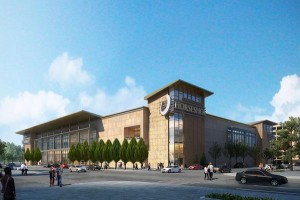 by MGM National Harbor, up 23% to $62 million. That meant National Harbor was hitting a record $2 million/day, giving you an idea of what gambling gluttons Washingtonians are. The rising tide lifted all boats. Maryland Live grossed $52 million, an increase of 13.5% from last year. Horseshoe Baltimore was far behind at $24 million but that still represented a 2% uptick. As for the small fry, table games continue to propel Oceans Downs, leaping 21% to $6.5 million. Hollywood Perryville rose 7% to $7 million and Rocky Gap Resort climbed 4% to $5 million.
Over in West Virginia, Hollywood Casino at Charles Town Races saw minor slippage in slots (-2%) but a big dive in table win (-16%). Statewide, casinos were slots were off 4% and tables 12%. While this slow drip of revenue can’t be of great comfort to West Virginia, MGM National Harbor has not turned to be the category killer that some feared it would be.

[…] Stiffs and Georges blog notes that MGM Growth Properties (MGM’s REIT) is snooping around a couple of stalled […]