

“I think that we were trying to copy what was happening in Vegas. Everything out there had a theme, and I think that is what we were trying to do.” So says former Trump Taj Mahal executive Steve Norton 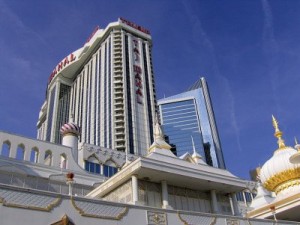 about the ultra-gaudy casino that become his erstwhile boss’ signature property. The beginning of the end of the Donald Trump era came this week, as Hard Rock International began removing the marquee and some external decorations, just the first step in converting the Taj into a sleek, modernistic, Hard Rock-branded resort. Interestingly, Trump was more forward-thinking than some of the his, favoring an open casino-floor plan of the type that has become standard, while Norton leaned toward the traditional maze layout (and if you’ve ever been to Excalibur you know that gets old quickly). If the financing of the Taj ultimately was its undoing, it could have been worse: Trump wanted to outfit the entire property in “the finest quality” marble, an urge that — had he not been talked out of it — could have been even more disastrous for the bottom line.
Buried in The Press of Atlantic City‘s coverage is the disclosure that Carl Icahn parted with the resort for $50 million. That’s chicken feed — and a huge embarrassment for Icahn. One can see why he didn’t want the 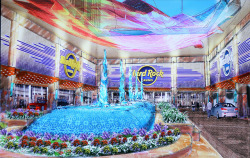 number publicized. Meanwhile, the Taj continues to sell its now-unwanted inventory, giving thousands of Garden State citizens a chance to walk off with a piece of (rather tacky) history. Gaming consultant Robert Ambrose pronounced this epitaph of the Taj: “The legacy of the Taj is a monument built on the ideology of the day, reflecting the excess of the ‘80s and ‘90s. In some respects, it is a model to a lack of vision among some of the corporate power brokers and government entities that influenced decisions during that period.” With Trump having traded the Taj for the White House, could a new era of excess be in store?
* Slot revenue in Pennsylvania may be showing some fatigue, calling into question the Legislature’s desire to expand video gaming, but tables are doing just fine. In the Philadelphia area, SugarHouse Casino was up 12%, while slot revenue rose nearly $2 million. Slots retreated nearly $2 million at Park Casino but table revenue was up 9%. There wasn’t any good news to report at Harrah’s Philadelphia, where slots tanked, down $15 million, while tables slipped 2%. That casino just can’t catch a break.
* Roulette is enjoying a boom year in Nevada, giving craps a run for its money, so to speak. Not only is it a well-known, interactive game, its simplicity of play is giving it a leg up with patrons. This spin of fate has not noticed the escape of table-game developers, who are working on new side bets for those who crave a higher level of complexity when betting than “Baby needs new shoes.”
* The Trump administration stuck up for a land-into-trust transfer for California‘s Wilton Rancheria, one that was being challenged for a minor deviation from administrative protocol. The decree was “final for the [Interior] Department,” said Acting Assistant Secretary for Indian Affairs Michael Black. Casino opponents are now promising a court challenge but Wilton leadership is sanguine. While Chairman Raymond Hitchcock hopes to break ground on a casino by 2020, first he must negotiate a compact with Gov. Jerry Brown (D). That timeline pleases Stand Up for California Chairwoman Cheryl Schmit, who sniffed, “This dismissal doesn’t change anything. The casino is still a long ways off.”

I still think the Taj had “tremendous” brand equity on the East Coast. Its debt burden was its un-doing. If it had kept up on Cap Ex spend, it could have continued to flourish. While it has a lot of catching up to do (I was in it for the liquidation sale this past weekend) it can reign supreme again as the HR. I am still amazed at its fall from grace. The Taj’s fall is what saved the rest of Donald’s empire (a big unfortunate for Atlantic City).