
If you want to know what it’s hard to get financing to develop on the Las Vegas Strip you could either A) ask Steven Witkoff or B) look at the latest, very blah numbers from September — $546 million. That 4% decline actually inspired Credit Suisse analyst  Cameron McKnight to call them “better than expected.” Meanwhile, Nevada as a whole was up 1% and locals revenues rocketed 16% into the stratosphere. The prior-year comparison on the Strip was hardly a difficult one: +4.5%. So what went wrong? Baccarat win fell through the floor, down 27.5%, with play 15.5% lower than 2017. That negated a 5% gain in slot win and accompanied a 4.5% drop-off in non-baccarat table games, despite almost 5% higher wagering. “In a 3Q that should be forgotten, LV Strip [gross gaming revenue] declined 7.2% Y/Y, while statewide GGR declined 2.2%,” wrote JP Morgan‘s Joseph Greff. Take baccarat out of the equation and, thanks to slots ($285 million), Strip gambling revenues were actually 1% up. Nothing about which to get excited but a silver lining in a rather dark cloud. (Airline passengers coming into Las Vegas were down 1%, by the way.)
Elsewhere, Downtown grossed $55 million, up 11.5%, while North Las Vegas shot up 22.5% to $24 million and the Boulder Strip had a bonny month, gaining 27.5% to $67.5 million. Uncategorized Clark County grossed $103 million (+8%) and Laughlin managed a 2.5% gain to $28 million. Reno was off 1.5%, to $58 million, while ever-volatile Lake Tahoe plummeted 16% to below $18 million. Elko (+13%) was feeling the love with $28 million while Carson Valley rode a 10.5% gain to a $10 million gross.
As for McKnight’s optimism, it was more predicated on volume of wagering than on how much the house took home. “Bottom line, revenues were better with normalized 
mass market revenues up 4.6% — versus our expectation of down low single digits – and against tough comps from last year,” he wrote, although we don’t think the comparisons were particularly tough. Unlike Greff, McKnight feels “Q3 fears are overdone.” He cites higher slot handle and “mass table volumes up +4.8% suggests the ‘everyday’ customer is doing well.” He uses the slot figure to underline the “resilient” bread-and-butter customer, saying, “In our view, normalized mass market revenues are the best indicator of market growth and health as they include slot machines, which represent 50% of Las Vegas, and excludes the volatile baccarat business, in which only a handful of casinos participate.”
* Yesterday we discussed Sheldon Adelson‘s heavyweight participation in the 2018 election. An undercard sees him duking it out with Warren Buffet (no lightweight  himself) over how and where casinos buy their electricity. The duo have spent a collective $100 million on the battle over whether Nevada customers can opt out of Buffett’s NV Energy or not. (We have no love for NV Energy, let it be known.) The ballot question was a big hit two years ago, with 72% support, but its fortunes are flagging at this point, with 16.5% of voters undecided — an electoral tranche Adelson and Buffett are both courting. In the Silver State, constitutional amendments must survive two consecutive election cycles, hence the Adelson/Buffett rematch this fall.
“It’s a very complicated issue, one that probably shouldn’t be handled at the ballot box, given how much uncertainty there is around it,” says UNLV poli-sci professor David Damore, articulating the rationale that renewable-energy companies have for sitting 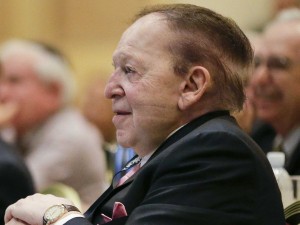 this grudge match out. To put the spending context, an energy bill to increase the use of renewables in Arizona has seen only $40 million in ad buys and the Jacky Rosen/Dean Heller senate race remains comfortably below $100 million in ad buys (though you’d never know it from my e-mail inbox). If you think Adelson is the bigger spender, think again. Buffett’s “coalition” to beat Question 3 is outspending Sheldon two-to-one. If Adelson wins, however, Nevada power customers lose as Buffett would be left with “stranded assets” in the form of useless energy plants, for which consumers would be socked with costs. As for Adelson, he lives in a mansion that used enough water in one year to supply 55 normal households, so he’s not exactly Mr. Sustainable.
