
In a development that is sure to be followed with interest by sports book operators, predictive system Swarm AI outdid human oddsmakers in a trial run. During a 20-week slice of the NHL season, Swarm AI correctly predicted the outcome of 61% of games, compared to 55% by Las Vegas bookmakers. A product of San Francisco‘s Unanimous AI, Swarm AI “employs a unique combination of real-time human input and AI algorithms that are modeled after swarms in nature.” Traditional bookmakers have good reason to welcome Swarm AI, as it can deliver a 22% return on investment. That’s welcome in this new era of high sports-betting taxes and “integrity fees” (read: skimming). If Swarm AI is ready for domestic deployment we predict bookmakers will embrace the new technology.
Sports Illustrated visited “smoky, dimly lit gambling meccas, with marble countertops and colorful carpeting, where betting sheets share tabletops with fancy cocktails and fried food platters” in Mississippi to see how casinos and SEC sports betting mixed. “They’re going to bet [SEC] like there’s no tomorrow,” said analyst Danny Sheridan of punters. Indeed, Mississippi’s status as a haven for sports bettors in the Deep South appears to be giving business a shot in the arm. “They’re pouring in from Louisiana, Florida, Georgia and Alabama,” reports restaurant owner Bobby Mahoney. Already Dixie bettors have learned the habit of “balking”: placing their bets at the very last second.
For the moment, book managers plucked from Las Vegas and rushed to the Mississippi front lines, are operating from makeshift betting parlors. The Golden Nugget sacrificed a video-poker area en route to create a Buffalo Wild Wings-type ambience. Permanent sports books are coming (Beau Rivage has budgeted $7 million) but, in the meantime, there is no shortage of action.
* Casino operators are doubtless applauding the action of the Chinese government on easing visa requirements on 8 million citizens if they want to visit Macao or Hong Kong. Analyst Cameron McKnight of Credit Suisse writes that the “change 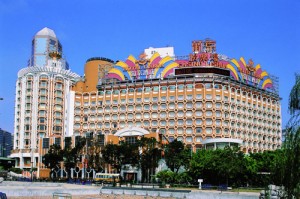 speeds the visa process for migrant workers, and permits them to join tour groups in Macau … Migrant workers and tour groups are generally lower value. This policy change was made for wealthier tourists in 2016, so we expect limited direct upside.” As for the latest anti-corruption push, “We think government tension is caused by slower growth and US trade conflict, so economic stimulus is a higher priority than the anti-corruption drive.” Ergo, U.S. casino operators might want to ask their pal Donald Trump to go easier on China tariffs.
* Las Vegas historian Dennis McBride has penned a book on gay life in Nevada, Out of the Neon Closet. One of its chapters details the attempt in the 1980s to set up a gay-friendly village in the Nevada desert, the pipe dream of an interracial couple, Fred Schoonmaker and Alfred Parkinson. The former, a Reno casino employee and the latter brainstormed Stonewall Park, which was intended to be exclusive enclave for gay people. Nationwide fundraising was begun and, even in historically homophobic Nevada, progress on the Stonewall Park project showed momentum.
Of course there were die-hard opponents like Janine Hansen: “I can’t believe that under these circumstances with regard to AIDS that someone is trying to bring this into our community. … I’m not just concerned about AIDS, but bringing the homosexual ‘death style’ to Reno would be a blight on our community.” Hansen need not have worried, as Schoonmaker and Parkinson settled upon the ghost town of Silver Springs. However, Lyon County residents proved no more hospitable than those in Reno and, as Atlas Obscura concludes, “The Silver Springs dream was over and Schoonmaker and Parkinson were all but chased out of town.”
The two men tried again, in Nevada’s most famous ghost town, Rhyolite. “As an incorporated city, Rhyolite could be operated autonomously of state or county law; in theory, Rhyolite could write its own laws and ordinances decriminalizing homosexuality,” McBride writes. Improbably enough, gay people migrated to Rye County, even though the homophobia was comparable to Lyon County’s. County Commission Bob Revert put it this way: “We accept atomic waste. We don’t accept the gay community.” In the end, Stonewall Park evaporated not only from a lack of funds but an unwillingness by gays to exile themselves to the middle of nowhere. However, Schoonmaker saw the glass as half-full, saying, ″After awhile people will realize that gays and lesbians paint their house, plant flowers and take out the garbage like everyone else.″ Could he have realized that one day Las Vegas would use gay-friendly marketing to tap into new customers bases? Maybe not but he’d be happy if he did.
