
Jan Jones Blackhurst has really been racking up the frequent-flier miles on behalf of Caesars Entertainment, having made multiple  trips to Brazil to assess the potential for casinos down there. She’s narrowed down the possible sites to Brasilia, Sao Paulo, Salvador da Bahia and (of course) Rio de Janeiro, although her top pick might surprise you. “Personally, I like Brasilia,” the original CityCenter, “because it’s the capital and many affluent people live there. It’s very safe.” Over at Las Vegas Sands, President Rob Goldstein seconded Jones’ enthusiasm, noting that Brazil (like Japan) has a large population base. “He decided to have a look for himself and he was impressed with what he saw,” said Goldstein of CEO Sheldon Adelson‘s May reconnaissance of the country.
Of course, there’s the little matter of casinos being presently illegal in Brazil. Barring any enabling legislation (two bills are floating around  the Brazilian parliament), never mind regulation, Goldstein said it was “early innings” for U.S. operators looking southward for expansion, although he did note that Sao Paolo’s enormous population made it a prime location. Jones added that entry into Brazil would be contingent on a tax rate that allowed for a good ROI, not to mention regulations that were of a probity level with which American companies would be comfortable.
MGM Resorts International was more circumspect about the extent of its Brazilian ambitions, merely saying it was “interested” and “monitoring” current events. “In the case of Brazil, it’s unclear because you don’t know what’s going to happen there. It’s in flux with all these accusations and national headlines,” explained Sands’ Goldstein, alluding to the Operation Car Wash scandal, involving money laundering, bribery and kickbacks at state-owned oil company Petrobras. As we’ve seen in the Philippines, American companies fight shy of jurisdictions that are synonymous with corruption.
* Remember those mansions along the eastern side of the Desert Inn Golf Course that Steve Wynn clawed away from their owners (even shutting off their water) back when Wynn Las Vegas was a-borning? El Steve is finally planning to monetize the acreage, opening up Wynncore to Paradise Road and he says he’s got joint-venture partners on the line. As with anything Wynn-related, this will bear close watching, although the CEO is being coy about his plans at the moment.
Over in Macao, Wynn’s casinos produced a 7% revenue increase but room revenues took a bath (down 12%) in 2Q17. That mirrors weakness 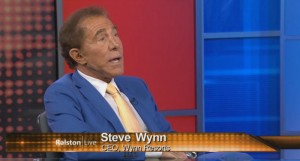 in mass-market play, which Wynn blames partly on construction disruption over at MGM Grand Cotai. “We’re literally surrounded on four sides by things that are under construction that will all add to our mass,” he explained. Mind you, Wynn’s crying all the way to the bank, since Macao generated 180% more revenue than Wynncore. “It’s very important that you don’t get caught up in the very short-term myopia that your professions demand in many respects,” Wynn lectured analysts. “When we look at the numbers that you’re looking at … we say the train is on schedule.”
As for the oncoming smoking ban, Wynn Macau President Ian Coughlan said that, in terms of infrastructure, his casinos weren’t able to enjoy a level playing field. “We will be the biggest beneficiary of that because we’re operating handicapped right now,” he said of the citywide ban that will be enacted in 2019.
* Massachusetts is putting the cart before the horse if legalizes i-poker and Internet casinos before its brick-and-mortar casinos are up and running. That’s the conclusion of the Special Commission on Online Gaming, Fantasy Sports Gaming & Daily Fantasy Sports (whew!). The Special Commission made an exception for DFS, saying it favored “legalizing DFS as a subset of online gaming and  enacting legislation that would put into law the proposed regulatory, governance and taxation system.” Despite that go-ahead, DraftKings spokesman James Chisholm threw a hissy fit over the definition of DFS as gaming, wailing that it “could impact our ability” to do business in Massachusetts. In other words, DraftKings is threatening to take its ball and go to a new home. DFS may require “special skills,” but so too do casino games ranging from baccarat to certain breeds of slot machine.
Considering that DFS is provisionally legal in Massachusetts, thanks to Attorney General Maura Healey and Gov. Charlie Baker (R), DraftKings doth protest too much. It should probably direct its attention to meeting the July 31, 2018 deadline for formal legalization rather than spewing hot air at the Special Commission.
* Despite some early hiccups with its skill-based slot machines, GameCo is now looking beyond the United States, to slot-mad Australia, where punters are said to play “at near-epidemic levels.” Meanwhile, chief rival Gamblit is making inroads in Las Vegas, with contracts at Caesars Palace, Linq and Paris-Las Vegas, as well as at MGM Grand. Gamblit exec Darion Lowenstein already likes what he sees: “We are averaging players nearly 20 years younger than those of a slot player.”
* How important are tribal casinos to the American economy? A new report on Oklahoma shows that its industry employs 28,000 people, two-thirds of whom are rural and 57% of whom are non-tribal. Keep that in mind the next time someone like Donald Trump gets on the rag about Indian gaming.
