

It may be hard to believe in retrospect, but at the time of Harrah’s Entertainment‘s LBO, some analysts thought it would be partly amortized by selling off the company’s regional properties. That prompted me to write something to the effect that it would be like “saving” a tree by severing its roots. Harrah’s has not only not pulled back from its Mid-America base, it continues to expand thereupon.
 Today comes word that a casino-management deal with Dan Gilbert‘s Rock Ventures has been signed. This would put Harrah’s at the helm of casinos in both Cincinnati and Cleveland, at the price of a “significant” (but unquantified) monetary investment. Or Harrah’s equity stake may be thriftily achieved by throwing its Thisteldown Racetrack into the deal in lieu of cash.
A significant redesign of Gilbert’s original concept for Cincy (above) may also be on the drawing boards, metaphorically speaking. It’s speculated that the Caesars and/or Harrah’s or Horseshoe brand will be emblazoned upon the finished product.
They darn well oughta be: Those are strong brands and I’ve long argued that Harrah’s isn’t deploying them aggressively enough (“Bill’s”? WTF?). The Cincinnati.com story includes a complete inventory of Harrah’s properties and it’s staggeringly impressive. The accompanying photo essay, though, is so fugly that only The Rio comes off looking good.
I’m not sure I buy into Rock Ventures‘ exec Matt Cullen‘s (paraphrased) contention that “Harrah’s has made its downtown New Orleans casino part of the surrounding community.” Back during the Phil Satre regime, Harrah’s agreed to operate in New Orleans without either restaurants or a hotel … concessions that it wrested back from the city and state during the casino’s painful early years. So, instead of becoming part of the surrounding area, Harrah’s N.O. became a self-sufficient islet of commerce.
Such is the nature of the contemporary casino; I just think Cullen’s blowing smoke unless he’s referring to “green” or social-responsibility initiatives, areas in which Harrah’s can be found at or near the forefront. (Fiscal responsibility … well, let’s leave that for another day.)
It’s also an open question as to whether the Ohio casinos will generate a beneficial ripple effect on businesses in the immediate vicinity. That’s not happened in Atlantic City and I saw scant evidence of it in Detroit. That isn’t a knock on casinos (I’ve heard the same spin put on proposed sports stadiums). I just wish Gilbert and his people would argue the merits of their project — the creation of jobs, amenities, amusement, revenue — and not promise things which are beyond their power to deliver. Hopefully, Gilbert’s concept of a pleasure palace in which retail and dining line the streets, and the casino is inside, at the hub, will be retained. (Some of the downtown Vegas and Reno operators, I swear, they’d put slots out on the frigging sidewalk, if only they dared.)
Once bitten, twice shy? Harrah’s is also in the paddock for the umpteenth running of the Sumner County Casino Derby in the great state of Kansas. This is the same market that Harrah’s jilted in 2008, as its finances were going into the toilet. Given Harrah’s well-documented fickleness toward projects, the company would appear to be a long shot in this three-horse race. But compared to its rivals, Harrah’s is offering the most generous inventory of gambling options. This comes at the price of a somewhat vague and spartan amenity package, despite the $260 million budget. Such add-ons “an RV park, water park, golf course, tennis facility, retail, and swimming pools and spa” aren’t covered by the initial investment and would happen somewhere down the road, presuming that business is good.
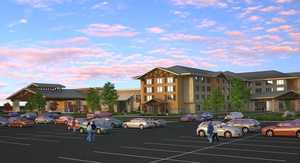 Harrah’s ace up its sleeve, of course, is Total Rewards, a customer magnet that can scarce be rivaled in gaming. It’s no coincidence that Harrah’s is the only “major” that has a heavy presence in the tribal-casino industry right now (although Station Casinos is making inroads) It brings serious brand equity and an immensely powerful marketing engine to the table. Tribally owned Global Gaming and rival applicant Peninsula Gaming aren’t remotely in that league. Peninsula is offering to put the biggest investment ($300 million) and hotel (150 rooms, left) into the pot, and throw in an equestrian center for good measure.
Global counters with the quixotic notion of building a horse racetrack, as part of Phase II. Its principal Phase I amenity would be a concert arena and Global’s planned arsenal of gambling options is far more diverse than Peninsula’s. Global is considerably less experienced in Class III gambling than Peninsula, though, and its presentation (as seen on video) was laughably vague. Also, it’s very eccentric to hear a Native American conglomerate being repped by an executive with a near-impenetrable Australian accent, one who makes “power- and utility-trading” come out as “cow- and utility-trading.” How big a credit line will a Guernsey get me a Global casino?
All my predictions as to who’d get which Kansas casino contract have been wrong, so I won’t make any more. Peninsula looks like the safe, reliable (if somewhat unexciting) choice, Harrah’s the riskier but also potentially more lucrative one. Global (above) wouldn’t seem to have a prayer but, in the topsy-turvy world of Sunflower State politics, that usually makes you the front-runner. Better go out and buy some cows, just in case.

“Better go out and buy some cows, just in case.”
– Wouldn’t that be sheep, instead?
Take 2 🙂
I think Harrahs is a good partnership for Gilbert’s group, they definitely needed someone with a track record of running a casino. They also gave Gilbert’s group Thistledown as part of the deal, pending the racinos being passed. Thistledown is basically a wash though, as it’s so close to Cleveland 10-15 minutes top, and in such a bad area, I can’t imagine anyone choosing it over the casino. Unless they do some development around it.
Speaking of development around it, I can’t speak much for Cincy, but for Cleveland, I think we are cautiously optimistic that it can spur some development. We had very good success with the Indians ballpark, creating a new corridor of restaurants and bars and moving the center of town from the lakefront to the shoreway during the summer.
I think the big key for Cleveland’s casino is where it’s located. Originally there was a lot of talk about reigniting the Flats (our former bar district, think Bourbon street or Beale street) that died out. Part of the problem with the Flats though was that it was horribly inaccessible. From reports I’m seeing they aren’t looking there anymore and that’s a positive. The casino here in Cleveland really needs to be a hub, there are plenty of spots they could build it that that would make it a 3-5 minute cab ride (tops) to places like the Rock and Roll Hall of Fame, Playhouse Square, HOB Cleveland, Progressive Field, Quicken Arena, the Warehouse District, and Cleveland Browns Stadium. Having those options along with a casino in downtown Cleveland could work very well if it’s accessible. If it doesn’t wind up being accessible its going to wind up being a self serving entity, which will cannibalize the existing nightlife in the city, in my opinion. I think Gilbert gets that and having a vested interest in the arena due to owning the Cavs, I think it’s a a better then average chance that the casino gets built in a good spot.
To the point of other business development, I wanted to mention something from my trips to Detroit many years ago. I had visited the temp casinos by Motor City and MGM, the areas around them were crap. The new Greektown had opened though and after parking there was a restaurant/bar/gift shop row across the street from the property. I was amazed to see that there seemed to be deals in place with Greektown where you could use comps at a number of them too. It was quite a happening little spot. I don’t know whether Greektowns management troubles, Detroits troubles, or the fact that people just decided to not leave the casino after being in there, but a return visit between 3 and 5 years later displayed that nearly all the restaurants were shuttered or on life support. This was before MGM or Motor City had opened their new spots, so I don’t think that was a factor. I point it out because I think there was a very strong attempt to make the outside development work, but something broke down in the process and I suspect that it was more about customers just deciding to stay in the casino rather then venture outside, which is a shame if it’s true.
I have not been to the new Motor City casino, but the new MGM casino has no interest in my opinion of outside development, it’s a completely self serving property and the area its in doesn’t exactly make people want to walk the streets at night anyway. If the new Motor City casino is anywhere near where the old one is, I’d suspect the same issue with it.
Anyway, the only other thing I wanted to point out about Detroit, is that in my opinion it’s going to take a huge hit from the Ohio casinos. Up until the last year (maybe two) it was the closest place to play table games for Greater Cleveland (which while Cleveland is becoming a smaller city, the Greater Cleveland area is around 15th for population by area for the nation. West Virginia did introduce some games, but getting there tends to be fairly hard compared to Detroit. The surrounding states overall are going to be hit fairly hard when the casinos get up and running in Ohio, but I’m guessing Harrahs already has a pretty good idea on that, with so many in Indiana, PA, and management contract on Windsor. In my opinion Toledo while a concession to the Northern part of the state to split casinos 2/2, is purely a roadblock for Michigan casinos and to maybe attract some border gamblers from Michigan or Indiana. Nice alternative to having to drive into Detroit with the suburban style layout of Toledo.
Anyway, I know this rambles some, but wanted to give you some thoughts from the ground here in Cleveland, rare I get to provide some unique perspective :). Next month, I’m moving to Columbus, so it will be interesting to see what they are doing down there.