


A horrible idea for the taxpayer, the economy and for gaming in particular has been resurrected in Congress. Yes, it’s the “national sales tax,” which would lay a double-digit impost on all goods and services, and which only could be rebated to us if we fill out onerous, monthly paperwork—much more burdensome than dealing with the IRS once a year. As formerly championed by disgraced ex-lawmaker Steve King, the root of the bill is the “strong father” model of government, in which the sales tax would be intended to A) make people resent government itself and B) curb consumer spending. An especially odious carve-out in the 2004 iteration of the bill—and this bears close watching—is that all businesses would qualify for tax refunds … except casinos and gambling-related businesses, which would get nothing. It’s a dagger aimed straight at the heart of the Big, Bad Casinos.
We covered this wretched proposal at length back in 2004 and looked up what some gaming savants had to say about it. Nothing good, that’s for sure. “We’ve always believed you can’t tax gaming at the customer level. You can’t change odds,” said Lesley Pittman, then-director of corporate and government relations at Station Casinos. “You can’t start charging people $10.25 for a $10 roll of quarters.” Added the late Bill Eadington, “you’re going to basically stifle demand and actually create opportunity for illegal markets. There’s a lot of historic precedent for that.” Were tribal casinos to be exempted from the tax—they are sovereign nations, after all, “we’re worse than Barstow. We’re Bakersfield without the oil. We’re nothing—a federal bombing range.” So lamented then-UNLV professor William Thompson, seen below.

The kindest words for the tax were from University of Macau law professor I. Nelson Rose, who remarked that “it works well with a lottery. They [the bill’s drafters] just don’t know how casinos work.” Said Eadington, “It certainly is going to have a major effect on the psyche of the consumer. It would discourage or make it much more difficult to have substantial non-gaming-based capital investment. You’re going end to end up with fairly Spartan gaming that doesn’t have a lot of attractiveness.” Or, as then-UNLV economist Keith Schwer analyzed it, “We could see a situation in which—if domestic prices went way up—people would travel elsewhere. The sticker shock will be in the short run. After a while, you get adjusted to what the prices are and what your income is, and you act accordingly. But there’s no way to get around the impact of a 25 percent to 30 percent increase in price to pick up the tax.” (Individual states would be expected to administer the impost, in return for a microscopic slice of the proceeds.) And the more exemptions you make, the higher the tax has to go, spiraling upwards in a never-ending revenue chase.
Then there’s the sheer regressiveness of the tax, even at its current, 23% proposal (actually 30%, due to some voodoo math—see below). Never mind the crushing impact on poor people. Where are bread-and-butter consumers expected to find the discretionary income to patronize, say, Horseshoe Baltimore? And what happens in Las Vegas when a $175/night hotel room (plus resort fees) suddenly cost 23% with no added values. Sin City, because of its unique nature, might survive better than regional casinos, but Joe Sixpack is going to be inevitably more selective in how often he comes to Vegas and where he spends his money. Oh, and you’d be taxed 23 cents on every 77 you spend, not every dollar, Satan truly being in the details herein. For that matter, the entire gaming industry (all the way down to the vendors of cards, dice and slot stools) is going to be hurting—costs that will be passed down to us. Whoever wins in this scenario it’s neither Big Gaming nor the customer. It’s pure fiscal insanity, being pushed by crazed ideologues who cannot conceal their contempt for the average citizen.
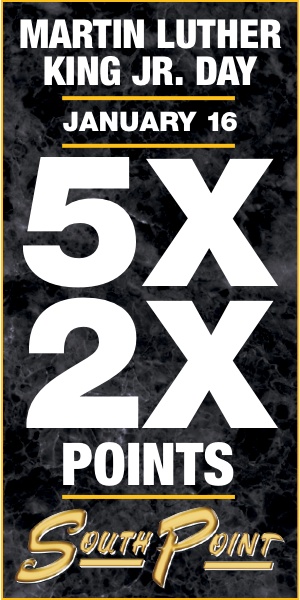
We missed the part of the March on Washington where Dr. Martin Luther King Jr. said, “I have a dream of five-times odds at South Point.” But maybe we just weren’t paying attention. Seriously … some casino promos can be crass and this is one of them.
In the wake of the Golden Globes, the Screen Actors Guild nominations and last night’s Critics Choice Awards (a near-sweep for Everything Everywhere All At Once), we thought we’d update you on the Oscar derby. Bovada has taken its odds down but DraftKings updates its constantly, so we have to lean on that. As of this morning, Best Picture is a tossup between Everything … (-120) and The Banshees of Inisherin (+200), with The Fabelmans fading again to +400 after a brief, Globes-propelled bounce. If you want to play a long shot, you’re better off with Top Gun: Maverick (+1000) than Avatar: The Way of Water (+2800), which is closer to sixth place and Best International Film favorite, India‘s RRR (+3500). We guess James Cameron isn’t going to be forgiven yet for being a jerk. Heck, the Directors of Guild of America passed him over in favor of Todd Field (Tar) and Joseph Kosinski (Top Gun: Maverick) in its nominations.
For Best Director, Steven Spielberg continues to hang tough (-120) against Everything‘s Daniel Kwan and Daniel Scheinert (+200) with nobody else in contention. Similarly, Best Actress is a two-way race between Tar‘s Cate Blanchett (-195) and Everything‘s Michelle Yeoh (+135), Michelle Williams having almost dropped from sight (+3500) after a SAG snub. Brendan Fraser (The Whale, -150) clings to a tight lead over Colin Farrell (Banshees, +220) and Elvis‘ Austin Butler (+240). As we predicted, Bill Nighy (Living +2500) has an outside shot, while the last nomination with probably go to either Academy fave Adam Driver (White Noise, +3500) or fast-rising Adam Sandler (Hustle, +3500). Ke Huy Quan (Everything …) is such a prohibitive favorite for Best Supporting Actor—28 awards and counting—that posting odds is pointless, while Angela Bassett (Wakanda Forever) is the current, surprise favorite to clinch a statuette that she should have received for What’s Love Got To Do With It. Having seen most of the movies in question, we’d say the Academy will have an embarrassment of riches when the nominations are announced next week.
Quote of the Day: “I never intend to adjust myself to economic conditions that will take necessities from the masses to give luxuries to the classes.”—Dr. Martin Luther King Jr., addressing the AFL-CIO in 1965.

A national sales tax would admit that the USA can’t pay it’s bills. I bought 18 eggs today at LIDL, it cost $7.33, which is 300% of what it cost 2 years ago. If this national sales tax also applies to autos, boats, etc, it will ‘sink the economy’ faster than the RMS Lusitania sank in 1915.
It’s HR25, they call it the “Fair Tax”, it abolishes the income tax, payroll tax, gift tax, estate tax, and the IRS itself, as it would be administered by the States… It should be called the Soak Poor People Tax, as lower income folks spend their entire paychecks, it essentially lets you save money tax free, an insane hand out to the rich who already get every break as it is. It’s in the Ways and Means Committee, which Kevin McCarthy stacked with far right reps in exchange for their Speaker votes, so it might actually get a floor vote. Like David said, this would devastate casinos. and it would severely impact every way they currently nickel and dime us. The good news is the Senate will ignore it if by some miracle it passes, Republicans in swing districts would be asked to walk the plank…