

Just like that, the E23 casino project near Albany is toast. But David Flaum won’t be asking for his $1 million back: He and partner Global  Gaming Solutions have their eyes on Rensselaer now. GGS blamed the demise of E23 on “significant land development constraints that limit our ability to deliver a destination gaming resort.” (Only 17 acres were developable.) Flaum and his partners are now proposing a casino of unspecified size at DeLaet’s Landing, a mixed-use development where Penn National Gaming and Cordish Gaming recently declined to pursue their own joint venture.
Rensselaer Mayor Dan Dwyer had hinted that another casino developer might be in waiting and he was as good as his word. Now the city council must ratify the Flaum/GGS proposal, which means that the latter must come up with some specifics. Albany Mayor Kathy Sheehan, meanwhile vented her wrath on Flaum’s retreating figure: “It has been very frustrating to have a developer come in and make promises and commitments to a community that clearly had no basis in fact.”
“We all knew we couldn’t trust David Flaum no matter how many promises  he was making us or how good they may have sounded,” added Common Council member Judd Krasher, getting his kicks in. Flaum, meanwhile, had been caught off guard by Gov. Andrew Cuomo‘s decision to build a 2,000-employee Thruway Authority headquarters at Exit 23, right in front of where Flaum’s casinos was supposed to go.
Meanwhile, the proliferation of proposals for Orange County has killed off one Catskills-area application. Len Wolman‘s Trading Cove Associates — in tandem with the Stockbridge-Munsee Community of Wisconsin — has pulled out of the process. A source close to Wolman told the Wall Street Journal that the Orange County situation made it difficult and costly for Wolman to raise funds. “The possibility, maybe even the likelihood, of a destination resort with gaming in Orange County so dilutes the market in Sullivan County that building and sustaining a first-class resort in Sullivan is not financially feasible for us,” said the would-be developers. Four Catskills applicants remain … for now.
* Tropicana Entertainment has its work cut it out for it recouping the $260 million it shelled out for Lumiere Place casino and two hotels. That’ll be the job of GM and Pinnacle Entertainment holdover Jeff Babinski. His fiercest rivals will now be his former competitors at River City. Managing expectations, he told the St. Louis Post Dispatch, “If we can recapture even some of that revenue … I think that will be success for us.”
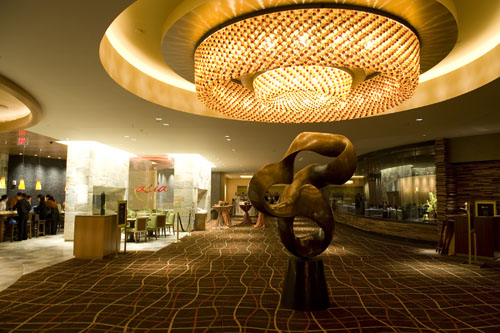 Complicating the issue, St. Louis has faded somewhat as a gambling market, down to seventh in the U.S. (from fifth). Bidness-consulting firm RubinBrown has recently released a report recommending that regional casino markets reinvent themselves as vacation destinations and target a younger clientele. Babinski promises a service-oriented culture at a reinvented Lumiere Place and says that Tropicana has “bigger plans” — albeit currently in abeyance — for the land occupied by its parking lots.
* Until Horseshoe Baltimore arrives to shake things up later this year, Maryland is effectively a one-casino state. Maryland Live grossed $59.5 million of last month’s $76 million statewide tally. According to The Baltimore Sun, it is “the top earner of all casinos on the East Coast offering both slots and table games.” And even though Maryland grossed 10% more last month last month, that was all the doing of Maryland Live and Rocky Gap Casino. Not so fortunate were Penn National’s Hollywood Perryville (-9%) or independent Ocean Downs (-1%). Considering Maryland’s insanely high tax rates on casinos, you have to wonder how the smaller joints make ends meet.
