

Indiana casinos are on course to face a significant new competitor: a $400 million project in South Bend, bankrolled by the Pokagon Band of Potawatomi Indians. No date has been  set for the beginning of construction but the Potawatomi have struck two deals with South Bend, bringing the casino closer to reality. The first was $400,000 commitment to pay for water and sewer service to the casino site. The second was a revenue-sharing agreement whereby, in lieu of property taxes, the tribe will pay the city 2% of casino profits. The minimum payment will be $1 million if the casino has 850-1,699 gaming positions, $2 million if the casino passes the 1,700-gaming-position threshold. This is on top of a veritable raft of commitments the Potawatomi have made to restore wetlands, fund schools, improve hospitals … the list goes on and on. Gov. Mike Pence (R) doesn’t want any new casinos in Indiana but he’d have to be a churl to reject such a “george” proposition.
The Potawatomi have been such a godsend for South Bend that it’s small wonder Mayor Pete Buttigieg said, “This is an extraordinary agreement in how comprehensive, how ranging and how generous it is. [The tribe took] a lot of measures that they were not required to do but were motivated to do.” Complimenting Hizzoner as “a tough negotiator,” tribal Chairman John Warren said the deal was 18 months in the works and “This agreement is just a stepping stone for the next seven generations of our people and also for the people of South Bend.”
Raining on the city’s parade was Citizens for a Better Michiana mouthpiece Jake Teshka, who said, “The payments made by the tribe will be based on ‘net win,’ meaning the more people pulling slot machine levers, the better for South Bend’s bottom line.” Well, yeah, that’s how these things tend to work. Or, as the mayor responded, “Under American law, they have the right to pursue this. This is about having an agreement that makes sure that any increased burden that does happen because of the gaming — whether it’s for public safety, traffic, whatever it may be —that we’re more than offsetting that with the flow of revenue to the community.”
For the moment, the project is on ‘hold.’ The Bureau of Indian Affairs is poring over the tribe’s environmental-impact statement. If approved, the Four Winds Casino will be augmented with a 500-room hotel, housing units and tribal-government offices.
* Money-losing Macau Legend Development, which finished last year $35 million in the red, has decided to raise some cash by putting its Landmark Macau casino-hotel up for sale, probably to one of the company’s minority shareholders. If Li Chi Keung‘s purchase goes through, he’ll get the Pharaoh’s Palace Casino and Babylon Casino,  both run by Stanley Ho‘s people. Macau Legend is seeking $710 million for the hotel and two casinos. “The past year proved to be challenging. The combination of the economic situation in China, the increase in new hotel and casino capacity in Macau and the changing profile of the visitors to Macau were among the key issues that negatively impacted gaming and non-gaming businesses,” said CEO David Chow.
Part of the drag on the company’s 2015 performance was a 35% decline in gaming revenue at Pharaoh’s Palace. The company to concentrate new ventures in Southeast Asia and in Portugese-speaking territories. To the latter end, it is building a $283 million casino in Cape Verde, a deal which includes “an exclusive [10-year] nationwide operation of online gaming, physical and online sports betting.”
Back in Macao, the developer is going to reinvestment the sale proceeds of Landmark Macau into completion of its Fisherman’s Wharf multi-hotel project (where Babylon 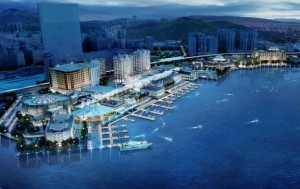 Casino is located). Ho’s Sociedade de Jogos de Macau will operate 35 new gaming tables as part of the Fisherman’s Wharf buildout. Macau Legend is currently sitting on 50 inactive tables, an action the local press views with consternation. Fisherman’s Wharf will also offer a unique amenity: Its very own border crossing. If you’re a yachtsman, just sail your boat up to the marina and go right through immigration. “Yacht tourists also tend to stay longer in destinations than the non-seagoing sort, according to yachting industry data,” reports GGRAsia. So, in a subtle way, Beijing is throwing a lifeline to Macao’s floundering casino industry … just not to the big American players.
