

 Congress is fiddling around the edges of the Indian Gaming Regulatory Act but, for all the talk of reform, only ‘reservation shopping’ seems to be a real subject of concern. This political bogeyman is cited whenever a tribe wants to take off-reservation land into trust for casino purposes. However, it’s an exaggerated worry. As Bureau of Indian Affairs chief Kevin Washburn told the Senate Committee on Indian Affairs, “Of the over 1,700 successful trust acquisitions processed since the beginning of the Obama administration in 2009, fewer than 15 were for gaming purposes and even fewer were for off-reservation gaming purposes.”
However, California Sen. Dianne Feinstein (D-CA) remains so het up about the issue that she’s taken the Carcieri “fix” hostage, putting a hold 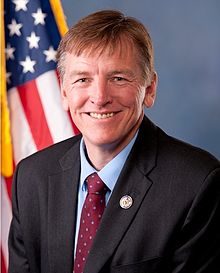 on legislation that would allow tribes recognized after 1934 to have land taken into trust for gambling purposes. (Massachusetts‘ Mashpee Wampanoags have a particularly vested interest in a Carcieri tweak.) Meanwhile, Rep. Trent Franks (R-AZ) is doing some tinkering of his own. He’s pushing a rewrite of the 1986 Gila Bend Indian Reservation Lands Replacement Act, one which would undo the gaming-enabled status of 54 acres of Tohono O’odham Nation land next door to Glendale, Arizona. Sens. John McCain and Jeff Flake (R-AZ) are pushing a slightly broader version of the same bill in the upper house … and doing an Alphonse-and-Gaston act as to whose bill will eventually take precedence: theirs or Franks’. Ironically, McCain was the original co-author of the Gila Bend act the Franks bill seeks to partly unravel.
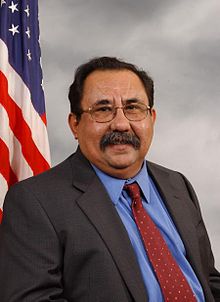 In the meantime, congressional proxies for the Tohono O’odham Nation and the rival Salt River Pima-Maricopa Indian Community duke it out on Capitol Hill. An alleged promise by the Tohono O’odham not to build any casinos in the Phoenix area was, accused Rep. Paul Gosar (R-AZ, above), “not something that Congress can ignore. No entity, governmental or otherwise, should be rewarded for deceptive conduct that violates a compact and is contrary to the will of the voters.” Rejoined Rep. Raul Grijalva (D-AZ, left), “Every court case, every administrative review, has upheld that law and the tribe’s right to the West Valley and the development of that” casino.
Given the he-said/she-said nature of the controversy, it’s difficult to know where to sympathize. However, the immensity of the forces arrayed against the Tohono O’odham lends the debate a certain David versus Goliath quality.
* There were a number of factors that landed Don Barden the casino contract in Pittsburgh that was his eventual undoing. One of them 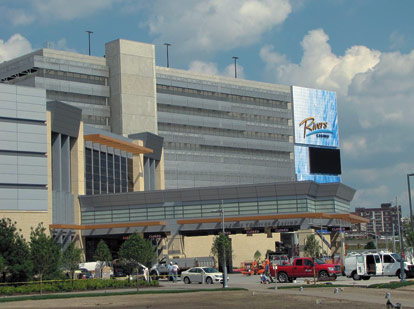 seems to have been a bad case of the Penn National Effect: the tendency to grossly inflate prospective gambling revenues in order to win an argument or an election. Barden foresaw $428 millions in slot revenue alone during the first year of what became Rivers Casino. In actuality, it brought in 56% of that figure. It’s up to 65% now, but you get the point.
The good news is that Rivers Casino has pumped $50 million into philanthropic coffers. As Robert Morris University Professor of Tourism, Hospitality & Gaming Denis Rudd points out, “It was not going to come in and cure all of the woes of Pittsburgh. Casinos aren’t meant to do that.” Rivers Casino has also proven to be a good neighbor to the Carnegie Science Center, whose co-director, Ann Metzger, says, “we have a wonderful relationship with the casino. I think they’ve really contributed to the vibrancy of the North Shore.”
The casino incentivizes participation in the Carnegie Center’s adult-education programs by offering free play to class attendees. Beneficiaries of Rivers’ largesse range from the Carnegie Library to the home of the Pittsburgh Penguins, Consol Energy Center. It’s even been hailed for its architecture, with Riverlife CEO Lisa Schroeder calling it “a model for other riverfront property owners.” It’s good to know that, for all its birth pangs, Rivers Casino has ended up being one of the feel good stories of the industry.
