

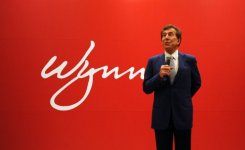
 Steve Wynn (no introduction required) and old pal — and major investor — Kazuo Okada are having a falling-out that spilled into the files of the SEC. Okada has lined up heavyweight Las Vegas law firm Lionel Sawyer & Collins to help him compel Wynn Resorts to give him access to corporate records. As someone who owns 20% of WYNN stock (compared to El Steve’s 9%), sits on the board of directors and even has a Wynncore restaurant named after him — though maybe not for much longer — you might say Okada’s got a legitimate beef.
 Okada alleges that “despite several written demands, Wynn Resorts insists on keeping its books and records hidden from its Director’s scrutiny.” His targets of interest include a recent, $135 million donation to the University of Macau, despite Hong Kong resident Okada’s personal opposition, and the use of $30 million he lent Wynn in 2002 “to help advance” the “due diligence” of what eventually became Wynn Macau. According to the SEC filing, Wynn Resorts denied to Okada’s face that he’d ever lent that $30 million to begin with, then backpedaled when confronted with evidence of same. “Nevertheless, the Company still denied access to any records showing how the funds were used.”
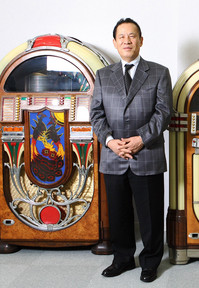 Hmmmm … money vanishing into Macao for purposes unknown. This is starting to take on a familiar ring within the casino industry. Let’s face it, the enclave’s casinos are the biggest Chinese laundry known to man — as many a Communist bureaucrat has exploited to his financial advantage. Regarding the 30 million clams, “In light of recent developments, Mr. Okada has become concerned regarding how Mr. Wynn caused these funds to be used,” Okada’s lawyers write. That may not be a direct accusation of untoward conduct but it’s a mighty dark imputation thereof. As for the $135 million bequest to Macau U, which is spread across the remaining duration of Wynn’s gaming concession, “Mr. Okada objected to this donation, which appears to be unprecedented in the annals of that University. Mr. Okada noted in this regard that the University sits on land owned by the government, and there was no discussion regarding whether such a large gift, over such a long period, is an appropriate use of corporate funds.”
(Wynn also kinda/sorta donated $13 million worth of Chinese objets d’art to Macao — a gesture to which Okada [above] utters no objection — on the condition that they remain ensconced at Wynn Cotai, if and when it gets built.)
The Macanese government has had issues with graft in the recent past, so even a blind man could follow Okada’s bread-crumb trail here. Wall Street Journal reporter Alexandra Berzon lays it out: “Mr. Wynn’s donations have raised eyebrows among some Macau casino executives, especially given the U.S. government’s investigation of fellow Macau operator Las Vegas Sands for compliance with U.S. antibribery laws.”
 However, like an overenthusiastic athletic booster, Wynn may simply be doing a crass and unsubtle favor in hopes of being fondly regarded 10 years hence. It will certainly be a frosty day in Hades when Wynn Resorts lavishes remotely similar largesse upon the University of Nevada-Las Vegas. No, it’s not playing well with Las Vegans now that the local papers have reported that Wynn has been a “george” donor to higher education … in China. Kazuo Okada, mind you, is planning to develop a pair of casinos in the Philippines, so notorious for corruption that it makes Macao look like Sunday school and which U.S. casino companies tend to approach with extreme caution (see below).
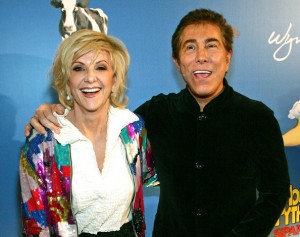 Elaine Wynn’s divorce from Steve also figures in the Wynn/Okada brawl, with the latter accusing the former of fiddling with the stockholders’ agreement to dilute the combined, 29% power of the ex-Mrs. Wynn and Okada’s Aruze USA. Regardless of whether the feds take an interest in Okada’s suggestions of influence-buying and misappropriation of funds or not, going public with his feud is a good way of bringing pressure on his erstwhile BFF to pony up those corporate records. Wynn, man and company alike, could hunker down and try to make this go away through simple intransigence. (“Bullwinkle, that trick never works.”) But Okada could also threaten to dump his 24,549,222 shares of WYNN and wreak havoc on the stock price. And, as the Wall Street Journal sagely implies, Okada could cause great trouble for Wynn’s attempts to crack the fiercely coveted Japan market. If these two decide to play hardball, it’s gonna get real ugly.
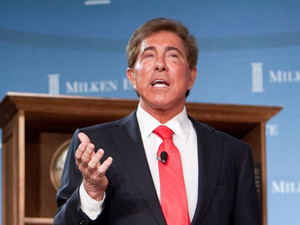 Update: It just did. About 40 minutes before my copy went online, Wynn Resorts lashed out at Okada, calling his lawsuit not just “without merit” (the usual boilerplate) but “preposterous.” It termed the litigation a diversionary tactic to distract from internal strife between Okada and the Wynn board regarding the aforementioned Philippines casinos. The Wynn release also strongly implies that Okada had been hinting at or dropping the magic words “Steve Wynn” in order “to imply the Company’s participation in projects that the Company had made firm decisions to avoid.” [Translation: We want no part of the Philippines.] Okada’s bullying approach toward the Japanese government in re casino legalization may not have endeared him either, given that Steve Wynn himself has chosen to tread softly on that issue. Wynn Resorts had been attempting to stonewall the media after the Okada lawsuit hit the wires — as Hunter Hillegas noted — today’s stock plunge rendered that strategy obsolete.
Oh, and Wynn is currently redesigning the “Okada” restaurant, too. Just a coincidence, I’m sure.
Exit “Phantom,” stage left. It gets draftier and emptier over at Venelazzo, as yet another tenant is scuttling its gondola and catching the next vaporetto out of town. Following the defections of Blue Man Group (to Monte Carlo) and Jersey Boys (to Paris-Las Vegas), Phantom of the Opera is lowering its chandelier for the last time next September. That will write finis to a six-year, two-month run; in terms of longevity, that’s one of the biggest success stories in Las Vegas Strip history. Unlike The Lion King, which was put out to pasture a year ahead of schedule, Phantom is going dark by impresario Scott Zeiger‘s choice.
 While the Las Vegas Sun simply amplified Zeiger’s spin doctoring, the Las Vegas Review-Journal‘s Mike Weatherford dug deeper and found that the length of Phantom‘s epic run didn’t compute into financial success. Zeiger expects to lose $20 million of the show’s $77 million production budget, even after labor concessions and even discounts on royalties — practically unheard-of in the theater world. The show was making its “nut” and then some, but operating profits weren’t sufficient to recoup that $77 million initial outlay. (Annual anniversary celebrations got smaller and stingier, then petered out altogether.)
Zeiger hints to Weatherford that paying rent to the Venetian for five years also contributed to the show’s eventual demise. That certainly harmonizes with the recurring theme heard from other recent defectors from the House of Adelson. Sands is already working on restocking its suddenly decimated entertainment lineup, but the shows being considered — Rock of Ages, Priscilla, Queen of the Desert and Spider-Man: Turn off the Dark — look like discount merchandise by comparison.
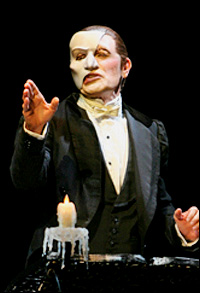 The only consolation is that Las Vegans will finally be spared the godawful caterwauling and gnarled, Methusaleh-worthy voice of resident Phantom Anthony Crivello (right) Never mind that he’s not a second Michael Crawford: Crivello’s not even a first Brent Barrett (the first Vegas interpreter of the part). I can think of at least two occasions where I turned down free Phantom tickets rather than be subjected to Crivello’s mauling of Andrew Lloyd Webber‘s melodies again. Judging by a recently published photo, Zeiger must keep Crivello in a coffin of his native Transylvanian soil between shows, nourishing him with the blood of freshly sacrificed virgins. Sentiment is all well and good at times like this, but Crivello is a dreadful hambone and will not be missed by this viewer.

Ok, I get the fact that those who do not possess any true talent if their own become critics, or worse become bloggers, but where do you get off attempting to make a joke like they keep him in a coffin. The picture you are looking at was taken right after he had his makeup removed from a performance and with a direct flash, which will never make a complimenting photo on anyone.
Anthony Crivello is an accomplished vocalist and and amazing actor as well. Do you think for a second that Sir Andrew Lloyd Weber would keep a “dreadful hambone” if he were “mauling his melodies”? Hal Prince for that matter?
Another thing that Mr. Crivello has accomplished with this role that no other Phantom has quite nailed as perfectly is when Phantom’s heart breaks…you can feel his emotions turn from sad to royally pissed to vengeful.
And I feel the same way about the entire Vegas cast!
I am appalled at the insulting statements you made in ”reviewing” Anthony Crivello’s performance as the Phantom! Not only does Mr. Crivello have a rich, beautiful voice, he brings a depth of emotion to the character which effectively draws the audience in to the Phantom’s pain and passion. Anyone with a heart cannot help but be moved! Andrew Lloyd-Webber and Hal Prince made a very wise decision in casting Mr. Crivello!
As for your ridiculous comments regarding the photo, Mr. Crivello was fresh out of the make-up removal process, and tired, yet graciously spending time greeting and posing for pictures with his fans. And just so you know, the fan in the picture with him is me!
I have seen Phantom 84 times, 60 of which were in Las Vegas! This production and cast are amazing, and I am dreading that day in September when the curtain falls for the last time. I will be there to say goodbye, knowing I have seen the BEST!