

Encore Boston Harbor continues to dominate the Massachusetts scene, with 61% of market share, compared to 25% (not bad) for MGM Springfield, the rest going to Plainridge Park. Encore  grossed $85.5 million last month, MGM did $21 million and Plainridge $12 million. That breaks down to $1.7 million a day for Encore, $676K in Springfield and $390K in Plainville. The latter took a 21.5% hit from Encore but still did an impressive $325/win/slot/day. JP Morgan analyst Joseph Greff is predicting Plainridge Park will decline 19% in the quarter, compared to his initial projection of 10%. Expect Penn National Gaming to clamor even louder for table games.
MGM’s gross was dominated by slot revenues ($15.5 million), at a slightly below average $198/win/slot/day. Table game win exceeded $5 million for $1,434/win/table/day. Greff projects revenue to settle into a two-to-one ratio of slot dollars to table ones. Encore might want to consider reducing its slot inventory, which is bringing in only $207/win/slot/day. (At 3,158 slots, the casino is not lacking in one-armed bandits.) Table games brought in $32 million, for win/table/day of $7,276. If Encore keeps those numbers up, it will continue to surpass MGM National Harbor as the premier table-game destination on the East Coast.
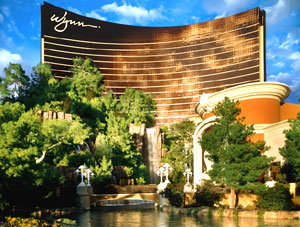 * Score one for consumer motorists. Wynncore has eliminated parking fees “without limitation, and without the need for validation.” Bravo, Wynn Resorts. Let’s hope this is the start of a trend. The new, park-free policy incepts Sept. 30.
* Fantasy sports are an $8 billion industry in America. That’s chicken feed compared to the $300 billion (mostly illicit) real-sports betting market. “Even in this short time and in Jersey, it’s already become a substantial portion of our business,” says DraftKings CEO Jason Robins. Meanwhile, the major leagues—eager to cash in on sports betting—must walk a tightrope between collaborating and giving rise to corruption. “The precursor of the NFL collapsed in 1908 in large part because of gambling scandals,” warns economist Victor Matheson. “If people think sports are fixed, then they don’t want to watch. And so it’s this real balancing act for the leagues.” That’s why the NCAA remains firmly opposed to sports wagering. Even so, companies like DraftKings are aiming to dominate the new industry. “I think there could be a $100 billion-plus company … So, we’re going after that kind of size opportunity.” Spoken with the recklessness we associate with DFS.
* Atlantic City casinos are doing better this summer. But they’re not taking chances. The payroll is down by 3%. This seems to be a combination of ‘rightsizing’ at the two newest casinos and a decision to hire seasonal workers earlier and keep them on the 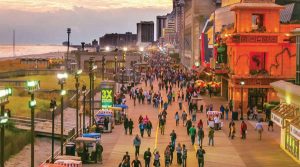 job longer, rather than hiring more permanent staffers, despite the increase in room and casino inventory. Unite-Here Local 54 President Robert McDevitt is keeping his eye on Oct. 15, when layoffs traditionally occur, as a leading economic indicator. “If they hang on to [seasonal workers] until the end, then it means there is business to support it.” Still, the Boardwalk appears to be skimping on full-timers, looking to part-timers and seasonal employees to fill the gap. But if the usually crotchety McDevitt is sounding sanguine that’s a positive indicator in and of itself.
* Oklahoma Gov. Kevin Stitt (R) has ‘come out’ as a member of the Cherokee Nation in an effort to quell perceptions of personal animosity toward the Sooner State’s Indian tribes. He frames his  showdown over tribal gaming compacts as a duly diligent review of state contracts, just like any other. He’s not prepared to concede that the compacts automatically renew: “No contract goes on in perpetuity one-sided. Whether one side feels they’re getting the raw end of the stick, there has to be mutual agreement.” He says that the tribes warned his predecessor, Mary Fallin, that the compacts were due to expire in 2020, dismissing current tribal talk as “posturing.” Claiming “100%” popular support, he added, “This is just business. It has nothing to do with the tribes, it has nothing to do with their sovereignty, it has nothing to do with their industries.” He concluded saying that “we’re going to get there.” However, a lack of gubernatorial specifics—other than a hint of a uniform level of taxation—won’t get him very far.
* Is the customer always right when they sexually maul an employee? There’s no question that player Lawrence Earnhart felt up an unnamed plaintiff: He pled guilty in court last year. The victim, however, says that Wildwood Casino retaliated against her. She says she was “singled out, isolated, unnecessarily scrutinized, blamed for systematic problems by the casino, and set up for failure, so that she would be forced out of her employment” for having stood up to “Scary Larry.” She also alleges that management knew chapter and verse on Earnhart’s tendencies and did nothing. “Nothing” would seem to describe what the company has learned from the #MeToo phenomenon.
