

Las Vegas is 20,000 attendees poorer now that Adobe Summit 2020 has pulled the plug on its convention. Although Sin City has been spared from coronavirus fears so far, withdrawals of this magnitude are at least as bad as a dearth of Chinese whales. Conventions, after all, are in money  in the bank whereas a poor month at volatile baccarat can spoil your quarter. “Over the past few weeks, we have been closely monitoring and evaluating the situation around COVID-19 to ensure we are taking the necessary measures to protect the health and wellbeing of Adobe Summit attendees. As a result, we have made the difficult but important decision to make Summit/Imagine 2020 an online event this year and cancel the live event in Las Vegas,” wrote organizers. Let’s hope this ‘online event’ thing doesn’t become a trend. It’s even worse for SXSW, which lost Twitter and Facebook. There’s a double whammy.
So far, coronavirus cases have been confined to the periphery of the country, although nine documented deaths is nothing to sneeze at. The U.S. has been providentially lucky, given that 3,100 people have died worldwide (mostly in slow-to-react China), and South Korea, Italy and Iran have become no-go zones. Two Singapore conferences have been postponed but not nixed, perhaps a tribute to the city-state’s speedy coronavirus containment. Event cancellations in this country are extending into May, so you can see why Wall Street is so apprehensive about the feasibility of the Kentucky Derby. While Churchill Downs is keeping its powder dry about its signature event, many conference organizers elsewhere are canceling left and right, with ‘an abundance of caution’ being the leitmotif.
As for Vegas, it has got to be hoping that pundit is Larry Dignan is wrong when he says, “One thing is certain: The coronavirus is likely to mean the definition of business, as usual, will change.” Meaning, less business travel and more teleconferencing. What a bleak prospect. The good news is that conference organizers Atlassian Summit 2020, Cisco Live, Dell World, HPE Discover, the National Association of Broadcasters and Oracle Code One are remaining loyal to the Strip. We’ll take consolation in that.
* In Alabama, the Poarch Band of Creek Indians would like to make a grand bargain. What’s in it for the state? $1 billion. Plus an estimated $350 million a year in taxes. What’s in it for the  tribe? Two Class III casinos and gaming exclusivity. If you think that’s a deal that’s tilted in the tribe’s favor, you wouldn’t be alone. Detractors include legislator-turned-lobbyist Gerald Dial, who says, “Once you pass a constitutional amendment, you can’t say the Poarch Creek Indians get the casino. You’ve got to have a process where you give anyone an opportunity. If someone from Las Vegas wanted to build one in Huntsville, they’d have the same opportunities.”
Mind you, the Creek have been doing the hard work in Alabama, building up an audience for casino gambling and Big Gaming has shown zero interest to this point. But juicing the tribe into exclusivity without seeing what other offers might be on the table sounds rash. Even exclusivity
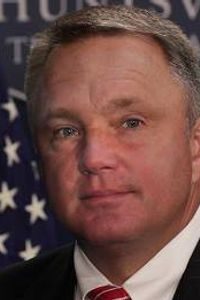 opponent state Rep. Rex Reynolds (left) allows, “I don’t know if anyone can compete with them in Alabama since they’ve got existing casinos.” Dial’s PAC complains that tribal gambling is a tax dodge, to which Poarch Creek Vice Chairman Robert McGhee hotly replies, “I don’t know where they get their numbers from. We pay hundreds of millions in payroll taxes.” Dial needs to gets his facts straight, saying inaccurately of tribal gambling, “In other states, it’s as high as 49 percent [taxes].” McGhee, meanwhile, promises to sweeten the pot with $225 million in licensing fees for the tribe’s three, existing Class III casinos. For the time being, Reynolds’ priorities—and Gov. Kay Ivey‘s—are elsewhere. “We’re gonna move forward on a lottery. We clearly got that message during our conference meeting yesterday … it’s the right thing to do. The people want to vote on a lottery and I think we need to give them an opportunity to,” the lawmaker says.
* MGM Springfield was supposed to stimulate downtown economic development. So far it hasn’t happened. Ergo, the city is creating a “casino impact district.” “At this point, it’s clear that the city ultimately needs to be the driver into what the next phase of development needs to be in and  around the casino area,” said Chief Development Officer Timothy Sheehan. High among the priorities would be residential redevelopment of Old First Church. That’s just one of a wish list of to-do properties that includes ones which were foreclosed upon by banks. In a scenario which Atlantic City denizens will find familiar, MGM Springfield is buzzing but there’s no spillover to the surrounding area. MGM even tried to limit the ways in which it could cannibalize local business, evidently to no avail. The Massachusetts Gaming Commission is enthused about Sheehan’s agenda but we’re a little more curious about what stakeholder MGM has to say.
* Imagine if this had happened during Steve Wynn‘s reign of terror. Yes, masseuses can now bargain collectively with Las Vegas casinos, thanks to a ruling that went against subcontractor IntuCorp. We’d give you the full ramifications but our Bloomberg subscription ran out … sort of like the Bloomberg presidential campaign.
* The British casino industry can’t catch a break. New immigration restrictions threaten to crimp, among other things, the supply of  croupiers, 70% of whom hail from outside the U.K. “Casinos are a hugely important part of our country’s leisure industry attracting thousands of wealthy tourists to the UK from around the world. In order to remain competitive our casinos need the best croupiers with great arithmetic agility,” protested Betting & Gaming Council Chief Executive Michael Dugher. The Boris Johnson government may be cutting off its nose to spite its face: Casinos contribute $386 million in tax revenue per year.
* PredictIt bettors who wagered on Joe Biden to run the table on Super Tuesday profited handsomely. The former vice president also improved their odds on a Biden nomination: 79 cents a share to Bernie Sanders‘ 16 cents, a complete reversal of (literal) fortune. Donald Trump, however, remains PredictIt’s favorite to win the election, at 2/3 versus Biden’s 3/2. Offshore bookies are unlikely to repeat their costly 2016 mistake when they simply assumed Hillary Clinton would win and paid bettors prematurely.
