
Investment firms like J.P. Morgan and Deutsche Bank have been sending emissaries to Las Vegas this week, to meet with all the major gaming firms during Global Gaming Expo. Since the latter is being held at Sands Expo Center, perhaps we should start there.
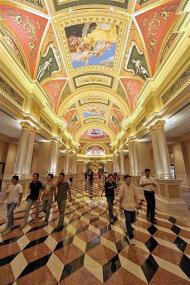 Deutsche Bank had Las Vegas Sands COO Michael Leven and President of Global Gaming Operations Rob Goldstein over for a “fireside chat.” They waxed positive on Macao and revealed that their The Parisian megaresort will be priced lower than Venetian Macao (left), in a play for the mass-market punters. But, in Singapore (where Sheldon Adelson is itching for more hotel rooms), Sands thinks it can wring another $5 million/day out of Marina Bay Sands, particularly through “optimization” of its three hotel towers. “Some of the highest convention bookings in number” on the Las Vegas front are not translating into higher ADRs — unlike those at MGM Resorts International — and our economy appears precariously balanced upon Asian play, estimated to be one-third of the total. Speaking of which, Leven and Goldstein said they are more optimistic than ever before of the chances for casino legalization in Japan.
The aforementioned MGM sent CFO Dan D’Arrigo to sit aside Deutsche Bank’s embers and chat up the company’s prospects. ADRs are growing at a sub-10% rate and convention 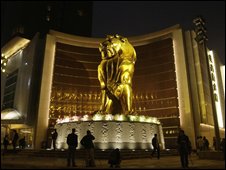 bookings are up by double digits. Conventioneers aren’t driving hard bargains as before and are looking at long-term commitments to MGM, in what was the headline item of the briefing. Construction on MGM Cotai is expected to begin before year’s end. Significantly, there was no mention of Toronto, as D’Arrigo emphasized Maryland, Massachusetts and Japan instead, where costs (in Nippon) are expected to be “significant.” However, with MGM constrained to $500 million in capital expenditures per year, it’s an open question how many projects MGM can juggle or how quickly they can be finished.
Unnamed surrogates of Steve Wynn were dispatched to meet with DB’s Carlo Santarelli. These droids reported that Wynn Cotai is on track both in time and  money for a possible January 2016 opening. It will be run separately from Wynn Macau, with the two pitted against one another. (I can see the reasoning … but is it wise?) Management doesn’t expect either a Philadelphia or a Boston casino-award decision before early next year. The Philly budget is holding firm at $900 million but Wynn’s Everett commitment continues to creep upward, now at $1.2 billion. Outspending the other guy may be a winning strategy in pursuing a Massachusetts license but it’s economic suicide in the already-glutted Philadelphia market.
Lastly, Isle of Capri came to make penance, as it were. It reported trimming its workforce by one-fifth and shaving $40 million off its operating expenses. “That said  management noted that the low hanging fruit has largely been picked and that ISLE must now find incremental savings in harder to identify areas,” wrote Santarelli. Isle of Capri Cape Girardeau continues to disappoint, a failing that management blames on a nationwide saturation of gambling, not the property itself. “With regards to regional gaming trends, management noted that the recovery seen in other areas of discretionary spending has failed to materialize in gaming spend. As a result of the lackluster trends within regional gaming, ISLE has focused its efforts on driving rated play instead of retail play, given the difficulty in incentivizing and stimulating retail play.” Slot fleas, at least, are reported to be dropping away.
Isle’s strategy will be to reinvest in its core assets and extend their usefulness. Since the company has no projects in train and no significant debt maturities until fiscal year 2016, Santarelli likes Isle’s prospects for reducing leverage as it sails ahead.
