

JP Morgan analyst Joseph Greff has just returned from a two-day field trip to Las Vegas. His overall reaction was “incrementally positive.” He said he sensed “a fairly steady trend line in terms of overall spend and net revenue performance.” Preferred stocks  were MGM Resorts International (“its LV Strip exposure next year should be a big positive”), Boyd Gaming (“regional and LV Locals trends remains steady, free cash flow underappreciated, with a primary focus on reducing its balance sheet leverage/net leverage ratio, and don’t foresee any irrational [mergers and acquisitions], an investor concern of late”) and a company whose Las Vegas Strip presence is easily forgotten, Penn National Gaming (Greff thinks it’s under appreciated in its ability to pay down the leverage on its balance sheet).
Visibility into future Macao performance was diplomatically described as “challenging,” while “operators are excited about the Strip outlook for 2020 given better convention calendar/rotations of large shows back into 2020, with more market-wide convention square footage driving some of this, and the arrival of the Raiders.” The bear-market case for soft traffic next year “shouldn’t hold weight,” abetted by a lack of new hotel capacity.
“Our view is that the LV Strip seeing accelerating (though not herculean) revs and EBITDA growth is a theme that most  investors are not (yet) embracing,” wrote Greff. He added that MGM was seeing cash-flow growth at its non-luxury resorts, “something goes against history entering into a U.S. slowdown (i.e., this relative growth dynamic wouldn’t be happening if there was an acute downturn.” As for casinos changing hands (see “Heard along the Strip“), Greff penned that enthusiasm on the Strip will drive different ownership, new investment, with four to eight assets that “could transact,” driving higher land prices on the Strip (’bout time). “We were told don’t be so sure that asset transaction activity is on pause until major industry consolidation [read: CZR] is closed.”
Greff made a surrealistic reference to Barbary Coast Casino (now Caesars Entertainment‘s The Cromwell) in discussing a locals market in which operators expect to see 2%-3% growth next year 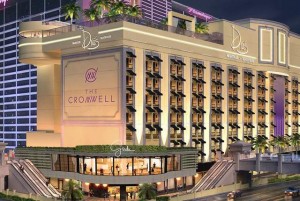 despite some recent and “erratic” promotional activity (largely driven by the Palms). As for Japan, the withdrawal of Las Vegas Sands from Osaka has made MGM more optimistic about its prospects there. Requests for Osaka concepts are due in a few days. Sports betting was also on the docket, with regional operators reporting “pretty good” volumes which don’t, in and of themselves, provide much direct profit but which seem to be lifting table game, restaurant and bar volumes. Sports betting is a rising tide which seems to be lifting all boats.
* Congratulations, Las Vegas. WalletHub has named you the most-fun city in the U.S. Sin City’s thriving nightclub scene helped push it to the top. Las Vegas is #1 in both dance clubs per  capita and number of attractions (think Mirage volcano). It’s second in bar accessibility, fourth in restaurants per capita—my waistline can vouch for that—and fifth in festivals per capita. Vegas is seventh in fitness centers per capita but only 18th in average beer price. It must be all those $7 drafts. Vegas youngsters seem to be getting the short end of the fun stick as the area is 22nd in parkland acres per capita and 52nd in playgrounds. OK, Las Vegas, you’ve seen what you’re doing well. Now how about looking after the locals a bit?
* Farewell to Caesars Executive Vice President for Public Policy & Corporate Responsibility Jan Blackhurst Jones, who leaves the position Oct. 1. Welcome, Caesars board member Jan Jones, who will presumably continue her crusade for gender 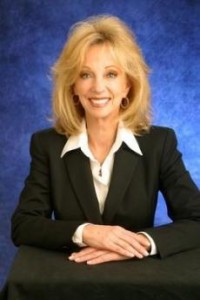 equity (among other issues) from her new bully pulpit. Said Caesars CEO Anthony Rodio, “Jan is known and widely respected for helping create a diverse, inclusive workplace, advancing environmental stewardship, advocating for important social issues and contributing giving to individuals, families and communities in need. Caesars has been very fortunate to develop and refine its social responsibility practices under her leadership.” Added board Chairman James Hunt, “With her appointment, Caesars will continue to benefit from her vast experience, expertise and incredible relationships.” True that.
* As Dan Gilbert recovers from a stroke (we wish him a full recovery), his estate is selling down his participation in the casino industry. Greektown is gone, Jack Cincinnati is going, and Jack Cleveland, Jack Thistledown and a minority stake in Horseshoe Baltimore remain unsold. The first and third of those have historically underperformed but Thistledown would make a nice pickup for a company (Boyd? Full House Resorts?) looking to strengthen its hold on the Ohio market.
* Speaking of Full House, it’s making a full-court press for one of the Waukegan casinos, with its planned “American Place.” Whoever wins, the casino will have to go onto the site of the defunct Fountain Square shopping mall, so there are some constraints—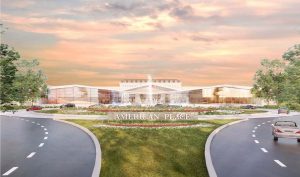 but not many. As previously announced, Churchill Downs and Rush Street Gaming will team up for a Rivers Casino Waukegan (1,625 gaming positions). Waukegan Gaming, nixed in 2004 for corrupt political ties, is trying to partner with Churchill Downs and Rush Street, but has filed its own plan to cover its butt. An “ultra-luxurious collection of villas” is part of CEO Dan Lee‘s vision for American Place, along with a helipad and 1,560 gaming positions. If page-counts won bids, Lee would be in like Flynn, with a 402-page pitch.
Tap Room Gaming/Warner Gaming are being cagey with specifics of Lakeside Casino, not even saying how much they’d pay Waukegan for Fountain Square. Main backer, former politician Michael Bond bought and paid for much of the city government in 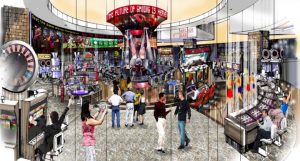 a recent election, so this proposal has the inside track. Potawatomi Hotel & Casino, brought to you by the same Native Americans who own the massive Potawatomi casino in Milwaukee, has the drawback of being a stalking horse for an out-of-state interest group (sort of like Mohegan Sun trying to get into Boston). They’d have 1,850 gaming positions, but would eschew a hotel in favor of tie-ins with existing ones. The project would cost $343 million and is estimated to create 2,599 jobs.
Tap Room Gaming investor Andrew Hochberg is also pushing his 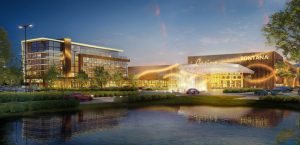 own project, Casino Fontana. The city would get $7 million for the site, there would be 1,380 gaming positions, plus a “scaled replica of a famous Italian fountain.” An upscale hotel, dine-in movie theater and a spa would all be part of a second phase. No budget seems to have been announced.
* MGM is making no apologies for the “venue fee” it is tackily tacking onto cocktails at its Las Vegas properties. Customer outrage doesn’t seem to be making a dent in the company’s posture. “I go to Las Vegas three or four times a year, and every time things have gone up,” wrote one customer. “I will most likely stop going, as it’s getting very expensive.” As an Internet commenter noted pointedly, ”One would think that the Sahara, which is attempting to get some new legs underneath itself through a current rebranding/ownership change, would offer a discount or promo to draw folks into their establishment rather than adding another fee. I don’t understand that at all.” Nor do we.
