
 Mike Friedman
Coronavirus – Airlines
Today, JP Morgan’s annual transportation conference began and wouldn’t ya know it, the airlines kicked things off on day one. Since I don’t know a darn thing about viruses, I thought that it might be interesting to do something different and talk about the business aspect [ Coronavirus – Airlines ] of the virus’s impact, based on what I learned from the conference today.
Needless to Say, Demand is Lousy
Virtually every airline is saying the same thing: They’re feeling good about travel for, say, the next three weeks. After that, it’s anyone’s guess. United noted that it is preparing for the possibility of revenue being down 70% in April and May, followed by a slow “increase” to -20% by the end of the year. They were significantly more bearish (or more prepared for a bearish scenario) than their competitors.
International bookings for the Big 3 (American, United and Delta) all seem to be down in the 50-75% range. These numbers are simply astonishing and compare to the post-9/11 period when airlines saw revenue declines of up to 40%.
Capacity is Coming Down, Costs are Going up
Everyone is cutting capacity. Strictly domestic carriers are cutting only a bit. Ultra-low cost carrier Spirit, for example, is only cutting 5%, while the majors are cutting anywhere from 10-20%, depending on the region.
Which means that costs are going…up. That may seem to be counterintuitive, but it’s based on the way that airlines measure their costs. Airlines use an indicator called CASM, which stands for “cost per available seat mile.” It measures how much it costs an airline to fly one seat one mile, whether that seat has a butt in it or not. But many of the airlines’ costs, such as rentals and labor, are largely fixed, meaning that the airline has to pay them whether the planes are flying or not. Thus, fewer seats in the sky means a lower denominator in the cost equation.
The aforementioned Spirit faces particular challenges, as it pertains to growth. First, it makes a lot of its money on ancillary fees, with the average passenger paying approximately $50 for extras such as seat assignments and carry-on bags. Fewer passengers mean fewer fees. But lower growth also raise costs for the reasons mentioned above. The secret sauce to Spirit’s low costs has always been its fast growth.
Fortunately for all of the airlines, fuel costs, which represent the second-largest cost for airlines, have dropped precipitously.
Will Everyone Make It?
Coronavirus – Airlines
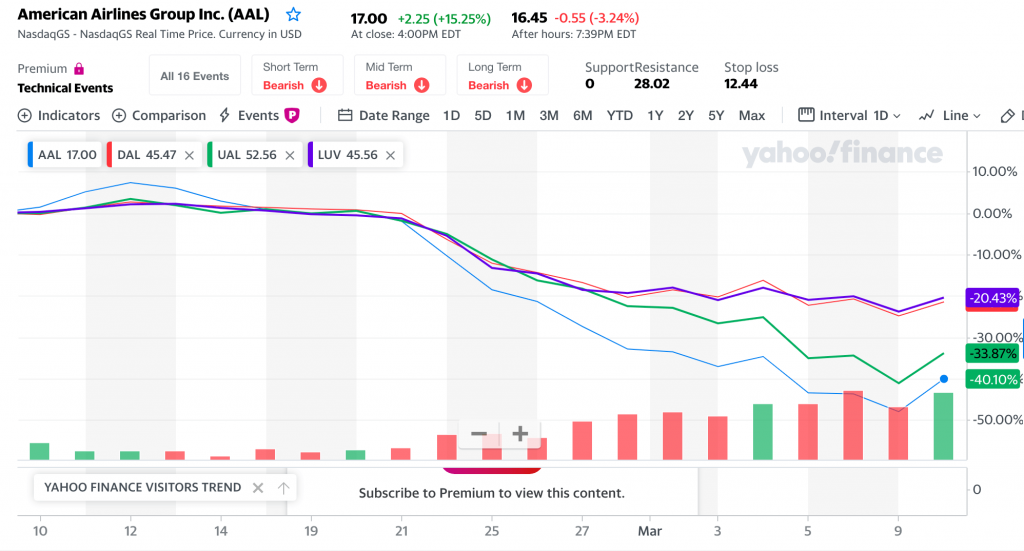
Airlines are notorious for their brushes with bankruptcy. It’s a hard business: costs are high, labor relations are volatile and passengers base their purchases largely on who has the lowest price. In good times, the airlines can offset these factors. But in the bad times, all the debt that the companies accumulated buying planes starts to matter. And then the market tells us who it thinks is going to be the winners and losers; naturally, nothing that I say should be taken as advice to buy, sell or trade any stocks.
Here’s what stocks of the four biggest airlines have done since COVID-19 fears kicked in a few weeks ago:
Got any other questions? Throw them in the comments and we’ll try to come up with an answer.