
 Mike Friedman
“Hidden City” Ticket
It’s hard to talk about the history of airlines without a discussion of the rules and regulations that governed them for decades. The most significant change to the pricing structure came in 1978, when Congress passed the Airline Deregulation Act, taking the pricing and routing out of the hands of the Civil Aeronautics Board and giving it to the airlines themselves. Competition increased dramatically and fares fell.
Two Bugaboos
But there were still two bugaboos built into the system that weighed on cheap travel. They were:
- Saturday night stay restrictions. Because business travelers usually flew midweek, airlines imposed a “Saturday-night stay” restriction. If your roundtrip fare didn’t include a Saturday night, it was significantly higher (One-way fares were often no cheaper than the round-trip.). That ended in 2002, when America West, then led by current American Airlines CEO, introduced a series of dramatically lower fares that essentially ended the Saturday requirement, particularly after the other airlines matched.
- Monopoly airports. This is a bigger problem. Airlines each have their “hub” airports, where they control a significant number of flights. Flying to Minneapolis? You’ll probably be on Delta. Charlotte? Think American Airlines. This dominance means high prices to many of the country’s biggest cities.
Skiplagging and the “Hidden City” Ticket
Crafty travelers soon developed a strategy, though, which has become known as “skip lagging” or “hidden city” ticket. Gilbert at God Save The Points has written an outstanding article about it, but here are the basics. If you are traveling to an expensive city, it’s better to buy a ticket that connects in your destination. For instance:
The price for a longer flight, with more segments, is actually less!
Let’s say that I want to take an evening flight from Boston (BOS) to Charlotte (CLT) on June 12. I’m probably flying American, given their dominance in Charlotte, so I take a look at a non-stop flight:

Not terrible. $234 one-way, although it’s going to cost you almost triple that to site in the good seats. But what happens if you decide to “skiplag,” with Charlotte as the hidden city. For instance, let’s book a trip to Fort Lauderdale (FLL) with a change of planes in Charlotte?
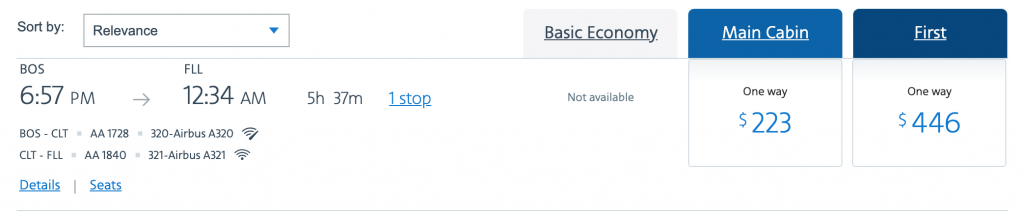
The price for a longer flight, with more segments, is actually less! In both cases, you’ll fly on AA 1728.
You’ll save $11 with the FLL flight in coach, but if you want to fly up front, you’ll save a whopping $219! So what do you do with the ticket from Charlotte to Fort Lauderdale? Nothing. Throw it out. Burn it. Frame it.
“Hidden City” Ticket – What to Watch
- First, make sure that you are only booking a one-way flight. If you book round-trip and don’t show up for a leg, the airline may cancel the return.
- Don’t check bags. Your bag will go to FLL, not CLT.
- Don’t brag about it to the airline. Obviously, they’re not a fan of this method.
Here’s Where It Could Get Dangerous
As Gilbert pointed out, the airlines can threaten to ban you, take away your points, void your ticket, sacrifice your first-born, etc., but they probably won’t. It’s unlikely that they’ll catch you, but even if they do, just claim ignorance (e.g., your plans changed.). I wouldn’t worry as much about the potential “consequences,” since they are so unlikely.
The bigger deal is if something goes wrong. Let’s say that Charlotte has a power outage. Never fear, American says, you can be routed through Chicago! And they’ll rebook you Boston-Chicago, then Chicago-Fort Lauderdale.
You now have a problem. You’re supposed to be in Charlotte. American, however, doesn’t know that, since you bought your ticket to FLL. So when you say that you would rather take the next flight through Charlotte, not only are they going to question you as to why but they’re still going to stick you on the flight to Chicago, and then tell you that you’re lucky that they’re doing so.
The Bottom Line – Skiplagging
Skiplagging through a “hidden city” ticket is a powerful tool and can save you a lot of money on a one-way ticket. Be aware, though, that things can go very wrong if there’s a small change to the flight. Use your judgment when deciding whether to do so.
Some other articles to check out:
- GUIDE TO POINTS AND MILES: Just the BASICS
- BEGINNERS GUIDE TO POINTS AND MILES: FOUR STEPS TO AIRLINE POINTS
- AIRLINE FREQUENT-FLIER PROGRAMS – MAJOR US CARRIERS
- HOTEL REWARDS PROGRAMS – THE BIG FOUR