Mike Friedman
Return To Las Vegas – Fly Southwest Airlines
Over the past several weeks, I’ve seen several news articles indicating that Southwest Airlines may win national market share as we get through and past the effects of COVID-19. (Also, as we return to Las Vegas and Fly Southwest Airlines.)
Southwest Airlines Will Win Market Share
To some extent, I disagree with those articles. Saying that they “may” win market share is unnecessarily pessimistic regarding the airline’s prospects. As far as I’m concerned, Southwest absolutely will win market share, and it could be substantial. The industry will be smaller, but more of it will belong to the LUV airline.
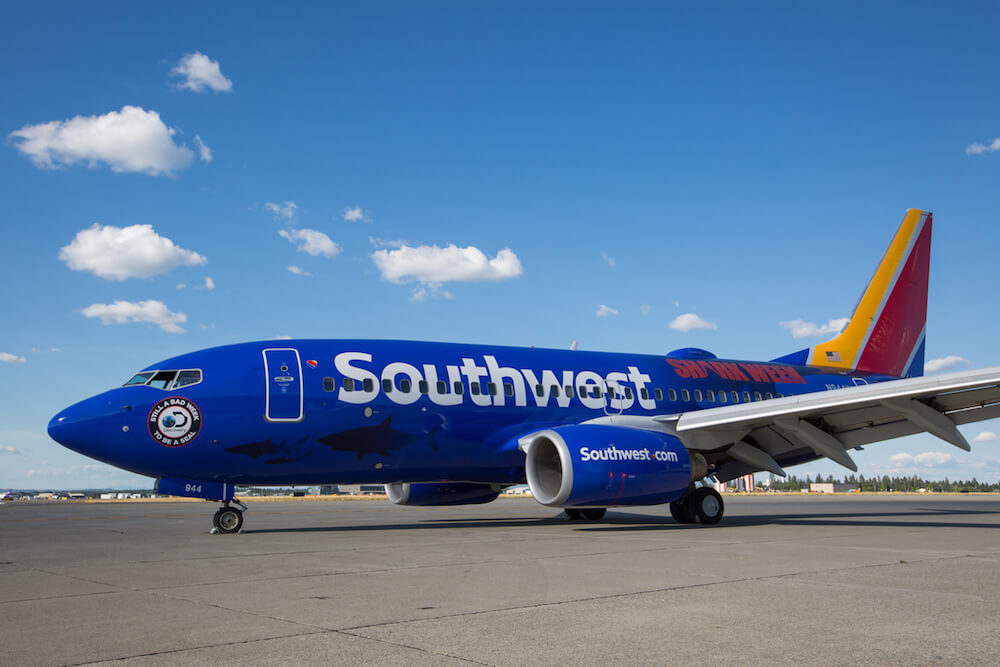
For those of you who are not familiar with Southwest, it is a low-cost carrier based in Dallas. Unlike traditional major carriers, which operate by connecting passengers through their “hubs,” Southwest flies mainly from point A to point B, meaning that it doesn’t have planes sitting on the ground waiting for connecting passengers. With fast turn times at the gate, aided by a lack of seat assignments, the carrier simply operates more efficiently than its competition.
Do you give up anything with Southwest? Sure. There’s no first-class, no seat assignments and no meals. But there are also no annoying fees, such as ticket change fees or baggage fees. It’s an extraordinarily simple model.
We’ve Seen This Game Before
In the first quarter of 2001, low-cost carriers represented about 12% of the domestic airline industry. Then, 9/11 happened, demand fell off a cliff and the high-cost carriers (everybody else) could not keep up. Both US Airways and United, who had been trying to merge, filed Chapter 11, while Minnesota-based sun Country filed Chapter 7 (liquidation).
But, more importantly, everyone else was forced to pull back capacity. Routes that had been secondary but occasionally profitable began to bleed red ink, leading to an endless basket of opportunities for low-cost carriers with solid balance sheets like Southwest (including big moves into Las Vegas and Phoenix). By the first quarter of 2003, low-cost carriers (primarily Southwest) had over 18% of domestic market share.*
In fact, virtually every downturn has been good for Southwest. Inevitably, a carrier with higher costs pulls back or goes bankrupt, leaving more room for the airlines that can make profits at lower fares.
That’s particularly applicable to leisure destinations, which can’t command the same ticket premiums that business routes do. Las Vegas is either at or near the top of the list. I doubt that any carriers will pull out of Sin City entirely, but they’ll probably cut back frequencies on marginal routes, leaving openings for competitors who can survive with lower ticket prices.
Is It Different This Time?
Of course, it is. No two downturns are the same, and this one comes with an added twist: People aren’t avoiding planes because they can’t afford to fly. They’re avoiding travel because they’re afraid of catching a disease. In other words, you couldn’t get most people on a plane if the tickets were free. In its most recent quarterly conference call, Southwest indicated that its capacity for May would be down 60-70%. That’s better than the major carriers, who are down anywhere from 70-90%, but they’re hardly taking a victory lap.
The industry has changed over the past ten years. For instance, it’s only been in the last decade or so that the ultra-low-cost carriers like Spirit and Frontier have taken off. These airlines price their tickets even below Southwest and make their money on fees.
The ULCCs face a different battle, though. While Southwest typically tries to open new routes from underserved cities, the deep discounters compete directly against the major carriers, scooping up the overflow passengers that the majors don’t want. But in an environment where there are no excess passengers, the majors will be happy to get the bargain hunters, leaving, well, nobody for the ULCCs.
In 2000 – There Were Six Major Carriers
Issue #2: In 2000, there were six major carriers (American, United, US Airways, Continental, Northwest and Delta) that competed against Southwest. That number has been halved, as three of the former were merged into the other three. Theoretically, that should be good for Southwest.
The problem is, if something were to happen to one of the Big Three, the US airline industry would be in major trouble. Once the world recovered, there would not be nearly enough capacity for the market, meaning that prices would skyrocket and cargo belly space would disappear. Oddly, too little capacity can be almost as bad for the economy as too little demand.

And What Hasn’t Changed
Return to Vegas Fly Southwest Airlines
With its investment-grade balance sheet, Southwest has the strongest financial position in the industry. But the longer that the effects of COVID-19 go on and the more damage they cause, the better it will be for Southwest in the long term.
Leisure markets are going to be the first ones that the major carriers desert, and Southwest will be happy to cover what’s left.
*http://businesstravelcoalition.com/statements/195.html
Southwest Airlines Cancel and Change Policy Covid-19
Southwest Made Almost No Adjustments To Its Policy
There’s A Good Reason Why