Though it liked to call itself the Entertainment Capital of the World, when it came to concerts by touring acts, Las Vegas was decades behind cities like San Francisco, Chicago, New York, Los Angeles, Phoenix, San Diego, and Miami. In fact, as late as the mid-1980s, Vegas had all of two venues for concerts: the smallish Aladdin Theatre for the Performing Arts and the even smaller Rotunda at the Las Vegas Convention Center.
The paradoxically conservative casino bosses hated rock ’n’ roll; hippies and teenyboppers weren’t exactly coveted casino customers. At the same time, the bands considered Vegas crass and plastic and a place where performers went to die.
When the 18,500-seat Thomas and Mack arena opened in 1982, it gave some of the bigger acts a place to play—Genesis, U2, Van Halen, Elton John, and Garth Brooks among them. But for Vegas to compete for ticket sales with L.A., San Diego, Phoenix, and San Francisco, it needed a venue that the superstars could fill. The Las Vegas (now Sam Boyd) Stadium fit the bill, but the challenge was to get one of the biggest bands of the day to play there.
In the early 1990s, the Grateful Dead were having trouble booking dates in L.A., due to the disruptions caused by the Deadheads around the venues. So they agreed to take a chance and play Las Vegas’ stadium. For its part, the city foresaw few problems, given that the venue was eight miles away on the eastern edge of town.
The 60,000 total tickets for the two shows at $23.50 sold out immediately. The Dead liked playing Vegas and appeared at the stadium for three more years, until Jerry Garcia died in 1995 and the band broke up.
But their success gave the stadium and Vegas credibility. Aerial photographs of the sold-out stadium abutting the mountains was a great story to tell the live-music industry. Las Vegas finally had a hook.

Carlos Santana opened for the Dead in 1991 and appeared briefly with them on stage.

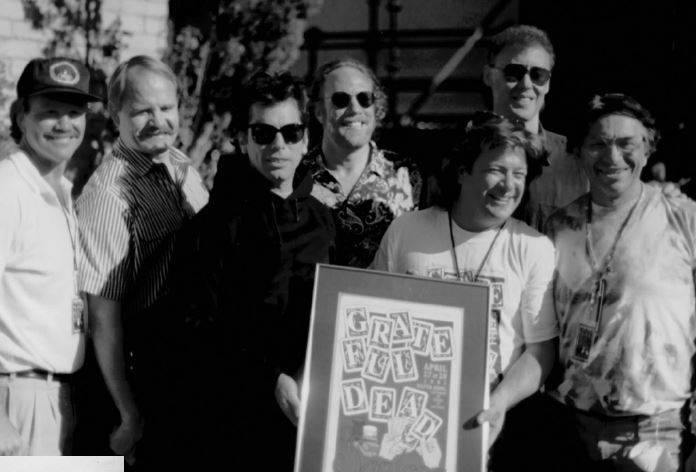
The players (from left to right): Rock Vegas author Pat Christenson, stadium director Dennis Finfrock, Dead drummer Mickey Hart, keyboardists Vince Welnick (of the Tubes fame) and Bruce Hornsby, and promoters Danny Zelisko and Bill Graham at the Dead’s first Vegas stadium concert, 1991
Speaking of stories, this one comes from our new book, Rock Vegas—Live Music Explodes in the Desert. Rock Vegas covers the live-music scene in the Entertainment Capital from A to Z: the challenges of the earliest concerts, including the Beatles; Caesars’ outdoor concert venue; history of the Thomas and Mack and Sam Boyd Stadium and an eventual four more arenas and a dozen theaters; the live-music business; residencies and festivals; and the future of music, both live and recorded.
Rock Vegas is a must for music and Vegas fans and it’s a great read for anyone interested in contemporary culture. For more of a sneak preview, the author, Pat Christenson, has a Rock Vegas blog.

 Never miss another post
Thanks for this. I recall that weekend fondly as one of the great moments of my life, and still have my ticket somewhere in my garage. Unlike the Dead concerts of that era in Northern California, where they had a system to crank out 20 or so shows a year, the Silver Bowl events had a charming do-it-yourself flavor, with lots of homemade signs and a “shower area” of water running through PVC pipes with holes drilled in them, which was great for cooling off. It was the weekend I became a fan of the Grateful Dead, and my first trip to Las Vegas since visiting as a child. My own take on it can be found at the link below.
Anyone can listen to the recordings, which like almost all Grateful Dead concerts were recorded in the tapers’ section and are now saved for posterity at https://archive.org/details/GratefulDead?and%5B%5D=boyd . Back then I had to give one of the tapers a set of blank cassettes and a self-addressed envelope and waited about a year until he had a chance to copy his recordings for me.