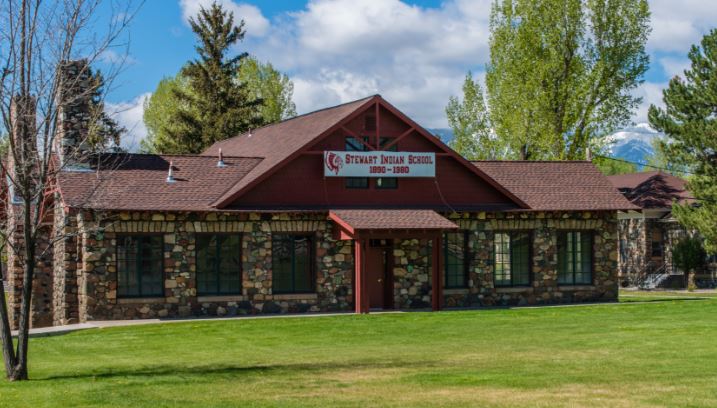
One of the highlights of Carson City, the Nevada state capital, is a visit to the Stewart Indian School.
Thirty full years after the complete dislocation of Nevada’s Native population, the U.S. Senator from Nevada, William Stewart, acquired federal funds to open this school in 1890 on a 240-acre campus south of the town.
At the time, the policy was to “assimilate” Native American children, which actually meant compelled conversion to white ways. In the early days, students were essentially kidnapped and forced to attend the school, which was run like a military boarding academy, with strict discipline, a total prohibition on Native traditions, ceremonies, and languages, and an emphasis on vocational skills. By the more enlightened mid-20th century, the direction changed to academics and Native heritage, though the vocational program remained strong throughout its history and Indian youth elected to attend the school.
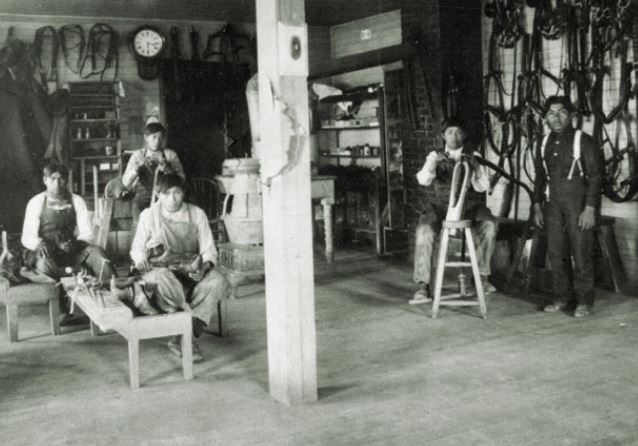
Stewart was the only off-reservation Indian boarding school in Nevada for all 90 years of its existence. When it closed in 1980, upwards of 30,000 students had gone through the program. In 1985, the school was listed in the National Register of Historic Places; it’s currently managed by the state, with some of the buildings occupied by administrative offices for the Nevada Department of Corrections and a law-enforcement academy.
The campus is open to the public. You can take a self-guided walking tour with 20 points of interest and listen to recorded stories accessed via cell phone. The school also annually hosts a Father’s Day Powwow, which was recently recognized as the 2017-2018 Best Cultural Heritage Experience by the American Indian Alaska Native Tourism Association. Several million dollars have been earmarked for renovating the Cultural/Welcome Center and the old gymnasium (where Governor Brian Sandoval played high-school basketball in the 1970s).
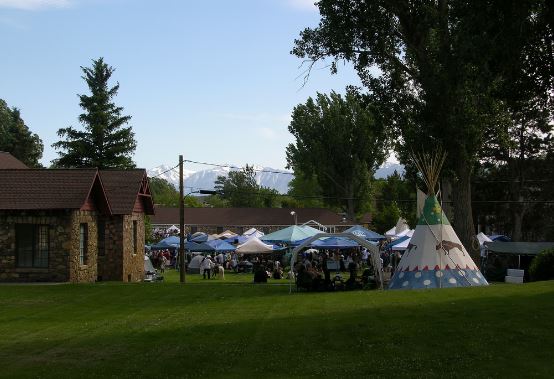
The campus has a palpable spirit. The stunning 1930s’ polychrome stone buildings, the huge old shade trees, some of which are 125 years old, and the connection to the long history of Native-white relations all epitomize the powerful soul of Carson City, which I’ll discuss in an upcoming blog.

 Never miss another post