This is a big topic that could easily fill a book — and it easily did: our own Cheating at Blackjack–Inside the Mindsets and Methods of the Game’s Most Successful Cheaters by Dustin Marks, one of the most successful blackjack cheaters from both sides of the table (he was also a dealer) of all time; he was never caught.
 If you want the deep inside dope on this subject, including stacking, past-posting, coolers, handmucking, outside plays, turning bosses, disguises, and more, you won’t do better than reading this book, only $14.96 from LasVegasAdvisor.com.
In the meantime, we thought we’d give you a preview of what we ourselves learned from Dustin and his highly revealing and entertaining tome, with a Question of the Day from LVA.com we ran in October 2016, along with further Q&As we fielded and answered in the comment boxes. This is a long page, but we believe you’ll find it worthwhile reading.
Question: I was playing blackjack during our last visit to Las Vegas. The dealer was dealing from a hand-held double deck. On three almost back-to-back deals, every player at the table showed a good and potentially winnable hand. On all three occasions, the dealer drew a 21 and beat every player. I’ve seen some amazing tricks and am aware of what can be done with a deck of cards. Is it possible that some dealers are so good that they can control a hand now and then to give the house a bigger advantage? In this case it sure seemed like it.
Answer: The short answer is yes.
A mechanic,” or a cheating dealer, can control the cards to the extent that he can “stack” the deck, or manipulate it in a such a way as to create or preserve a certain desired sequence of cards to be dealt. He can also deal seconds, which means knowing the value of the top card on the deck and dealing out the second card, saving the first card for himself or a confederate. The dealer can also ascertain the value of the top card if it’s marked in some way or by “peeking.”
Marking cards and dealing seconds are fraught with risk for a casino dealer, while stacking the deck is, essentially, free of the risk of getting caught (the deck can be stacked wrong, with would cost the dealer his money, but not his freedom). Stacking can occur in all card games and can be done in many ways, though the most successful method is to use a skillful shuffle. And blackjack is one of the easiest games to stack, because in its simplest form, the dealer has to control only two cards.
About those two cards. These are known as the “key cards,” the ones that have to be controlled during the shuffle, so they’re dealt to the proper player at the proper time. Key cards might be an ace and 10. Obviously, if this natural blackjack can be arranged to go to a player of the dealer’s choosing, it’s not a question of if the dealer’s “agent” will win, but how much he’ll win.
So that’s the first part of the long answer: A dealer needs a confederate in order to stack a deck (or deal seconds) for cheating purposes.
And here’s the second part. Stacking the deck is a highly complicated process that involves identifying the key cards as they’re dealt, picking up the cards in such a way that the key cards are in the proper position to be dealt after the shuffle, calculating the IBN or “in between number” of cards that have to be dealt in order that both key cards wind up in the same hand, controlling the slug that contains the key and IBN cards during the shuffle, and accounting for the burn card. And all this is for one hand, the first that’s dealt after the shuffle. To go through all that for even a second hand, let alone a third, would require superpowers.
Now, here comes the third part of the long answer –- in the form of a question. Why would a dealer go to all that trouble if there’s nothing in it for him? If his agent has a $2,000 bet out, he’s got plenty of incentive to stack the deck and deal him a natural, especially if the dealt cards are laid out just right before the shuffle.
But to do it just to beat the players? That makes no sense on several levels.
First, with some exceptions, all dealers want the players to win. Winning players tip out; losing players don’t. And tokes are the main source of income for dealers, who make minimum wage.
What about a cheating dealer taking off square players to cover his agent’s winnings? 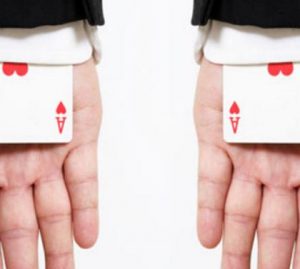 When the agent wins a substantial amount of money, it naturally generates attention from the bosses. But if the dealer cheats other players to make up for the loss, the attention doesn’t go away. The bosses will still focus on the winning player, possibly on the dealer too, if they suspect something’s not kosher. The only thing the dealer accomplishes by cheating other players is increasing his chances of getting caught. The fewer moves a cheater makes, dealer or agent, the better the chance of getting away with it. Getting caught means jail time and a felony record.
Yes, it’s tempting to think that a cheating dealer can make move after move on a table, but in real life, it doesn’t happen. In fact, the optimal result is when the agent wins so much money on the square that the dealer doesn’t have to cheat at all. Of course, this is a rare occurrence, but it’s the best possible scenario.
Finally, what about a mechanic employed by the casino to cheat the players? We believe it happened in the past, when a marginal casino could take off a high roller at will using a card mechanic. But in today’s world, the casino doesn’t have to cheat. A well-run joint has a million ways to beat the players legitimately and not risk its gambling license to eke out a few more dollars here and there by various nefarious means. Besides, then the casino is in bed with the dealer and that’s bad for both parties.
Ultimately, we consider the chances of a cheating dealer drawing to 21 to beat all the players at the table three rounds in a row are, statistically and realistically, zero.
Comment: “Re the Q about a blackjack dealer getting 21 three times in a row to beat all the players at the table, I’m puzzled as to why you wrapped up your discussion by saying that this occurrence was essentially impossible: ‘Ultimately, we consider the chances of a cheating dealer drawing to 21 to beat all the players at the table three rounds in a row are, statistically and realistically, zero.’
“I don’t know how to calculate the odds of that happening, but it’s not zero. I’d estimate it would be about 1 in 2,200, assuming that the chances of getting a 21 are about 1 in 13, and then to get the chances for 3 times in a row, you’d multiply 1/13 by itself and then again by itself (and get 2,197). That may sound like a long-shot, but from my own experience, either the dealer or a player getting the same total 3 times in a row actually happens relatively often.”
Response: Good point. What we meant to say, and should’ve worded more precisely, is that the odds of a cheating dealer being able to manipulate the cards to give himself natural 21s three times in a row are .00001 against.
Of course, anything is potentially possible, but again, not only would the mechanics of the move be so unlikely as to be improbable, but we also maintain that the herculean effort involved in such a thing, with a dealer’s normal disincentive also arguing against it, would put the odds hovering at just above zero.
Comment: “Regarding today’s QoD, another possibility. Granted, it was many years ago. I was playing BJack at a pretty sleazy casino and the dealer was dealing out of her hand with a lot of unnecessary razzle dazzle (lots of hand movements). After losing 7 hands in a row, I was convinced that she was practicing her skills on me. She kept dealing me low cards and herself 20s or blackjack. I had not seen her shuffle (should have asked for her to reshuffle, but if she was real good she might have had a way to conceal stacking the deck). I got up in disgust, figuring that she’d stacked the deck with the faces/aces on top–dealt me from the bottom (or some variation). So, what about a dealer who is just perfecting their skills on an (admittedly) novice player?”
Response: Hard to say for sure. But elements in your story don’t quite jibe.
First, “a lot of razzle dazzle with the cards.” The last thing a cheating dealer wants to do is draw attention to his or her hand movements. A cheating dealer is decidedly not a magician and would never use distraction and misdirection as part of a move. (Granted, cheaters do use misdirection, also known as “turns,” to get bosses and surveillance to look away when business gets conducted, but that’s a whole different story.) A cheating dealer wants to use as few unobtrusive moves as possible — just another auto-pilot dummy-up-and-deal robot putting in her time, collecting her tokes, and going home.
Also, dealers don’t “practice” their moves at the table. They practice endlessly at home (and at dealer schools), but when it’s time to get the money, they do their business quickly, quietly, and efficiently and then it’s over.
Finally, again, there’s the question of incentive. What was in it for her? Unless she was employed by the casino, which is a possibility (slim, because as mentioned above, now Miss Razzle Dazzle and Sleazo Casino are on a probable path of mutually assured destruction), risking her job and career just to beat a low-roller out of a few bucks in a grind joint? If she’s not beating the players on behalf of the house, then she has to get away with the money, which is what confederates are for, of whom you obviously weren’t one.

 Never miss another post