

Atlantic City had a bit of adversity in April, down 3.5%. However, when last year’s Trump Taj Mahal grosses are removed from the comparison, 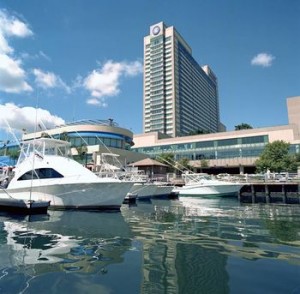 the Boardwalk was up 4%. Market leader, by an astonishing margin, was Borgata, garnering $58.5 million, almost one-third of the total market. In fact, it carried the market, as you will see below. Its tables parlayed a 3.5% increase in wagering into a 15% gain, while its slots eked out a 1% increase on flat revenue. Market-wide, table-games were down 12% on 4% less wagering and slots saw 2% less coin-in, resulting in flat revenue.
While Borgata was up 4%, the results were mixed for the Caesars Entertainment trio. The eponymous casino was up 13%, to $28 million, but Harrah’s Resort, usually the lead dog, fell 7% to $27 million. Bally’s was also off the pace, down 5% to $17 million. (We should all have such problems.) Resorts Atlantic City was flat, stuck in last place with $14 million, while Golden Nugget (pictured) was up 8%, for a gross of $18 million. But the standout performer was Tropicana Atlantic City, whose $28 million gross represented a 15% improvement. As for all those displaced, grind joint players left homeless by the Taj closing, the Nugget and Trop seem to have done the best job of Hoovering them up.
* Indiana casinos caught a break when the Lege revoked the state’s $3-a-head admissions tax, replacing it with on gross gaming revenues. They also eliminated an “add back tax,” which casino said was a tax on the taxes they were paying and that they were the only Hoosier State industry burdened with this levy. Said Horseshoe Hammond General Manager Dan Nita, “We are encouraged that the state is supportive of a few measures that will enhance the competitiveness of our casino operations. They recognize that no other business in the state is required to pay income taxes on other state taxes, which as we know, are quite significant.”
Boyd Gaming spokesman David Strow described the admissions tax as punitive. Every time Blue Chip made an improvement and foot traffic rose, so did taxes on the casino. In other words, it wasn’t rewarding casinos for making their facilities better — and a casino, like a shark, has to keep swimming or die. (Of Indiana’s Majestic Star II, I would quote Woody Allen and say, “What we have here is a dead shark.”)
As for the add-back tax, Pinnacle Entertainment‘s Troy Stremming said, “The current add-back tax is unfair. We are paying taxes on gaming revenue twice. Indiana is the only state to have such a policy. We will see some cost savings from that change and could use it for marketing or property improvements.” We encourage the Indiana government — and new Gov. Eric Holcomb (R) — to keep doing the right thing.
* Wichita Greyhound Park wants slot machines. It’s not going to get them, as the Kansas Legislature voted down the request. The vote was driven at least in part by the fact that this would violate the compact with the state’s four private casino operators by creating a *de facto* fifth casino. Sorry, Wichita.
* Even if American casino patrons don’t cotton to skill-based slots there may be another mother lode to mine: Japan. The wild popularity of pachinko is thought to create the kind of mindset that would respond  favorably to the SBS machines. “Maybe by the time [a] casino is opened in Japan, we will probably be in the second or third phase of developing skill-based games, giving us time to learn what kind of skill-based games works in the market,” said Sega Sammy Creation exec Takashi Maekawa. Considering that Japan is four to six years away from opening a casino, Maekawa’s remark is a bit of an understatement.
When casinos do open, they may find that Wakayama has dealt itself out of the game. Mayor Masahiro Obana is pushing the fiscally unappealing idea of a foreigners-only gaming house. He’s motivated by a lack of faith in his constituents, thinking them a rabble of problem gamblers waiting to happen. Sega Sammy COO Haruki Satomi responded that such a restriction might result in a far smaller casino investment, too. (Presuming that Obana wants to both have his cake and eat it.)
Casino developers are also going to have to deal with a very directive mentality in the prime minister’s office. Already they’re being told they’ll have to include a convention center, retail, a hotel and a tourist center that encourages travel to other parts of the country … including ones that have rival casinos. It’s a rather perverse suggestion but nothing about the casino-legalization process in Japan, filled with imponderables, has been straightforward.
