
Poor table play punished the Las Vegas Strip last month, driving revenues down 8%. Locals casinos, by contrast, were up 13%, possibly helped by some end-of-June coin lingering in the slot 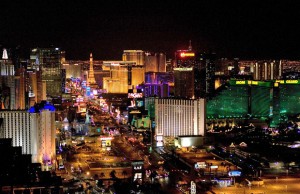 hoppers. But, if so, what’s the Strip’s excuse for not doing better? Las Vegas visitation was down only 1%, after all. Room rates and revenues were up, despite a tough comparison, Conventioneers flooded the city. Strip coin-in was actually up 3% but winnings slipped 1%. The real bloodbath came at the tables. Baccarat revenue fell 18% on 17% less wagering, while other table games dropped 9% on 9% less wagering. Although we’re always hearing about how Millennials love table games, non-baccarat wagering has been down in 11 of the last 12 months. A strong July 2016 (up 10%) made last month’s results look that much worse.
Downtown casinos were doing just fine, up 8%, while the Boulder Strip shot up 19%, hotly pursued by North Las Vegas, up 17%. Laughlin (+7%) and miscellaneous Clark County (+8.5%) also registered strongly, Reno was up 2% but Lake Tahoe tumbled 15%. I guess vacationers were too busy swimming and water-skiing. Elko and the Carson Valley were both up 8%.
Back on the Strip, Caesars Entertainment Chairman Gary Loveman had better start cleaning out his office. He’d promised to leave the  company once it was through bankruptcy and now we’ll see if he’s true to his word. There’s light at the end of the long Chapter 11 tunnel, with Caesars Entertainment Operating Co. projected to exit bankruptcy sometime this summer. That’s assuming that Louisiana and Missouri regulators don’t object, and we don’t see why they should … provided they can stay awake while reading the 800-page reorganization plan registered with the SEC.
Those last regulatory approvals should put an end to a two-year process of negotiating with creditors and coming up with a solution amenable to all. That resolution will free up CEO Mark Frissora‘s time to pursue casino opportunities in Brazil and Japan, even if the Nipponese market looks less promising by the week.
* Once you get past the initial shock of seeing the enormous slot floor at Sands Bethlehem comes the news that there’s less free play available at Pennsylvania casinos. It’s down 9%. That’s $59 million less than in 2013. (It could be worse: West Virginia free play has been slashed 21% in the last five years.) The explanations are manifold, and include both a strong economy and casinos writing off Baby Boomers. It comes down, as always, to the theory that slots have to be made more attractive to Millennials, although it will be some time before the industry solves that riddle.
* Taking a page from the Doug Ducey playbook, Indiana Gov. Eric Holcomb (R) says it’s “premature” to talk about entering into a gaming compact with the Pokagon Band of Potawatomi. The latter  are going to start building a Class II casino in South Bend, starting early next year. At the risk of questioning Holcomb’s competency, he’s putting the state’s taxpayers at risk. If Holcomb ignores the Potowatomi (who have entered into a revenue-sharing agreement with South Bend), the state isn’t going to see a nickel of revenue made at Four Winds — revenue that is probably going to be diverted from the state’s 13 private -sector casinos. Complacency hardly seems the advisable course at this moment.
Although not as close to Boyd Gaming‘s Blue Chip as the tribe’s Four Winds New Buffalo (in Michigan), Four Winds poses a serious threat to the Boyd riverboat and a lesser one to the two Majestic Star riverboats. Casinos are already a failing revenue source from Indiana, down 35% since 2010. Four Winds will make the problem that much worse. At present, plans for the casino call for 1,800 electronic-bingo machines. Holcomb could dangle table games and full-fledged slot machines before the Potowatomi but, for reasons known only to himself, is choosing not to do so.
The state has hired the Dykema Gossett law firm to conduct a year-long study of the issue, which seems a lot like bolting the barn 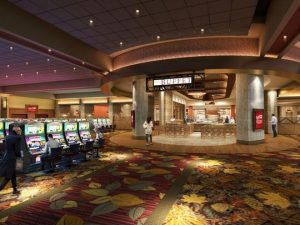 door after the horse has fled. Don’t put all the blame on Holcomb: Legislators seem actively indifferent to the giant sucking sound over in South Bend. Already, a proposal to put a casino license in Terre Haute died from disinterest. Nor are the Potowatomi actively pursuing a compact, arguing, against conventional wisdom, that table games don’t generate that much revenue and they’ll be just fine with Class II machines.
The only person not whistling past the graveyard is Boyd CEO Keith Smith, who told investors, “We’ll be prepared to fight it out and see what happens. We don’t have any predictions, but we’re certainly aware of it, certainly paying attention to it and certainly preparing for it.” Two other tribes are trying to obtain land-in-trust for Indiana casinos, but they’re stuck in red tape, giving the Potowatomi an open field to the goal line.
* While we’re in the vicinity of Michigan, it’s worth noting that state  Sen. Mike Kovall (R) is making one more run at legalizing Internet gambling this fall. He’s spent the summer making nips and tucks to his previous legislation, which would enable all the state’s tribal and private-sector casinos to set up i-gaming platforms. Although details of Kovall’s new bill aren’t available yet, we’re keeping our hopes up.
* A big S&G hats-off to MGM Resorts International and partner Pansy Ho for kicking $3.7 million into typhoon-recovery efforts in Macao. Not to be outdone, Lawrence Ho pledged to match the  MGM-led contribution. Acknowledging the lack of potable water in Typhoon Hato‘s aftermath, Sands China distributed 10,000 bottles of H2O to employees. A 100-volunteer task force was detailed to “clean up debris in the streets Saturday. They then headed to Fai Chi Kei public housing to distribute bottled water, meal boxes and cleaning kits to families in need.” Sands is also making shelter available in Venetian Macao, as a second typhoon makes land. A big thank-you to all the casino companies who are giving back to the disaster-stricken Macanese community.
