
Gaming & Leisure Properties met with Wall Street analysts this week and it had the future of Wynncore on its mind. “While GLPI remains open to doing Las Vegas 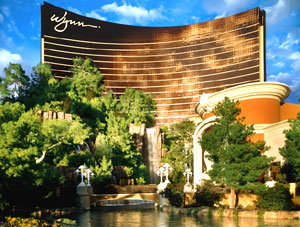 asset transactions, they view the risk profile as considerably higher given the volatility and maintenance capital expenditure requirements,” wrote Deutsche Bank‘s Carlo Santarelli. “CEO Peter Carlino made a vague reference, to we believe, Wynn Las Vegas, noting that they are unlikely transaction participants if ‘expectations are anywhere near what I’ve kinda heard'” That doesn’t mean GLPI isn’t in a buying mood: “Management noted that tax reform should aid future transactions as it provides several benefits, as well as clarity.”
In the meantime, GLPI is buying Belterra Park and Penn National Gaming‘s Plainridge Park, and renting them back at $7 million and $25 million, respectively, which seems fair in light of their relative performance. JP Morgan analyst Joseph Greff liked what he heard, adding that “we think investors are getting an attractive dividend.”
GLPI’s main tenant, Penn National Gaming, told Santarelli “trends in the regional markets were relatively weak in January and early February and attributed the softness 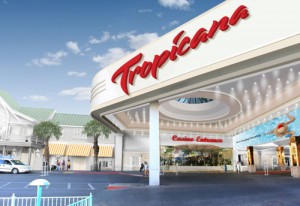 to weather … Management remains comfortable pent up demand will come forth in the quarter, though our revenue forecasts assume a more modest pickup. Lastly, management commented that, with respect to the database, rated spend per visit was healthy across the board in the 4Q17, while unrated play grew in 2/3 of their properties.” Room rates at the Tropicana Las Vegas were falling, dragging other departments with them. Ownership blamed this, in part, on an aggressive promotional climate. “While group trends have been largely unaffected, leisure/transient rates remain challenged.”
On its home turf in Pennsylvania, Penn National is vexing Gov. Tom Wolf (D). Despite having successfully bid for a mini-casino, it’s suing the state — in effect, suing against its own business interests. Wolf isn’t buying Penn’s claim of irreparable harm at its eponymous racino. “Hollywood Casino‘s 25-mile protective zone in all directions is more than a casino like Presque Isle of [sic] the Meadows receives due to competition in neighboring states,” reads a court filing. Wolf’s case hinges on whether Penn can “demonstrate that it was intentionally treated differently than other casinos.”
* Indiana gaming revenues slipped 2% last month, grossing $164 million and possibly indicating early inroads by Four Winds Casino in South Bend, which is not compelled to report revenues. The strongest indicator was an 11% falloff at Blue Chip Casino ($10.5 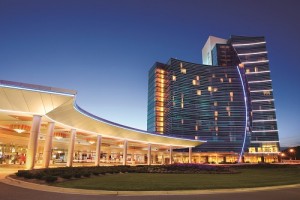 million, left), Boyd Gaming living to regret its having scoffed at Four Winds. Majestic Star I also suffered ($6.5 million, -11%) as did Majestic Star II, down 6% on a $4.5 million gross. Horseshoe Hammond was flat at $33.5 million, while Ameristar East Chicago was positively triumph, up 9% and grossing $18 million.
The star performer remains Tropicana Evansville, up 9.5% to $11 million. All other southern Indiana casinos were down, especially French Lick, taking a 10.5% licking ($6 million). Hoosier Park ceded 4% for a $13 million gross while Indiana Downs took in $18 million but was off 5%. Rising Sun ought to be called Setting Sun, sinking 10.5% for a $3.5 million pittance. Belterra was 9% to $7 million, while marginal retreats were made at Hollywood Lawrenceburg ($12.5 million, -1%) and Horseshoe Southern Indiana ($18 million, -1.5%). Players were spending large — 20% more — as foot traffic was off a staggering 19%.
* MGM Resorts International can’t make the aftermath of the Mandalay Bay massacre go away but it can perfume the pig a bit. It’s renumbering the floors in Bay. Henceforth, 31-34 will be 56-59. In a sense, that puts them floating in thin air, because the hotel has only 43 stories. Law enforcement is making some progress on the case, nailing the arms dealer who sold Stephen Paddock his tracer ammunition. Mesa, Arizona ammo salesman Douglas Haig has been charged with conspiracy to make and sell armour-piercing ammunition without a license. It’s a good start.
For all of MGM’s post-10/1 angst, it’s doing some good that we’re glad to help publicize. Let’s hope the rest of the industry follows MGM’s lead.
