

Our in-box has been flooded with links to the Roeben leak, which serves the company as a nice distraction from $19 billion in long-term debt and a $7 billion Eldorado Resorts balloon payment. Emphasizing who they’re keeping from the ancien regime momentarily takes our attention from the elephant in the middle of the room: Who’s getting the chop? Also, could Tom Reeg find himself in the position of the dog that caught the car? We remain unpersuaded that Eldorado hasn’t bitten off more than it can chew. It’s grown exponentially in a dizzyingly short time. You’re not in Reno anymore, guys. At least they’re getting off to a “george” start by offering 30%-35% room discounts to essential workers, across the Roman Empire. Two caveats: Don’t book through the call center or you’ll be walloped with a $15 surcharge and don’t book a Las Vegas stay unless you want to pay resort fees, which may negate your savings.

Sen. Lindsey Graham (R) used the Senate Judiciary Committee yesterday for some election-year grandstanding—his seat is contested this year—against gambling. The ostensible subject of the hearing was the integrity of college athletics, but Graham got in some gratuitous blather about the evils of Internet play, thereby warming the cockles of Sheldon Adelson‘s heart and wallet. He also “also expressed his concerns on sports betting, particularly of the amount being wagered on athletes in college.” There’s money being gambled on college sports? We’re shocked, shocked! University of Pittsburgh Director of Athletics Heather Lyke railed against sports betting and prop bets in particular. Complaining of a “patchwork of state laws,” (damn that state sovereignty!) she called for congressional intervention. Seeking to turn back the clock, she demanded a federal prohibition on collegiate sports betting, and its “corrosive and detrimental impact.” Lyke raised such specters as athletes receiving death threats if they don’t cover the spread or what have you.
Continuing to swat at phantoms, Lyke fretted about student players missing jump balls, for instance, to fulfill prop bets—as though this could be legislated away—and warned of “gambling interests” bribing “individuals that have daily information about student-athlete’s health and readiness for competition [who] are fellow students, athletic department staff members, athletic trainers, graduate assistants who may be more susceptible to the temptation to share that information for money.” And pushing sports betting back into the shadows solves this how? Lyke even admitted that the combined forces of the NCAA and school system are “unable to police” the situation. Lyke’s ‘compromise’ would be an outright ban on collegiate-sport betting, such as certain states have enacted. But would her cure be worse than the (largely imagined) disease? Even Lyke admitted “she could not say how many sports and contests may involve match fixing today.”
 Playing on defense, American Gaming Association President Bill Miller gave what is described as “solid testimony” which “noted that legal operators have always been the first to alert to improprieties in the market and bring these issues to regulators that have, in turn, addressed the issue.” Said Miller, “Rather than preventing sports betting in the U.S., [the Bradley Act] instead enabled a massive illegal sports betting market that the AGA estimated to be in excess of $150 billion dollars annually. Though certainly not what Congress intended, this failed policy inadvertently provided a near monopoly to illegal gambling operations that fuel other criminal activity, do not provide any consumer protections, and generate no economic benefits to states or tribal nations.” His curative to the illegal market would be a continued march toward the legal sports betting enjoyed by 41% of Americans today. Talking in a language politicians are sure to understand, Miller pointed out that taxes on sports betting raised $195 million in the last two years.
After outlining various AGA problem-gambling initiatives, Miller returned to his main theme, saying, “Even the mere suggestion of scandal poses the risk of inflicting significant damage to our operators’ brands and reputations, as well as real economic harm if a bet is placed on an event if the outcome is fixed … Analyzing data from legal wagers leads to identifying potentially irregular betting patterns that can uncover match fixing. In fact, the vast majority of sports betting scandals over the past 40 years were uncovered either directly by or with the assistance of legal sports betting operators in Nevada,” a microscope now magnified by data from 18 other states (with more on the way). Throwing Lyke a bone, he said, “we realize some stakeholders remain concerned about bets being placed on collegiate events—based primarily on the presumption that unpaid, amateur athletes are more at risk of being corrupted by those seeking to influence the outcome of sporting competitions. While that may indeed be the case, it is also perhaps the most compelling reason to apply strict regulatory oversight and that only comes from the legal market.”
Noting that iterations of legal gambling exist in 48 states and are among the most highly regulated industries around, Miller summed up, “As Congress has refrained from regulating lotteries, slot machines, table games and other gambling products, it should similarly refrain from engaging on sports wagering, barring an identifiable problem that warrants federal attention … the AGA vigorously opposes efforts to use federal or state legislation to mandate certain relationships between the gaming industry and sports leagues. These are commercial relationships that are routinely left to private business contracts.” He also neatly skewered efforts to make information ranging from sports scores to injury reports proprietary data subject to copyright.
In what may have been an unfortunate concession to the Senate, Miller allowed that “we do believe it is appropriate for Congress to consider targeted measures to help ensure the success of a safe, legal, regulated sports betting industry … We believe Congress should consider increasing the maximum criminal penalty for match fixing beyond five years given the seriousness of this offense.”
On the other hand, he represented for sports books (and their low margins) by calling for repeal of the federal excise tax on sports bets. “In contrast, illegal wagering operators generally have little overhead and virtually no tax or regulatory compliance outlays. This competitive advantage allows them to enjoy far higher profit margins, while also offering consumers better-paying odds.” Miller concluded, “I hope members of the Committee will recognize that prohibition has already proven to be a failed approach that creates significantly greater risk … The primary role of the federal government should remain enforcement against the illegal marketplace and represents the most meaningful solution to help ensure the integrity of sports.”
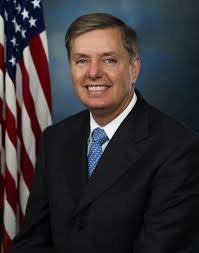 Graham continued to get his skirts in a bunch about prop bets (abetted by Sen. Richard Blumenthal [D], who furrowed his brows about match fixing) before getting back to his old hobbyhorses, the Wire Act and Internet gambling. Focus, Lindsey, focus! (Not present at the hearing but also trying to get the federal camel into the state sports-betting tent are Sens. Chuck Schumer [D] and Mitt Romney [R], but even they don’t call for prohibition, to their credit.)
Global Market Advisors, after witnessing the charades on Capitol Hill, scolded Lyke for her “naivety” on the history and penumbra of illegal betting on college sports. But it reserved its greatest scorn for the NCAA, guilty of “putting their head in the sand when it comes to legislation and allowing their ignorance to result in the use of scare tactics and half-truths which only caused confusion in the debate.” Furthermore, it’s had two years to formulate a response of the voiding of the Bradley Act and “has ignored multiple attempts from multiple organizations to provide education, programs to member institutions, and an understanding of how best to operate internally in a legal market. Their lack of engagement will only continue to feed the illegal market and the ills that come along with it.” Amen to that.

Staying now and I’m a platinum card holder! I will never return ever to theses properties!! So disappointed
Ceasers s security is a joke! They let prostration And homeless haremassmaent to the customers! Got the money stay else!