

Undistracted by the current shenanigans in Washington, D.C., the American Gaming Association‘s Geoff Freeman is staying on course  about legalized sports betting. The AGA recently commissioned a Greenberg Quinlan Rosner poll that concluded — surprise! — that most Americans favor legalized sports betting. What is a surprise is that 62% surveyed didn’t realize it was illegal. Other takeaways from the poll were that 28 million Americans would be more likely to bet on sports if it were legitimized and that 72% of hardcore fans favor terminating the Bradley Act, which outlawed sports betting in all but three states.
“A majority of Americans see clear positive consequences of legalizing sports betting: increased revenue for communities and increased safety for bettors,” reasons the report. At present 55% of those surveyed (using a 1,200-response sample) favor legalization against 35% opposed. It’s almost a deadline among non-sports fans but, even here, legalization is favored, albeit by three points. Millennials are 61% in favor and, no shit, Sherlock, DFS players are 88% positive. I’m only surprised that the last number isn’t higher since they’re betting on sports already. Women, older people and the churchy set are the study’s weak underbelly.
Nineteen percent of respondents admit to betting on sports, although the survey reckons the actual number to be even higher, “whether due to social desirability bias or because they forgot or did not realize that they had.” The appeal of sports betting crosses party lines, including 61% of Donald Trump supporters. (Hillary Clinton voters were relative milksops, only 50% in favor.) Higher-income demographics are also strongly in favor. Football, not surprisingly, the bettor’s sport of choice, with golf way down at the bottom, at 25%. Good news for Pete Rose: 53% surveyed want to legalize betting on baseball. Charlie Hustle might make it into Cooperstown yet. Concludes the report: “Few other issues attract such clear support from Americans across party lines.” You can say that again.
* Indiana gaming revenues seesawed so much last month that one needs Dramamine when reading the tallies. Horseshoe Hammond, the only casino in Chicagoland that can go mano-a-mano with Neil Bluhm‘s Rivers Casino, was as potent as ever ($35 million) despite a 5% dip. Ameristar East Chicago was not so lucky, falling 15% for an $18 million 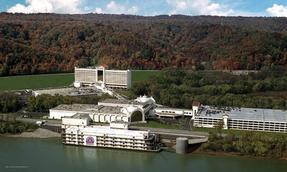 gross. Maybe they should put the Trump brand back on Majestic Star II. Business never seems to get better there, as it tumbled 9%to $5.5 million. Majestic Star I remained the players’ choice, up 1% to $9 million. Boyd Gaming‘s Blue Chip fell off 4% to $13.5 million.
Pinnacle Entertainment recouped some of its fortunes at Belterra, up 9% to $10 million. Hollywood Lawrenceburg fell off 13% to $14 million. Horseshoe Southern Indiana only rose 1% but that was good for a dominant $21 million gross. Even construction can’t keep players away from Tropicana Evansville, up 1.5% to $11 million. Rising Sun eked out a 1.5% increase to realize a $4.5 million gross. Further north, French Lick Casino was up 10% to $8 million, while racinos Hoosier Park and Indiana Downs were 1% and 1.5% off the pace, respectively, grossing $16 million and $20.5 million.
* Well, knock me over with a feather. The Schaghticoke Tribal Nation wants to be included in a Connecticut bill that would open bidding on a “satellite” casino to everyone, not just Mohegan Sun and Foxwoods Resort Casino. Considering that everyone making a bid would have to pledge $500 million in investment on the project, I think  I detect the fine hand of MGM Resorts International. No offense but the Schaghticoke haven’t shown that they have two nickels to rub together. Indeed, MGM’s Uri Clinton said, “From our standpoint our win is whether or not we can find an economically feasible path to tapping into the New York market which by the way also helps the citizens of [Connecticut] and that’s a win win.” MGM, however, appears to be swimming upstream.
Casino expert Clyde Barrow sees it differently. If someone other than the Mohegan Sun/Foxwoods coalitions wins, then the state’s existing tribal compact is reopened for negotiation, with potentially deleterious effects upon the state budget. Barrow was commissioned by the two casinos to conduct a study on the economic impact of a competitive-bidding process and concluded it would cost the state over $85 million. “For the State of Connecticut to merely break even in terms of state revenue, a competitively bid third casino would need to generate $1.063 billion in gross gaming revenue annually. There is not a single commercial casino in the United States generates that level of gaming revenue,” said Barrow. No disrespect to MGM but we don’t think even they could crack the billion-dollar ceiling.
