

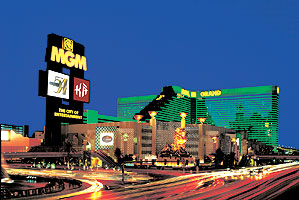
It should come as no surprise that Washington, D.C., the land of smoke-filled rooms where sleazy deals are made, should be deliver a bumper crop of players to MGM National Harbor‘s 39-table poker room. Even with a truncated month of operation,  MGM was responsible for $1.4 million of Maryland‘s $3.9 million poker haul. “We are either at capacity or near capacity most days, and we are regularly getting 100-150 name waiting lists for some games. It’s been incredibly high volume,” Manager Johnny Grooms told CardPlayer.com. He likens the room to the one at Aria, with a touch of Bellagio in the mix. The early results vindicate Groom’s early hypothesis “that there was an under-served population in Southern D.C. and Northern Virginia, and in the more expansive area down to North Carolina.” So far, the narrative that National Harbor will expand the market, not cannibalize it, seems to be largely holding true.
MGM’s also using its position near the nation’s capital to set up a lobbying shop on C Street for gaming interests (specifically MGM’s, although Continue reading
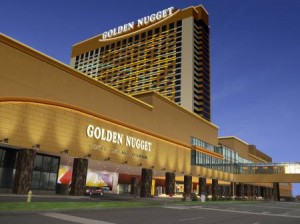 Golden Nugget is far and away the leader, with 26%. Enjoy it while you can, because would-be Attorney General Jeff Sessions
  ‘[Trump] said in a series of interviews that he does not need to read extensively because he reaches the right decisions ‘with very little knowledge other than the knowledge I [already] had, plus the words ‘common sense,’ because I have a lot of common sense and I have a lot of business ability.'” So writes gaming-law expert I. Nelson Rose in a stemwinder on how Trump’s policies toward China — and his propensity for diplomacy via Twitter — could ricochet and wreak havoc on Las Vegas. Rose explains the tortuous history of relations between the U,S. and Communist China, the importance of nuance in diplomacy, the primacy of saving face in Chinese culture — and how Trump’s bull-in-a-China shop tendencies could backfire. (In case you think Rose is an ivory-tower academic, he teaches annually at the University of Macao, putting him in closer contact with the Chinese people than Trump.
 “We have not considered that yet. Because we need to do well on our Grand Lisboa Palace project now, as the project is in full swing.” — Sociedade de Jogos de Macau Executive Director Angela Leong, dismissing rumors of a Japan foray by the company, whose Macanese resort is dragging behind schedule, its opening postponed into 2018.
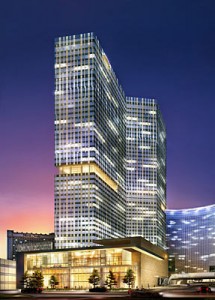 Convention business remains a pillar of strength: “we believe the overall book of group business remains quite strong and the rate of group pricing growth has accelerated.” High-roller player remains somewhat of a will o’ the wisp, although it’s been better on the domestic front … due in part to tighter holds and “player unfriendly rule changes.” Regionally, Santarelli is blaming Jesus Christ (or the NFL) for the surprisingly weak December, Christmas and New Year’s Day having fallen on Sundays — but don’t we have Christmas and New Year’s every year? Just checking.
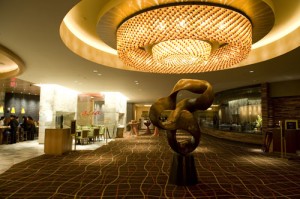 largely due to strength in the St. Louis area, where Pinnacle Entertainment‘s River City was up 4%, to $19 million. Ameristar St. Charles was less fortunate, grossing $22 million but down 5.5%. The latter lost market share to Penn National Gaming/GLPI‘s Hollywood St. Louis, up 6% to $19 million. Tropicana Entertainment had a good month at Lumiere Place (right), up 5% to $12 million. The brightest light in Kansas City was Ameristar Kansas City, down 1% to $16.5 million. Runner-up Harrah’s North Kansas City was down 9%, to $14.5 million. Penn/GLPI’s Argosy Riverside grossed $12.5 million, a 3% slippage. Isle of Capri Kansas City balanced a $6 million gross with a 6% falloff.
 to the increasing prevalence of slot routes (many owned by Penn National Gaming,) Foot traffic was way off (11%), although gamblers spent only 7% less … guess they weren’t saving that much up for Christmas, Boyd Gaming‘s Par-A-Dice took it upside the head, off 9%. ($6 million). Speaking of Penn, its three properties were flat in the aggregate, a 4% drop at Empress Joliet ($9 million) balanced by steady numbers at Hollywood Aurora ($10 million) and a 3% bump at Argosy Belle ($3.5 million).
 was down 4%. Had National Harbor been open a full month, the cannibalization would have been worse still. The new casino on the block grossed nearly $42 million, or $1.75 million a day. Maryland Live took it in the shorts, its market share diminished from 55% to 36% virtually overnight. (Of course, having 36% market share is still pretty good.) How big is MGM? Deutsche Bank analyst Carlo Santarelli projected 2017 results of $561 million but has revised that number upward to $637 million.
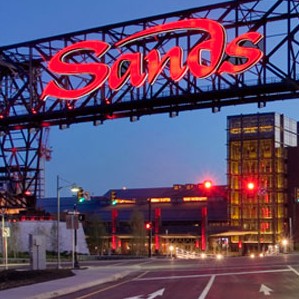 bean-counters instead of strong, committed local leadership that recognizes the advantages of a cooperative relationship with neighbors who share in its prosperity.” — Morning Call columnist Bill White on Sands Bethlehem‘s
  also
also  bankruptcy. “Tectonic changes in China” were tagged as the inciting incident (Sheldon Adelson recently lost $3 billion of his net worth in 30 minutes, when the markets had a coronary over China’s restructuring of UnionPay usage in Macao). In addition to heavy Macanese exposure, $39 billion in long-term debt
 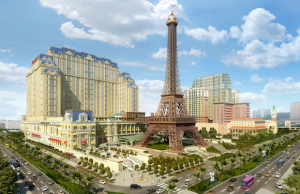 U.S., cushioning the blow felt from the drop-off in VIP play. At present, analysts expect Macao to close out 2016 down 3.5% in gambling revenue but to be up 7% this year, according to a survey conducted by Bloomberg News. Overnight stays are up 10% (and day-tripping is down a comparable amount) with the average length of stay just over two days. “There are definitely more reasons to come to Macao now versus two years ago and that is the key reason why overnight visitation is growing faster than total visitation,” reported Richard Huang of Nomura Holdings, who foresees continued growth in the mass-market sector. Even a bad year in Macao is a lucrative one: 2016 is expected to yield $28 billion, which only the most wildly optimistic projections for Japan can rival.
 casino-reporting “reforms” that would have been intrusive, onerous and costly. (Of course, it could be argued that the IRS’ purpose in life is to be “intrusive, onerous and costly.”) First and foremost, the idea of halving the jackpot-reporting threshold to $600 goes away, taking away untold amounts of paperwork — and idled slot machines — with it. Also abandoned is the notion of tracking players’ winnings through loyalty cards, which the AGA said “are not equipped to serve this purpose and customers are uncomfortable with the proposed approach.” (I’ll bet!)
 Absher didn’t exactly help his own cause by telling the Los Angeles Times, in essence, that the new policy was undertaken to
 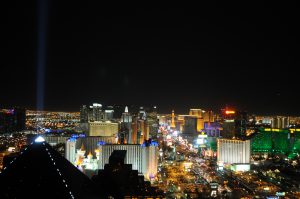 wagered. Strip casinos were somewhat luckier at other table games, down 4% on 9.5% less betting. (Tighter holds were credited.) But a 2% increase in slot revenue was of no avail, with win down 3%. JP Morgan analyst Joseph Greff, however, hailed the sixth straight month of increased slot handle as “an encouraging sign.”
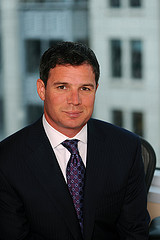 Association President Geoff Freeman was framing a
 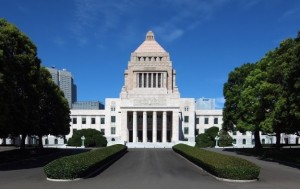 Japanese Diet prior to adjournment. “To us the opportunity is thoroughly Japanese and thoroughly delicious,” said a lip-smacking Steve Wynn. Due to several complicating factors, including the need to write gaming regulations, we’re a long way from “Let the games begin!” However, Wall Street analysts are busy counting the money already. “On an overnight basis, we would expect Japan to exceed the [gross gaming revenue] of the Las Vegas Strip,” opined Union Gaming Group‘s Grant Govertsen.