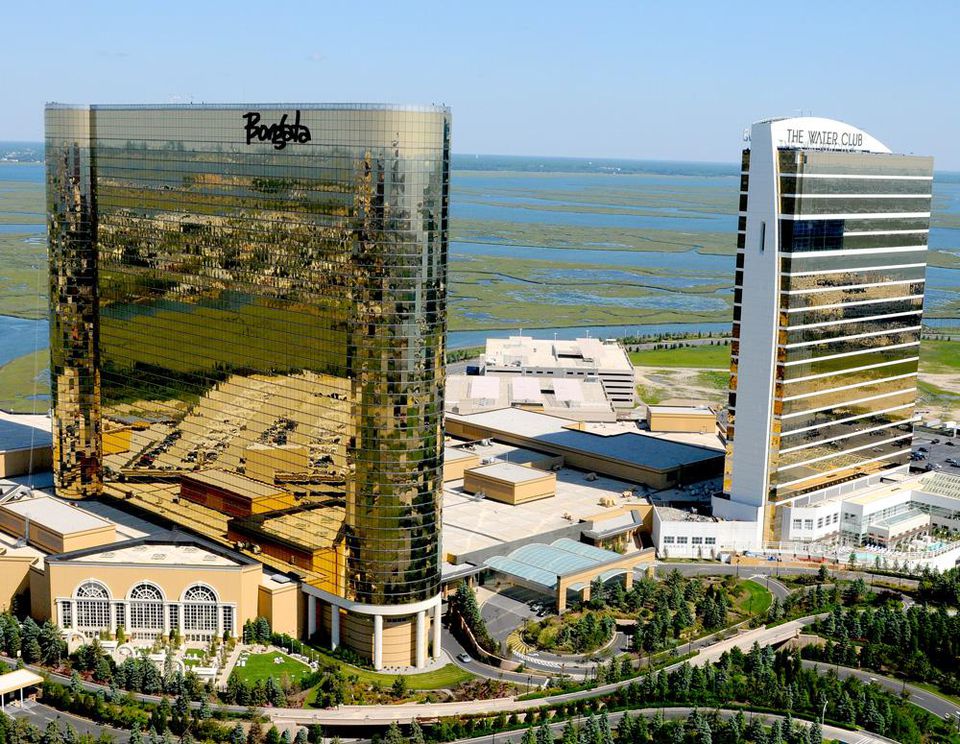
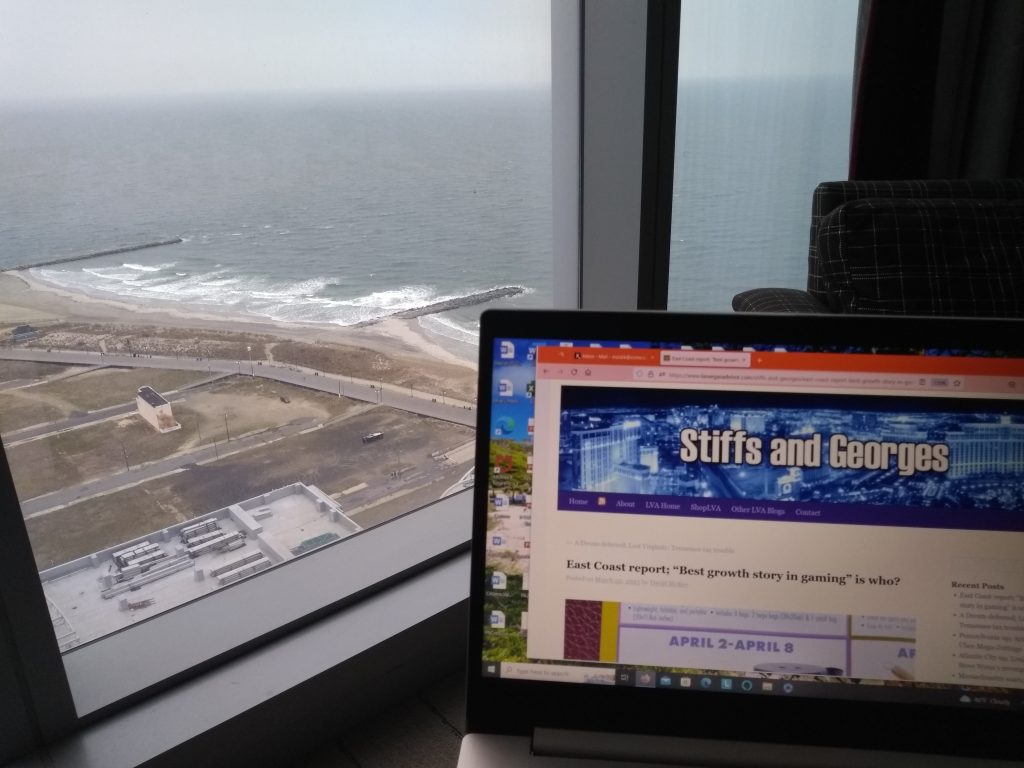
All was not sunny at Borgata last weekend. Our Atlantic City correspondent writes, “When we were driving back to Borgata, heavy rain started. As we pulled into MGM valet intake the wind was getting stronger. The luggage carts were starting to roll around, so the valet people took quick action and knocked the luggage carts over into the nearby grassy area to keep them from hitting parked cars. The wind got extremely strong, and started to make the parked cars rock back and forth, including ours, and we even felt some ‘lift.’
Caesars Entertainment CEO Tom Reeg and Senior Vice President of Corporate Finance Brian Agnew just sat down with Deutsche Bank analyst Carlo Santarelli, who came away sufficiently impressed with the Roman Empire to maintain a “Buy” rating on CZR. Santarelli found the execs “largely balanced and consistent,” their top priority being to reduce debt at the company, which definitely should be Job One. Other leading concerns are “operational prudence” and online execution. The analyst was pleased with “stable operations, underpinned by continued strength in Las Vegas,” as well as by continued traction towards profitability and growth in the Digital business.”
Truist Securities analyst Barry Jonas took a swing through Dixie casinos last month and had quite a bit to report. He hit the New Orleans, Lake Charles, Baton Rouge and Biloxi markets, his primary takeaway being that operators are consistent and resilient, and the macroeconomic impact “has been limited.” Horseshoe Lake Charles is reported to be growing that market, whilst impacting incumbent operators “less than we feared” (as already noted in these pages). As for macroeconomic impact, “The only notable softness appears to be with more value-oriented, lower-to mid-tier customers in select (but not all) markets.” Jonas partly blamed said softness on lower tax refunds (-11%) this year. He “also heard enthusiasm over social security cost of living increases and higher interest rates on savings flowing to discretionary spend for the older demographic.”
Ohio casino tallies jumped 10% last month, hitting $197 million. It was a decisive win for MGM Northfield Park, which outstripped the competition by grossing $25.5 million, an impressive feat for a casino with *no* table games. Jack Cleveland continues to surge, hitting $23 million (+13%) and surpassing the two Penn Entertainment casinos, so dominant for so long. Hollywood Columbus climbed 16% to reach $21.5 million and Hollywood Toledo nudged up 2.5% to gross $18.5 million. The last of the non-racino properties, Hard Rock Cincinnati, was up 6.5% to $20 million. The heat-up of Jack Cleveland didn’t hurt Jack Thistledown‘s cause, as the racino hopped 8% to $15.5 million. Scioto Downs grossed $20 million, an 11% leap, while Miami Valley Gaming delivered $20 million for co-owner Churchill Downs, a 14% vault. Belterra Park hung in there with $7 million (+2.5%), whilst Hollywood Dayton was up 8.5% to $13 million and perennial overachiever Hollywood Mahoning Valley netted $13.5 million in an 8% hop. As you’ve undoubtedly noticed, no one was revenue-negative, praise be.
Former casino overlord Donald Trump is monopolizing the headlines today but let’s not let him have all the fun. There’s plenty of other gaming-related news today. First and foremost, in the same week that Nashville has seen the latest in an endless series of mass shootings, our attention is drawn back to the Mandalay Bay Massacre, one of the worst. Seemingly every news outlet in the country has gotten ahold of the FBI report on shooter Stephen Paddock. Even though Paddock cased possible shooting sites from San Francisco to Boston, the G-men put down his Las Vegas outburst to a fit of pique. (Kudos to the Wall Street Journal for getting the feds to give up the goods.) A witness told G-Men that “was not treating Paddock well because a player of his status should have been in a higher floor in a penthouse suite.” Yup, that’ll really cause people to go postal. Happens every day.
Our East Coast correspondent had a good experience at Ocean Casino Resort last weekend. It started with no line at the “Prime” players-club check-in … although it was a quite a different (and worse) story if you fell into a lower player tier. Ocean rewards guests who “go green” (i.e., opt out of maid service) with a $20 F&B credit. “So our Saturday morning breakfast sandwiches were a few cents short of free. When we checked out, our balance due was $0.26 total. The employee asked if he should use ‘comps’ for the balance, but I paid cash.” Incidentally, Bart Blatstein holds several vacant lots in Ocean’s vicinty, but has announced no plans for them.
Gambling grosses were ultra-boffo on the Las Vegas Strip last month, up 19% over the year previous and leaving 2019 in the dust, +25%. Locals casinos didn’t fare too badly, either if not as spectacularly as their Strip brethren: up 4.5%. Strip casinos went “Kaboom!” with $712.5 million in the bank. Strip slots were tight, as 11% more coin-in yielded 16% greater casino win, for $390.5 million. Table game players also played poorly, luck being with the house to the tune of $223 million, an 11% improvement on flat wagering. Baccarat was back with a vengeance, as 20% more was played and the house took whales to the cleaners, to the tune of a 59.5% improvement in win, despite looser-than-usual hold.
Don’t hold your breath if you’re waiting for Tilman Fertitta to break ground on what will probably be a Post Oak Hotel on the Las Vegas Strip. The mogul is keeping his powder dry, or as Truist Securities analyst Barry Jonas summarized him, “No firm start date has been set, and management is willing to wait for clarity on economic conditions.” That could be a long wait. Already Fertitta’s high-end-dining business is softening, though Tilman expects his Joe Sixpack customers to be most affected by any economic downturn. And if you were wondering whether Tilman would expend any of his considerable political capital on behalf of Texas casino legalization, the answer appears to be no. Fertitta kept mum on the subject, beyond saying that Texas tribal casinos wouldn’t hurt his Lake Charles business, which hardly comes as a shocking analysis.
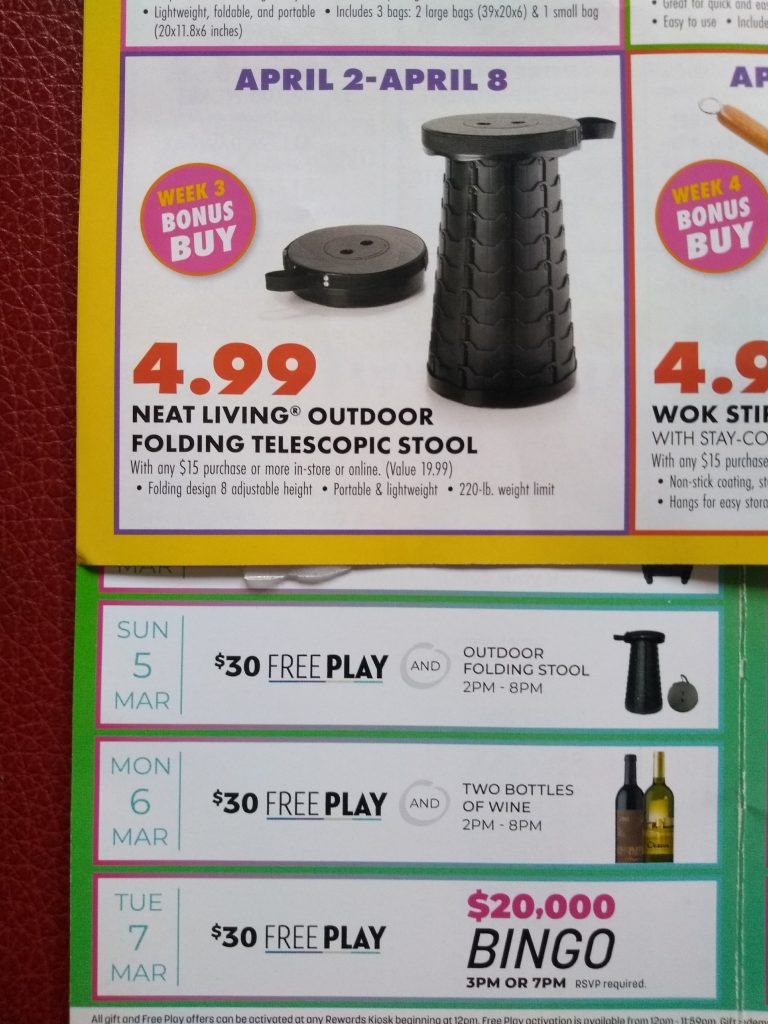
As we rummage through our mailbag, we find a number of dispatches from our East Coast correspondent, who recently helped prop up the Golden Nugget in Atlantic City with a three-night stay. He was drawn by a giveaway at Ocean Casino Resort (above): “They were having this odd gift of an ‘outdoor folding stool.’ Of course we had to have one. This week Boscov‘s (regional department store) had this ad showing the true value of the item: $4.99, with making a $15 purchase. I never knew the Illitch Family was so generous.” Throw in a mingy $30 of free play and it’s still not a George offer. That’s not how you get to number-one status, Ocean.
Speaking of promotions, Bally’s Atlantic City is touting “another free dinner at Guy Fieri’s, and a ‘meet and greet’ with someone from the Godfather film with drinks and prizes, including five violin-shaped vodka bottles.” That throws down the gauntlet to the Nugget, which is responding with “a ‘cocktail party’ with drinks and prizes (but no food). I can understand with the high price of food and ‘supply chain issues’. Perhaps Tilman Fertitta could ask Golden Nugget’s employees to go to some ‘food pantries’ and try and get some food for Nugget’s Elite level players.”
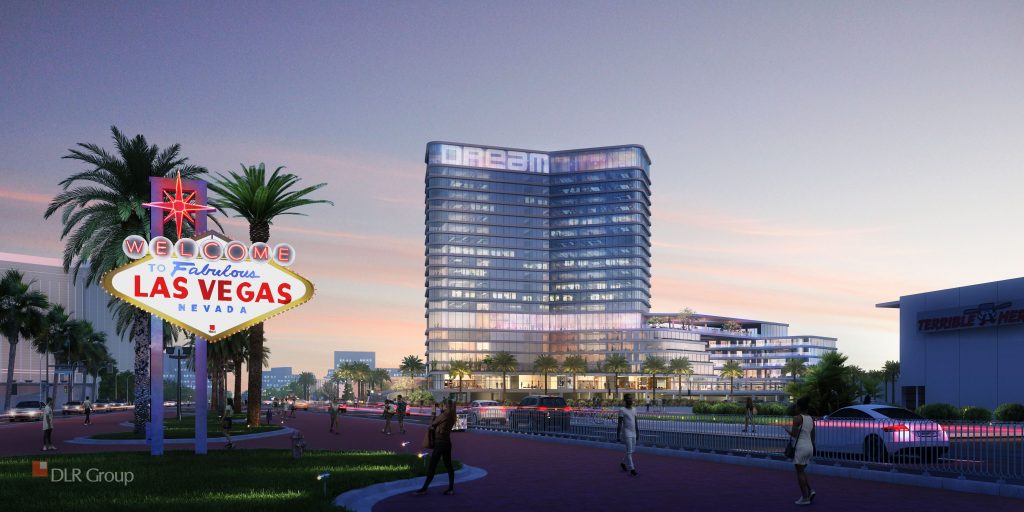
Don’t look now, Las Vegas but we may have another failsino on our hands. Construction has ground to a total halt on Dream, the south-Strip resort project that looked like a sure thing not so long ago. Developer Bill Shopoff is as much as $30 million in hock, stalling work on Dream. Shopoff is evidently renegotiating with his principal lender, for reasons undisclosed. (Cost overruns?) With a budgetary cap of $575 million, Dream has been proceeding so far from cash on hand, leaving it $400 million-plus short of the finish line. That’d require a “bridge loan” big enough to span Long Island Sound.
At $277 million, Pennsylvania casinos were 2% higher in February than last year, although a 12% declivity from go-go 2019 is further indication of a slowing recovery in gaming. Then again, after having reached record altitudes last year, how much higher can the industry go? Sports betting activing was flat at $599.5 million handle, which boiled down to $62 million in revenue, $43 million after promotional giveaways. As measured by handle, BetMGM is getting the least bang for its buck, spending 7% of handle for a 7% market share. Most efficient was Barstool Sports, laying out 2.5% of handle for a 6% share, closely followed by Caesars Sportsbook. Internet gambling was way up (29%) to $131.5 million. The catchall Hollywood Casino license, embracing three providers, brought in $56.5 million. BetRivers accounted for $26 million, surpassed by FanDuel‘s $27.5 million.
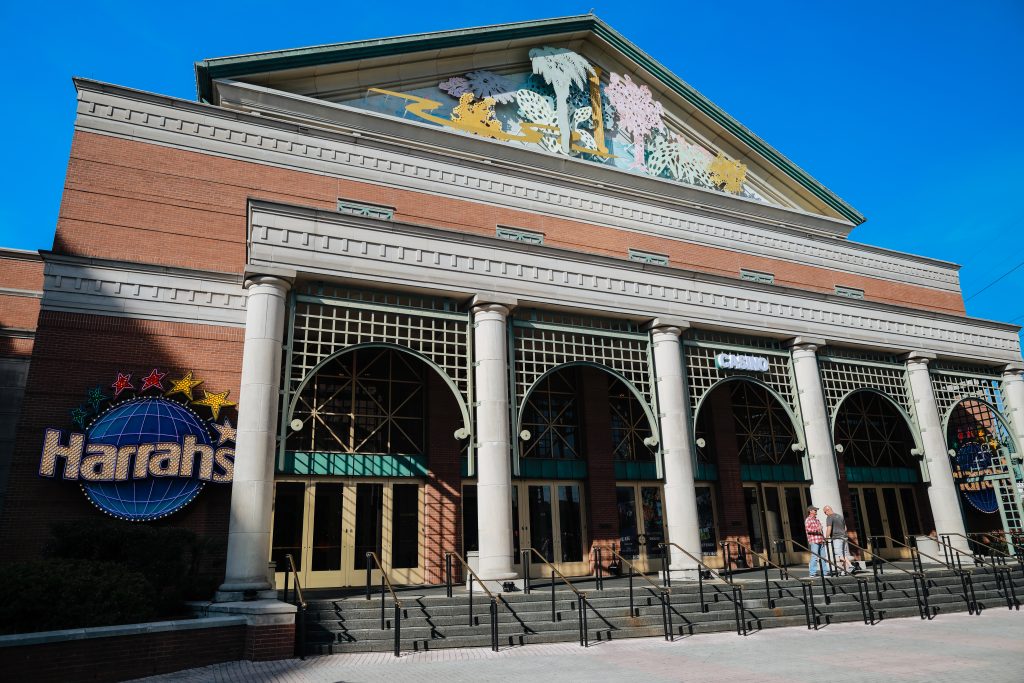
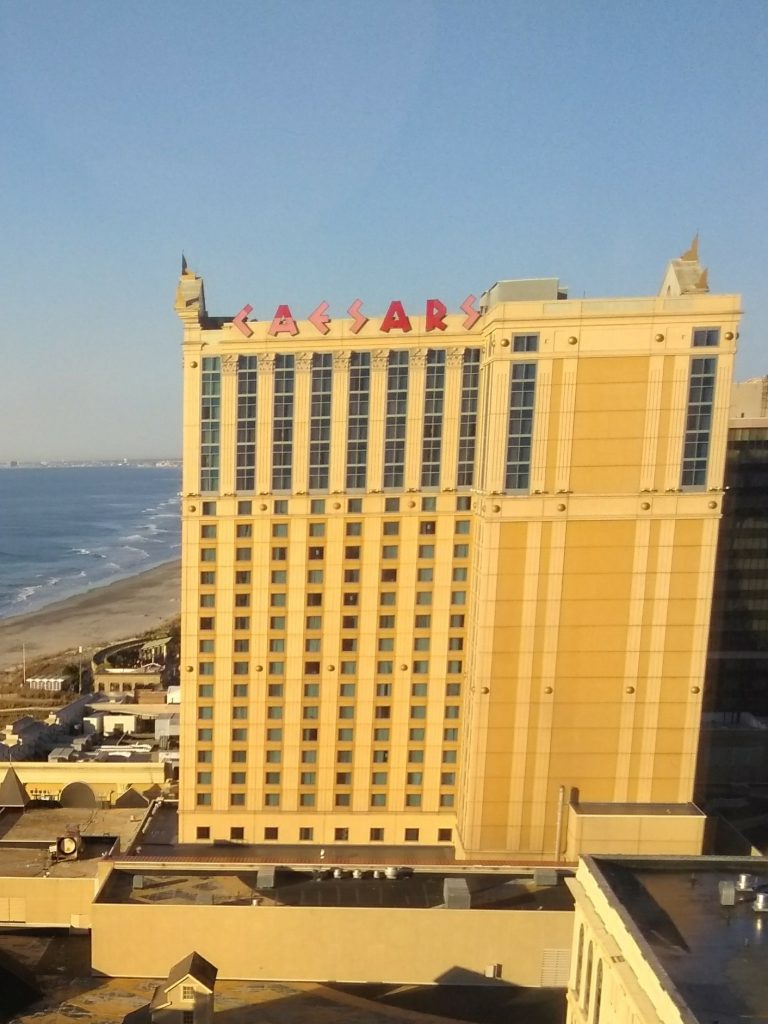
Gambling revenues inched upward in New Jersey, plus 1% statewide, mainly driven by Internet casinos (+9%). In Atlantic City, slot winnings rose 3.5% to ($159 million) on 4% more coin-in but tables slipped 4.5% to $54 million as wagering dipped 1%. The comp-sweating Golden Nugget tumbled 14% to $11 million, tightening its stranglehold on last place, well behind Bally’s Atlantic City ($12 million and an impressive +14%) and Resorts Atlantic City ($12.5 million, -2%). Borgata put even more distance between itself and the competition, up 9% to $57.5 million. Hard Rock Atlantic City was flat and way back at $37.5 million. Ocean Casino Resort slid 11.5% to $26 million. Does the Illitch Family still fantasize about having the top casino in A.C.? That leaves the Caesars Entertainment triumvirate, led by Harrah’s Resort‘s $21.5 million (+8%), lagged by Caesars Atlantic City ($19 million, +1.5%) and the Tropicana Atlantic City with $17 million, flat in February.
Gambling win in Massachusetts shot up 14.5% in February, reaching $98 million. Market leader, of course, was Encore Boston Harbor with $63 million (+14.5%). MGM Springfield leapt 17% to $23 million and Plainridge Park climbed 10% to $12 million. Wynn Resorts, Penn Entertainment and MGM Resorts International were among the companies represented at the J.P. Morgan Gaming & Lodging Forum and you can read our takes on most of them at CDC Gaming Reports. As for the others …
Maryland aside, gambling revenues continue to trend upward. Even in Iowa, where they nudged only 1% higher from last year (undoubtedly due to new competition from Nebraska) but were high heavens (+38%) over 2019, aka the good old days. Indiana’s gain was also a modest 1% from 2022 for a $199 million haul. Hard Rock Northern Indiana surged 9% to $34.5 million, while Horseshoe Hammond‘s decline slowed to 1.5%, bagging $28 million. Ameristar East Chicago slid 8% to $16.5 million and Blue Chip was up 4.5% to $11 million. To the south, Horseshoe Indianapolis galloped 8% faster, winning $26 million, while Harrah’s Hoosier Downs cantered +1.5% to $17.5 million.
Best of the non-racinos (other than Horseshoe Hammond) was Caesars Southern Indiana, grossing $21.5 million for a 9.5% gain. Bally’s Evansville peaked at $14 million and a couple of its competitors got hit hard. Rising Star fell 20.5% to $3 million and Hollywood Lawrenceburg tumbled 14% to $13 million. Belterra Resort rounded out the unfortunates, down 7.5% to $6.5 million. French Lick Resort climbed 8.5% to $6.5 million, enabling us to end on a positive note.
We tweeted after the opening of The Temporary at American Place (yes, that’s its cumbersome nomeclature) that it was “a hit.” We were wrong.
According to Full House Resorts CEO Dan Lee and CFO Lewis Fanger, The Temporary eked out just under $1.5 million in gaming revenues during its first two weeks of operation. (The State of Illinois says $3 million.) That’s $80 per gambler per day in the first week, $97 in the second, according to Lee. Full House is trying to spin these numbers as average for an Illinois casino. Trouble is, the company led us to believe The Temporary (and its eventual permanent successsor) would be above average, especially as it sits in prosperous Lake County, with outmoded, antediluvian riverboat casinos its nearest competitors. So you will forgive us if we are underwhelmed by its debut.
Stock boffins were treated to a fair amount of revisionist history by Full House. Now, for instance, opening without an Illinois database is realized to be a severe handicap. And we were told that Chicago denizens don’t drive to Lake County if they can help it. So why is Full House splurging on billboards along the expressway from downtown Chicago to O’Hare International Aiport? We’ve seen them.
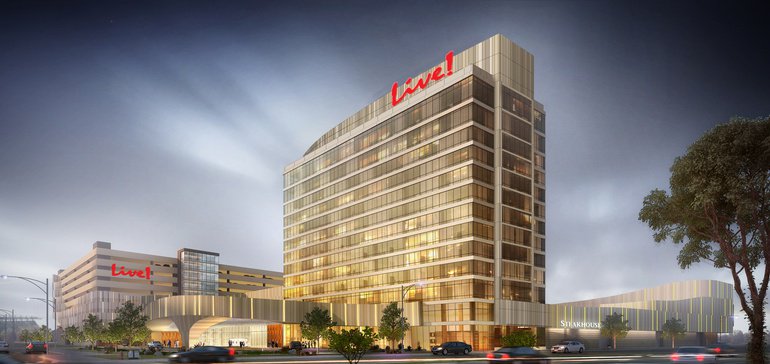
February was moderately unkind to Maryland casinos, which were down 3.5% from last year to reach $157 million. Top-grosser of course was MGM National Harbor, flat at $65.5 million. Reliable runner-up Maryland Live was close behind at $56 million, but suffered a 6% drop. Horseshoe Baltimore faded 8% to $16 million, which seems to be the floor but also very near the ceiling for this casino. The only revenue-positive casino was Ocean Downs, up 4% to $7 million, so owner Churchill Downs knows something everyone else doesn’t. Hollywood Perryville slid 7% to $7 million and Rocky Gap Resort was down 3% to $5 million. Are we entering a cooling-off period? It’s still too soon to say.
After hanging out with CEO Tom Reeg and Senior Vice President of Finance Brian Agnew, analyst Joseph Greff of J.P. Morgan came away “upbeat” about Caesars Entertainment. His optimism centered on three salient points: “Las Vegas strength and momentum”; “a path towards meaningful profitability” for CZR’s digital assets; “appealing free cash flow generation.” In Sin City, Caesars appears to be making money hand over fist. Attrition in group bookings has fallen to pre-pandemic levels, ADRs are much higher (think double digits) and occupancies average 95% or so. Given the absence of such 2022 headwinds as high utility costs, Omicron and a good-but-not-great event calendar, 2023 looks as though it will be very good indeed, leading into the 2024 Super Bowl, whose benefits should be obvious.
Lest we should get all warm and fuzzy about Blackstone Group, second-largest landowner on the Las Vegas Strip, here’s a bracing reminder of how it got to be where it is today.
Citing “very encouraging” trends in Macao, analyst Joseph Greff of J.P. Morgan gave Wynn Resorts a favorable notice today. Without getting too much into the minutiae, Wynn execs cited rapidly improving VIP business, 96% hotel occupancy and a 34% uptick in retail sales. Added Greff, “For the four-week period following the Chinese New Year, WYNN indicated that relative to 2019 levels, mass table drop was at 82%, direct VIP turnover was at 120%, and tenant sales were at 78%. Wow.” At those rates Macao will be back much, much sooner than expected.