
Almost broke again

"And the deficit is down over 40% since Obama took over. Even if you don't want it to be"

And he has added more to the debt than any other president


Obama's Deficit Dodge
Quote

Originally posted by: forkushV
Quote

Originally posted by: jatki99
HA! What am I saying, we already are,but it's that time to the US is almost out of money yet again and time to fight over raising the debt limit YET ONCE AGAIN. sigh...
Reagan raised it 17 times without a fight. But I think we had a lot fewer drama queens back in the 1980's.


You didn't have the 24 hour news cycle and the internet, well at least both weren't as prevalent as they are today.
Quote

Originally posted by: hoops2
And he has added more to the debt than any other president not named George W. Bush.
Fixed.

Again childish immaturity of people altering people's quotes. This time from Chilcoot. It is like the junior high boy who thinks his farts or belching are funny but nobody else thinks it is cute.
Quote

Originally posted by: DonDiego
Quote

Originally posted by: pjstroh
Yeah, I cant find many examples either. Surprising since that seems to be the underlying philosophy of one of our major political parties - at least when they aren't responsible for running the executive branch.

Nonetheless, DonDiego provided an example as requested - the 1990s.


No, when asked to cite economic growth in the reference of public spending reduction Don Diego cited George HW Bush. But Don Diego did not cite total spending of that administration, he instead found one line item of spending. If DOn DIego answered the question I asked using GHWB as an example he would have cited the rise from 1.144 trillion to 1.382 trillion in spending of that administration in its 4 year tenure ...which by my calculations is an increase of 20%.
source:
Your friendly, neighborhood wiki page

Quote

Originally posted by: DonDiego

Quote

Originally posted by: pjstroh
I would postulate "removing money from the economy" and "adding money to the economy" are two mututally exclusive things. And based upon their economic legacy, it would appear every president from the last 100 years would agree.

"Adding money to the economy" and "removing money from the economy" are, . . . umm, . . . different things, but mutually exclusive? DonDiego doesn't think so. He really cannot address the issue without some definition.

Does "adding money to the economy" mean, f'rinstance, Government spending? Does "removing money from the economy" mean, f'rinstance, Government taxation?
Or what exactly does pjstroh mean by "adding money to the economy" and "removing money from the economy"?


Gross Domestic Product:
1. the total value of goods produced and services provided in a country during one year.

By definition all government spending falls within this category. I do not believe taxation does...I could be wrong.

However, Private sector spending resulting from tax cuts would fall within this definition (if thats where Don Diego was headed)...but private sector savings, investment, foreign purchases, and foreign investment resulting fom tax cuts would not. See the post W Bush tax-cut era for an example.
Quote

Originally posted by: pjstroh
Quote

Originally posted by: DonDiego
Quote

Originally posted by: pjstroh
Yeah, I cant find many examples either. Surprising since that seems to be the underlying philosophy of one of our major political parties - at least when they aren't responsible for running the executive branch.

Nonetheless, DonDiego provided an example as requested - the 1990s.


No, when asked to cite economic growth in the reference of public spending reduction Don Diego cited George HW Bush. But Don Diego did not cite total spending of that administration, he instead found one line item of spending. If DOn DIego answered the question I asked using GHWB as an example he would have cited the rise from 1.144 trillion to 1.382 trillion in spending of that administration in its 4 year tenure ...which by my calculations is an increase of 20%.
source:
Your friendly, neighborhood wiki page

DonDiego thought the topic was the correlation between Government spending and prosperity.
DonDiego supplied the 1990s as an example where reductions in the increases in spending were effectuated in the context of fortuitous events like relative peace, Congressional limits on domestic spending, and low interest rates, . . . and the economy responded positively.
In 1990, total federal government spending was 21.8 percent of GDP. By 2000, it was down to 18.4 percent of GDP.
It was the best DonDiego could do.

So, OK, . . .the original question was a trick question. In DonDiego's lifetime there has never been a year in which overall Government spending has fallen.

DonDiego opines the ever-increasing Government spending is not necessarily a good thing, as it competes for monies and, hence, resources that might be better and more efficiently employed by the private sector. And it is likely a significant driver of waste and corruption as Government dispensed monies needn't compete in a market, but rather go to whomever the Government chooses to direct them.
He gathers that pjstroh favors increased Government spending in any case.

Quote

Originally posted by: pjstroh

Quote

Originally posted by: DonDiego
Quote

Originally posted by: pjstroh
I would postulate "removing money from the economy" and "adding money to the economy" are two mututally exclusive things. And based upon their economic legacy, it would appear every president from the last 100 years would agree.

"Adding money to the economy" and "removing money from the economy" are, . . . umm, . . . different things, but mutually exclusive? DonDiego doesn't think so. He really cannot address the issue without some definition.

Does "adding money to the economy" mean, f'rinstance, Government spending? Does "removing money from the economy" mean, f'rinstance, Government taxation?
Or what exactly does pjstroh mean by "adding money to the economy" and "removing money from the economy"?


Gross Domestic Product:
1. the total value of goods produced and services provided in a country during one year.

By definition all government spending falls within this category. I do not believe taxation does...I could be wrong.

However, Private sector spending resulting from tax cuts would fall within this definition (if thats where Don Diego was headed)...but private sector savings, investment, foreign purchases, and foreign investment resulting fom tax cuts would not. See the post W Bush tax-cut era for an example.

DonDiego becomes more confused.

Originally pjstroh wrote of "adding money to the economy" and "removing money from the economy". Now he speaks of Gross Domestic Product (GDP).
And he speculates about what poor old DonDiego intended. All DonDiego was trying to do was find out what pjstroh meant, so he could understand it. DonDiego still isn't sure but he'll try to address at least one aspect of Government spending.
Anyway DonDiego doesn't concur that GDP is the same as "the economy".

DonDiego has no quibble with pjstroh's definition of GDP.
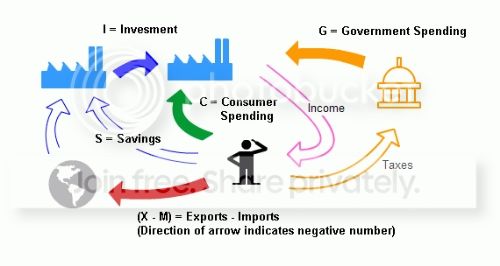
A more precise definition of GDP is:
GDP = C(Consumption) + I(Investment) + G(Government Spending) + E(Exports ? Imports)

And it looks like this:


n.b. The term Investment in the equation refers more to "capital spending", i.e. the value of capital goods produced. That production of these capital goods is financed by investment (as normally understood) is indicated by the blue-outline arrows.

[A curiosity: Transfer payments (Social Security, Medicare, Unemployment Insurance, Welfare, subsidies etc.) are NOT included in Government Spending.]

And pjstroh is correct, . . . taxes are not included in GDP, although it is taxes that fund the Government Spending, as indicated by the gold-outline arrow.
Just like personal income, the pink-outline arrow, which funds the Consumer Spending and Investment.

So that "the economy" does not mean the same thing as GDP should be apparent.

And because Government Spending comprises more than just taxes; the difference is borrowed money.

And there's the rub.

Borrowed money has to come from somewhere. It comes from whoever buys the Government debt. If the buyers are in the US, it likely decreases Consumption and Investment.

But regardless of where the money come from i. it requires interest be paid and ii. it has to be repaid or rolled-over at some time.
And because the Government expenditures do, in fact, increase every year so does the debt balance, i.e. the national debt.

So here's the point:
Over the next decade the national debt is expected to increase by over $10-trillion.
The CBO calculates the US Government will pay over $5-trillion in interest payments over the next decade.
More than 14% of all revenue the Government is projected to collect will be applied to interest payments; i.e. interest payments may exceed Defense Spending.

But the CBO calculates what it is told to calculate and it is told to employ a slowly rising interest-rate over the decade to a 10-year yield slightly over 5%.
What if rates rise faster, . . . and they will if/when, f'rinstance, the Fed decreases its purchases of US debt. Or, f'rinstance, the Chinese and Russian et al foreign buyers decrease purchasing US debt unless interest rates do rise.
What if rates go back to the rates of 1981 - over 15% [back when poor young DonDiego had a 19% mortgage] and require 40% of US revenue just to pay the interest? What will be cut?

There ain't no such things as a free lunch. All this wonderful, beneficial Government borrowing has a price, . . . and it could become difficult to pay.


Quote

Originally posted by: jatki99
Quote

Originally posted by: forkushV
Reagan raised it 17 times without a fight. But I think we had a lot fewer drama queens back in the 1980's.


That's just deflecting the issue and no argument about anything relevant to the current situation at all, is it? But to respond and humor you, I don't give two shits what happened back when Reagan or anyone else raised the debt limit in the past...
Yeah, I get that you're not into history. It shows in your politics.

But there are any number of massive American mistakes that could have been avoided had we paid attention to history, including Vietnam, Iraq, deregulating Wall Street, and installing the Shah in Iran. Likewise, history can help us avoid a feeling hysteria over what should be non-controversial issues, like giving equal rights to everyone, decriminalizing relatively safe recreational drugs, and yes, raising the debt limit.

Stephen Colbert said, "Reality has a well-known liberal bias." So does history.
Quote

Originally posted by: Roulette Man
Quote

Originally posted by: forkushV
Quote

Originally posted by: Roulette Man
Quote

Originally posted by: forkushV
Quote

Oh, did I forget? But Clinton! He raised the debt ceiling four times. Because it's, you know, normal, especially in a recession.

And the deficit is down over 40% since Obama took over.


Again a very misleading statement from the fork tongued one. You are talking about the annual deficit, not the overall national deficit...
There is no such thing as the "overall national deficit." It doesn't exist, and never has. Now you're just making shit up to make your argument.

The "national debt" of the federal government is the combined debt throughout our history, and it is still rising, although at a MUCH slower rate than before. The deficit is a one year snapshot.

And the deficit is down over 40% since Obama took over. Even if you don't want it to be.


Again another argument that makes absolutely no sense from you. If the deficit is down 40%, then why is Congress FIGHTING OVER RAISING THE DEBT LIMIT?
Because the national debt is not the same as the deficit. The deficit, for say, 2013, is Obama's "fault." But the national debt is the "fault" of every administration in American history, combined.

But if you do the math, it's mostly Bush's fault.

(Would you like me to do the math right here? I will if you ask nicely!)
Forky and chilly continue to peddle the fiction that President Bush was responsible for the 2009 deficit but ignore the fact that Obama was president for 9 months during that time and is therefore responsible for the spending. He had the power to reduce spending but he didn't.

He is number 1 and still has 3 years to go to add to his record.
Already a LVA subscriber?
To continue reading, choose an option below:
Diamond Membership
$3 per month
Unlimited access to LVA website
Exclusive subscriber-only content
Limited Member Rewards Online
Join Now
or
Platinum Membership
$50 per year
Unlimited access to LVA website
Exclusive subscriber-only content
Exclusive Member Rewards Book
Join Now