


It's coming !
"Comets have galvanized Mankind for thousands of years. Civilizations have risen and fallen with their appearance. The ancients feared comets and most cultures believed them to be celestial omens of death, war, and destruction.
Human sacrificies were made to comets. Of all the events that occur in the heavens, only total solar eclipses may have gripped the hearts of people with more fear."
"Most astronomers agree that the greatest historical comet was the Great Comet of 1680.
The comet arriving December 2013 is expected to far surpass the Great Comet of 1860 by several orders of magnitude and size. It could dominate the sky with a tail stretching from one horizon to the other."
Ref: The Mega-Comet of Doom
Comet ISON (C2012 S1) has been under observation by astronomers for 14 months. Many comets are periodic, . . . i.e. they are in elliptical orbits around the Sun and return regularly, like Halley's Comet which returns every 76 years. Comet ISON is on a sunward path from the Oort Cloud and it is not a periodic comet; it is on a parabolic path and once it circles the Sun this week it will never return.
The early reports that ISON would be a "great comet" have been tempered. Nonetheless, the celestial visitor has brightened significantly the last few week, . . . and now presents a pleasant green tail in telescope images:

ISON is now accelerating to its highest velocity as it will soon swing around the Sun, . . . in fact, very close to the Sun on Thanksgiving. One of the reasons that expectations have been tempered is that it may be so close to the Sun that it melts/breaks-up.
If the comet survives it will likely be a naked eye object in December as it departs the vicinity of the Sun. So, in early December:
" 'Before dawn, look for a prominent object with a bright tail pointing upward,' advises Damian Peach, a British astrophotographer who has managed to capture the fleeting comet with stunning detail.
'Look to the southeast around 30 minutes before sunrise, and you may be able to see the comet with the unaided eye.' ”
Ref: The Washington Post
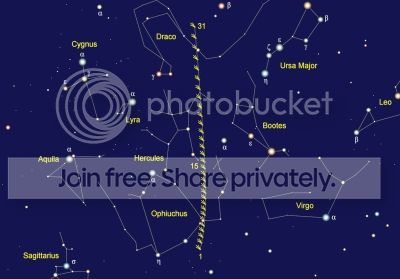
Here's a map showing the location in the sky relative to the stars, . . . from 1 December at the bottom through 31 December at the top. Throughout December ISON will be moving slowly toward the north in the sky, . . . becoming visible all night toward the end of the month. DonDiego counsels viewers to report sightings of a manger and child associated with the celestial object.
[n.b. DonDiego suspects most of the speculations in The Mega-Comet of Doom article are poppycock and balderdash. But one never knows.]
"Comets have galvanized Mankind for thousands of years. Civilizations have risen and fallen with their appearance. The ancients feared comets and most cultures believed them to be celestial omens of death, war, and destruction.
Human sacrificies were made to comets. Of all the events that occur in the heavens, only total solar eclipses may have gripped the hearts of people with more fear."
"Most astronomers agree that the greatest historical comet was the Great Comet of 1680.
The comet arriving December 2013 is expected to far surpass the Great Comet of 1860 by several orders of magnitude and size. It could dominate the sky with a tail stretching from one horizon to the other."
Ref: The Mega-Comet of Doom
Comet ISON (C2012 S1) has been under observation by astronomers for 14 months. Many comets are periodic, . . . i.e. they are in elliptical orbits around the Sun and return regularly, like Halley's Comet which returns every 76 years. Comet ISON is on a sunward path from the Oort Cloud and it is not a periodic comet; it is on a parabolic path and once it circles the Sun this week it will never return.
The early reports that ISON would be a "great comet" have been tempered. Nonetheless, the celestial visitor has brightened significantly the last few week, . . . and now presents a pleasant green tail in telescope images:
ISON is now accelerating to its highest velocity as it will soon swing around the Sun, . . . in fact, very close to the Sun on Thanksgiving. One of the reasons that expectations have been tempered is that it may be so close to the Sun that it melts/breaks-up.
If the comet survives it will likely be a naked eye object in December as it departs the vicinity of the Sun. So, in early December:
" 'Before dawn, look for a prominent object with a bright tail pointing upward,' advises Damian Peach, a British astrophotographer who has managed to capture the fleeting comet with stunning detail.
'Look to the southeast around 30 minutes before sunrise, and you may be able to see the comet with the unaided eye.' ”
Ref: The Washington Post
Here's a map showing the location in the sky relative to the stars, . . . from 1 December at the bottom through 31 December at the top. Throughout December ISON will be moving slowly toward the north in the sky, . . . becoming visible all night toward the end of the month. DonDiego counsels viewers to report sightings of a manger and child associated with the celestial object.
[n.b. DonDiego suspects most of the speculations in The Mega-Comet of Doom article are poppycock and balderdash. But one never knows.]


