"
Clip vs. MagazineYou know that boxy rectangular thingy that holds cartridges and slides into the bottom of your semi-auto pistol? It’s not a clip — no matter how often the term is misused. It’s a magazine.
A magazine holds shells under spring pressure in preparation for feeding into the firearm’s chamber. Examples include box, tubular, drum and rotary magazines. Some are fixed to the firearm while others are removable.
A cartridge “clip” has no spring and does not feed shells directly into the chamber. Rather, clips hold cartridges in the correct sequence for “charging” a specific firearm’s magazine. Stripper clips allow rounds to be “stripped” into the magazine. Other types are fed along with the shells into the magazine — the M1 Garand famously operates in this fashion. Once all rounds have been fired, the clip is ejected or otherwise released from the firearm.
In essence, clips feed magazines. Magazines feed firearms."
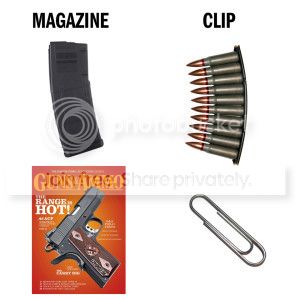
Ref: Guns & Ammo
*
n.b. DonDiego recommends this brief Guns & Ammo description of Misused Gun Terms if one wishes to be accurate in discussion of the "gun issue".
Ship vs. BoatNavy veteran DonDiego recalls being instructed that "a ship can cary a boat, but a boat cannot carry a ship", but apparently it's more complicated than that.
"One thing that sets a ship apart from a boat is size. According the U.S. Naval Institute, a boat, generally speaking, is small enough to be carried aboard a larger vessel, and a vessel large enough to carry a smaller one is a ship. Or, as Steve says his Navy Lieutenant father put it to him, 'You can put a boat on a ship, but you can’t put a ship on a boat.'
Now, this Naval convention is a good rule of thumb most of the time, but there are a few exceptions, among both naval and civilian vessels. Some yachts, ferries, tug boats, fishing boats, police boats, etc. can carry small lifeboats or dinghies, but they usually don’t graduate to ship status because of that. On the other hand, a large container ship or the USS Cole can be carried aboard an even bigger ship without getting demoted to a boat.
The U.S. Navy seems to want to have it both ways with their submarines. One component of each vessel’s official name is USS—that is, United States Ship—but seamen, the Naval Institute says, usually refer to submarines in general as boats, regardless of size.
Another factor the Naval Institute considers is the vessel’s crew, command, and use. If it has a permanent crew with a commanding officer, it’s usually a ship. If it’s only crewed when actually in use and has no official CO, then you’re probably dealing with a boat. Ships are also usually intended and designed for deep-water use and are able to operate independently for long periods of time. Boats, meanwhile, lack the fuel and cargo capacity for extended, unassisted operation.
Again, though, there are some exceptions in actual usage. Most commercial fishing vessels, for example, are large and can go out alone on the open ocean for weeks at a time. They’re almost always called boats, though, and rarely “fishing ships.”
Without any hard and fast rules about boats and ships, we humbly suggest another loose guideline that will ingratiate you to the captain of any sort of vessel: Call it whatever the skipper wants you to call it."
Ref: mentalfloss




