DonDiego wishes jphelan and others in the market Good Luck !
Poor old DonDiego is not a soothsayer. He does not know the future; he is lucky to remember some of the past.
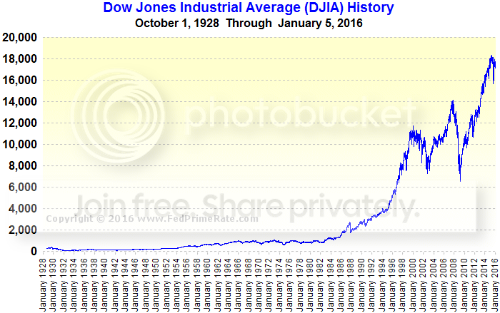
The DJIA history suggests the possibility of significant rises and significant drops are possible.
DonDiego has been in the stock market to some extent since the late 1960's, even before he graduated college.
He had never tried to time the markets until the late Fall of 2006 when his research suggested economic problems on the horizon. He'd sold about a third of his holdings by mid-2007 and pr'bly over two-thirds by the end of September when things broke loose; he was 90% out-of-stocks by mid-November.
He started buying back in slowly over the Summer of 2008. He pretty much stuck to large-cap, safe stocks like Exxon and Budweiser and some agricultural-related companies. He was fully invested by the end of 2009.
Sometime in late-2014 to early-2015 poor old DonDiego again became concerned about the economy and interest-rates and the future. He started exiting the markets again, . . . little-by-little. By August 2015 he was over 75% out, and on 24 August within the first hour of trading he was again out-of-the-market.
[There was one exception to being out-of-the-market both times, as indicated above; he retained and occasionally increased holdings in a Canadian mining stock as "insurance" against possible rising inflation and/or a
real calamity. And in 2015 he just neglected to sell a few shares of his agriculture stocks and a small security-firm as well, just to keep an eye on them.]
Presently DonDiego is not buying.
What DonDiego does know is that the US Economy, . . . and the World Economy for that matter, . . . are in unchartered territory.
This is a chart of 10-year-bond rates in 5 Countries from 1900 until 2012; the dark-red line is the USA. The rate in 2012 was about 3.5%; today is 1.75%:
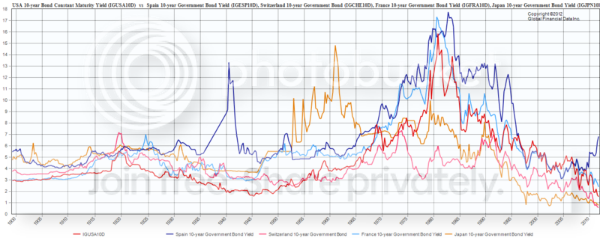
Central banks, including the Fed, are holding interest rates down to stimulate investment and to intentionally raise the inflation-rate. Unfortunately investment in capital, that is in productive physical assets, is not growing; what
has been growing in "faux-investment" in companies' own shares to raise share prices; this has kept stock prices relatively high. But prices in the economy generally are not rising. This aint' how things are "supposed" to work in a central-planned-economy.
DonDiego opines this cannot go on very long. In mid-December a tiny rise in the Federal Funds rate from 0.0% to 0.25% stalled the markets.
Worldwide, banks are in a dilemma. If they raise rates the economy stalls; if they lower rates those dependent on higher-rates, like pension funds and those seeking "safe income", are, . . . umm, . . . "troubled". It's a puzzlement.
DonDiego is content to be on the sidelines. He is more concerned with "return
of capital" than "return
on capital".
Which brings up questions:
__Why have the United States and Europe suddenly raised the issue of getting rid of paper currency to the extent practicable -
i.e. $100-bills and $500-Euro bills. There is likely a reason beyond the wish of Big-Government generally to track everything their citizens do.
__Why have the United States and Europe suddenly shown interest in "negative-interest rates"; some European banks already have negative interest on savings accounts - the saver must pay the bank to keep his money.
hint: These two questions are related, . . . but that is a story for another time, . . .