Today, July 23, 2015, NASA introduced us to Kepler 452b. This rocky planet orbits a star very similar to our own, has a year of 385 days, and gravity roughly double that of Earth’s.
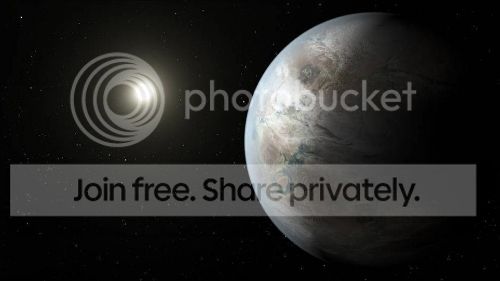
It has been within the habitable zone of its star for 6 billion years which is older than the Earth, giving the planet plenty of time for life to arise. The image above is an artists rendition of what the planet might look like. Unfortunately, Kepler 452b is 1,400 light years away but it is more likely to support life than anything we have discovered so far.
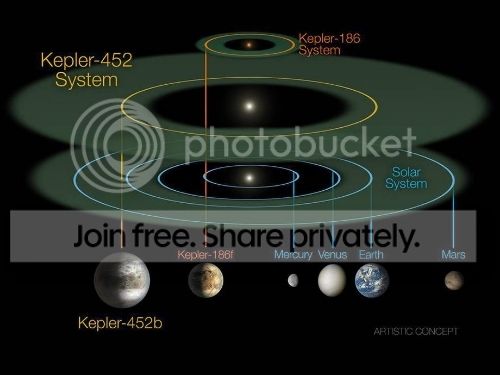
And here's a comparison of the Keplar Ststem to the Sol System. The greenish area indicates the proper temperature to support life as known on Earth.
The radio/TV waves generated by puny Earthlings are less than 10% of the way to Keplar452b. But in another 1300 years or so, the occupants of this distant world, . . . suddenly aware of humanity, . . . may pay the Earth a visit, . . . an unwelcome visit if the population is not prepared to annihilate them upon their approach.
It has been within the habitable zone of its star for 6 billion years which is older than the Earth, giving the planet plenty of time for life to arise. The image above is an artists rendition of what the planet might look like. Unfortunately, Kepler 452b is 1,400 light years away but it is more likely to support life than anything we have discovered so far.
And here's a comparison of the Keplar Ststem to the Sol System. The greenish area indicates the proper temperature to support life as known on Earth.
The radio/TV waves generated by puny Earthlings are less than 10% of the way to Keplar452b. But in another 1300 years or so, the occupants of this distant world, . . . suddenly aware of humanity, . . . may pay the Earth a visit, . . . an unwelcome visit if the population is not prepared to annihilate them upon their approach.