Stock Market Observations - 2015

Poor old DonDiego has been increasingly nervous about his stock market investments over the last few months.

There's a lot of things going on worldwide with regard to central bank operations, e.g. "qualitative easings, and economic conditions, e.g. petroleum prices, which could result in serious effects, . . . ultimately mostly negative.
Not to mention increasing activities among the Islamists and Islamist-sympathisers worldwide, . . . and now the death of Saudi King Abdullah bin Abdulaziz, a staunch US ally, and the fall of the Government of Yemen to an Iranian-supported rebellion.

But, anyway, it always comes down to the numbers when trying to anticipate stock market investment moves. And DonDiego has just come across the chart below suggesting a fairly strong correlation between market-account credit balances and subsequent market movement in the 21st century:
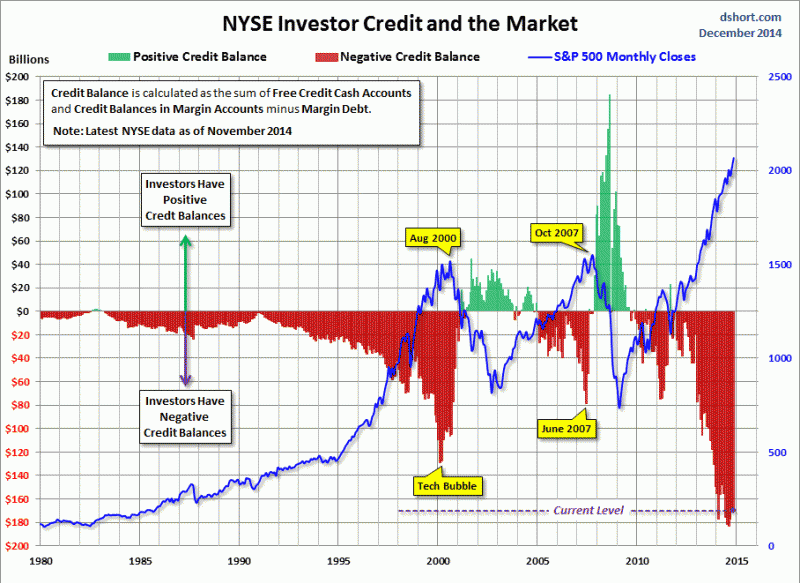


Maybe it's time for more folks to be getting nervous.

For the record, . . . after the 2007/08 drop DonDiego got pretty much fully invested, . . . say, over 85% or more, . . . back into the stock market through 2009/2010. And he hasn't sold anything since.

DISCLAIMER:
As usual DonDiego takes no responsibility for any actions taken by any reader of his posts. [n.b. DonDiego has actually not suggested any action be taken by anybody anywhere anyway; he just posted a graph, which anyone may interpret however they choose.]
I'm becoming more of a value investor looking for stocks that have high potential to change. My current play is ADXS. It's more like gambling than investing. I'm hoping for a big move tomorrow.

Also, shorting oil is still paying although not as much as last month. Who knows what gold is going to do.
Just buy low and sell high. How hard is that?
Quote

Originally posted by: stg200
Just buy low and sell high. How hard is that?


Harder than it sounds.

I'm more concerned about inventories than margin credit. Commodities are getting built up which is usually an early sign of an economic softening. When you start seeing it hit the manufacturers then its time to bail - at least for me. Some people suggest we have hit the peak of the automobile cycle. Car sales and inventories are a good thing to keep an eye on over the next few quarters.

In the meantime, there's lots of tailwinds like cheap gas, more employed consumers, and rock bottom lending rates... if by some miracle the government passes a significant infrastructure bill then its off to the races again. I'm not holding my breath.
Quote

Originally posted by: pjstroh
I'm more concerned about inventories than margin credit. Commodities are getting built up which is usually an early sign of an economic softening. When you start seeing it hit the manufacturers then its time to bail - at least for me. Some people suggest we have hit the peak of the automobile cycle. Car sales and inventories are a good thing to keep an eye on over the next few quarters.

In the meantime, there's lots of tailwinds like cheap gas, more employed consumers, and rock bottom lending rates... if by some miracle the government passes a significant infrastructure bill then its off to the races again. I'm not holding my breath.
pjstroh and DonDiego share similar concerns.
"A new WardsAuto forecast indicates the relative slowdown in U.S. light-vehicle sales that began in December will continue this month, while inventory is expected to rise dramatically."
Ref: wardsauto.com
And it's not limited to the USA:
"Chinese car dealers are sitting on their highest inventories of unsold cars in almost 2 ½ years, according to an industry group, in the latest sign of slowing growth in the world’s largest auto market."
Ref: wsj.com

DonDiego is also concerned some of the tailwinds may be lessening.

The cheap-gasoline is not entirely a good thing. The significant increase in US production is from the shale oil boom; shale oil extraction is expensive. (n.b. There is also some concern that the life of shale oil wells is significantly less than that of conventional wells; some speculation that even before the drop in the price of oil, the initial investment in these wells may often exceed the potential profits.)
So two problems:
i. Because most of the drilling has been financed by bonds, if the low prices persist and the wells are shut-down, many bonds may well default. This will primarily affect the wealthy; they do not like such defaults.
ii. Many, some say even most, of the good-paying jobs added to the economy over the last 5 years are directly or indirectly related to the shale oil boom. Pretty much concurrent with the bond defaults, there may be lots of layoffs in the shale oil fields and support economies.

The Central Bank has already terminated the Qualitative Easing which has kept interest rates low so as to increase inflation; the theory being that low interest rates and subsequent increased borrowing are necessary to keep the economy moving, . . . and QE [and subsequent inflation] eases the burden of continuous debt repayment. DonDiego would not be surprised to see QE reinstated.

DonDiego concurs with pjstroh's comments on infrastructure spending. Governments are almost inevitably prone to delay infrastructure spending, necessary infrastructure spending. Because it is much more photogenic for a politician to be standing on front of a new bridge or a new elders' community center or a new sports stadium, . . . rather than, say, a repaired/renovated bridge over the Mississippi River.
So poor old DonDiego will believe the infrastructure when he sees it. If it were to happen United States Concrete [USCR] and Vulcan Materials [VMC] would profit handsomely.
Ref: Barron's 12 January 2015.

"more employed consumers," THEN WHY IS ADULT PARTICIPATION RATE AT AN ALL TIME LOW?

"if by some miracle the government passes a significant infrastructure bill" - OBAMA TALKING POINT; BUT WHY HE WON'T SIGN THE KEYSTONE BIL?
Quote

Originally posted by: hoops2
"more employed consumers," THEN WHY IS ADULT PARTICIPATION RATE AT AN ALL TIME LOW?

"if by some miracle the government passes a significant infrastructure bill" - OBAMA TALKING POINT; BUT WHY HE WON'T SIGN THE KEYSTONE BIL?

DonDiego respectfully requests the LVA community refrain from turning this thread into just another a series of invidious partisan political comments.
Political decisions certainly impact the stock market, but DonDiego requests one address those causes/effects rather than just blame someone with whom one disagrees.

These Investor Credit numbers look to be a lagging indicator. When investors are fully invested, there's less borrowed money available to invest more. When investors dump their leveraged stock investments, they have more credit available to invest.

Of course there is a correlation between easy money policy and higher equity prices. I think that's more related to perceived equity risk vs crappy returns from bonds. It won't take much to flip the perceived risk.
Quote

Originally posted by: alanleroy
These Investor Credit numbers look to be a lagging indicator.

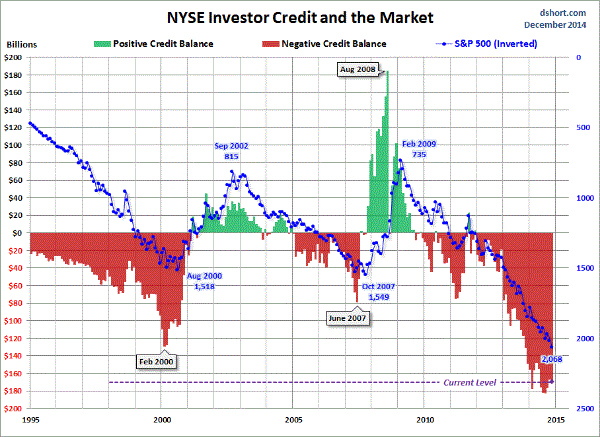
Here's the same chart posted originally with the S&P inverted and only displaying data after 1995:


The credit numbers looks pretty much co-incident or even slightly leading to poor old DonDiego; the 2007 reversal was so quick it's hard to tell.

In any case, the numbers are bigger and the credit is probably extended to a more concentrated group this go-round, . . . could well lead to a quicker reversal, as alanleroy suggests.
Already a LVA subscriber?
To continue reading, choose an option below:
Diamond Membership
$3 per month
Unlimited access to LVA website
Exclusive subscriber-only content
Limited Member Rewards Online
Join Now
or
Platinum Membership
$50 per year
Unlimited access to LVA website
Exclusive subscriber-only content
Exclusive Member Rewards Book
Join Now