


In the pre-dawn skies for the next few weeks Comet Catalina is visible near the star Arcturus; the celestial visitor will be slowly moving to the northeast towards the Big Dipper over the next several weeks.
The easy way to find Arcturus is to locate the big dipper high overhead, . . . and follow the curved handle of the dipper to the first bright star - that's Arcturus.
Or the interested reader, if any, can refer to the diagram below depicting the pre-dawn southern sky on New Years Day. The comet will appear as a fuzzy greenish ball through a pair of binoculars or a small telescope next to Arcturus; the inset on the upper-left of the diagram shows where on 1 January.
The Moon will be moving to the south-east and the comet slowly to the north-east over the coming days.
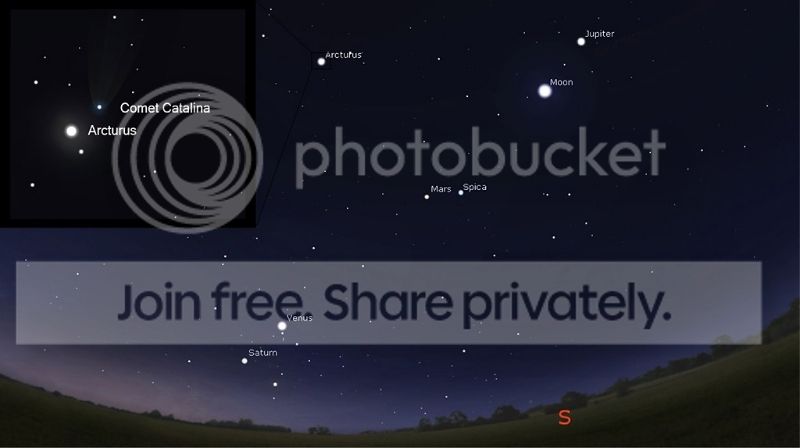
Oh, and there's lots of planets glowing in the pre-dawn sky right now too.
The easy way to find Arcturus is to locate the big dipper high overhead, . . . and follow the curved handle of the dipper to the first bright star - that's Arcturus.
Or the interested reader, if any, can refer to the diagram below depicting the pre-dawn southern sky on New Years Day. The comet will appear as a fuzzy greenish ball through a pair of binoculars or a small telescope next to Arcturus; the inset on the upper-left of the diagram shows where on 1 January.
The Moon will be moving to the south-east and the comet slowly to the north-east over the coming days.
Oh, and there's lots of planets glowing in the pre-dawn sky right now too.


